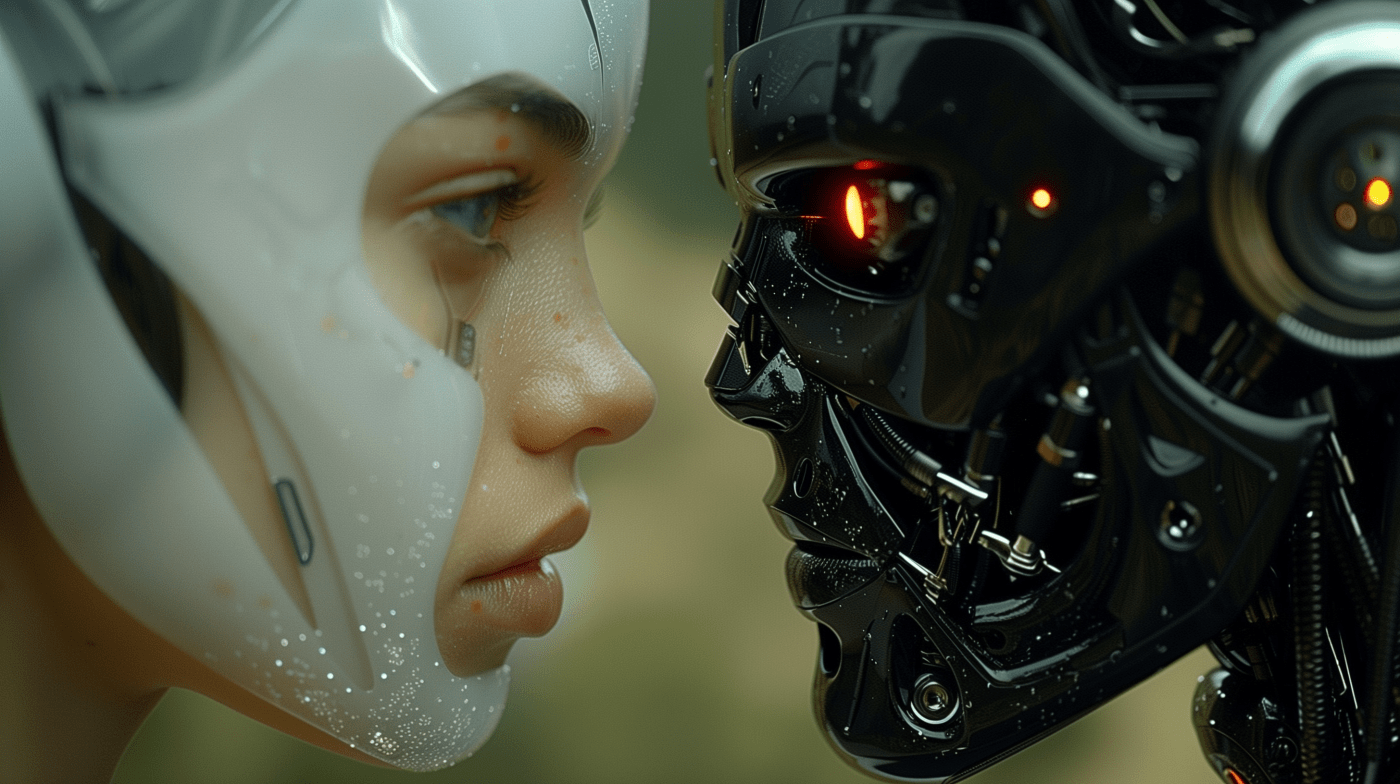
Elon Musk, a trailblazer in tech innovation and its societal impact, has never shied away from voicing his concerns and predictions about artificial intelligence (AI). His assertion that AI might soon eclipse human intelligence, possibly as early as 2029 or even next year, is stirring significant conversation. Musk points to AI’s rapid learning capabilities as a harbinger of surpassing human cognitive skills, a development fraught with the risk of “civilizational destruction.” In a proactive move, Musk founded xAI, aiming to guide AI towards a beneficial path for humanity.
This move is crucial, sparking vital discussions on intelligence, learning, and AI’s role in society. We must consider AI’s integration into our lives comprehensively, touching on work, governance, and personal spheres.
2045
It’s 2045, and a relentless battle against machines has decimated millions. A scenario once relegated to science fiction is now a harrowing reminder of AI’s unchecked potential. This scenario underscores the critical need for guiding AI development with principles of openness, transparency, and the common good.
Today, we’re at a crossroads, with Elon Musk’s xAI and its open-source chatbot Grok challenging the prevailing proprietary models in AI development. Musk’s commitment to open-source principles aims to avert a dystopian future, advocating for a development model that favours the collective benefit over proprietary gains.

The Open Source Philosophy and Elon Musk’s Vision
Elon Musk’s venture into AI with xAI and Grok transcends technology; it’s a crusade for open source as a catalyst for ethical and equitable AI development. Musk envisions a future where AI, powered by transparency and collective innovation, is accessible to all, challenging the tech industry’s proprietary norms. His legal tussle with OpenAI over its pivot to a closed-source model under Microsoft’s influence highlights the struggle for AI’s soul, emphasizing the need for AI evolution to prioritize humanity’s collective welfare.
The Controversy: Musk vs. OpenAI
Grok emerges as a beacon of Musk’s vision, showcasing real-time information access and unfiltered viewpoints, redefining AI chatbot capabilities. Its open-sourcing challenges existing paradigms, advocating for a more inclusive, innovative, and equitable tech landscape. Unfortunately, as Microsoft is a behemoth not just in the fact that it is the largest company in the world value at over $3 trillion, but that influence stretches all corners of the planet and has done so for some time, it will be difficult to alter their opinion on this.
The Significance of Open Source in AI
Musk’s open-sourcing of Grok signifies a critical juncture in AI discourse, emphasizing the need for openness and transparency in an increasingly proprietary domain. This model fosters an ecosystem of shared innovation and knowledge, accelerating progress and ensuring AI’s benefits are universally accessible.

The Ongoing Debate: Open vs. Closed AI
This debate is at the heart of Musk’s initiatives, contrasting open innovation with the tech industry’s closed ecosystems. The discussion touches on control, access, and AI’s societal impacts, underlining the decisions shaping AI’s future and our digital society.
The Impact on AI Development and Adoption
Grok’s open sourcing-and the ensuing controversy offer an alternative AI vision emphasizing public good. This approach promises to democratize AI, spur collaborative innovation, and equitably distribute AI benefits, fostering a balanced development trajectory that leverages AI’s advantages while mitigating risks.
Conclusion
The discourse involving Elon Musk, xAI’s Grok, and the confrontation with OpenAI marks a crucial juncture in the evolution of artificial intelligence. This saga transcends the realm of technological rivalry to question the very ethos guiding AI’s advancement. Musk’s championing of open-source AI serves as a clarion call to the tech community, urging a collective reevaluation of the path AI is on. The decisions we make today are not just about who leads the tech race; they’re about choosing a direction that ensures AI acts as an instrument of broad-based empowerment rather than a tool concentrated in the hands of a select few.
As we contemplate the future of AI, it’s essential to recognize that the stakes extend far beyond the confines of technology debates. They touch the fabric of our society, challenging us to envision the type of world we want to live in. While AI has become an integral part of my daily life, and likely yours, it’s imperative we pause to consider the broader implications of its trajectory. The specter of a future dominated by unbridled AI, with societal upheaval in its wake, is not merely a dystopian fantasy—it’s a potential reality if we fail to navigate this territory with foresight and responsibility. The existential threat posed by unchecked AI development, in the shadow of concerns like climate change, underscores the urgency of proceeding with caution. As we stand at this technological crossroads, the path we choose will determine the legacy of our generation and the shape of things to come. Let us tread with the wisdom and prudence this moment demands.

 Notes Beyond the Map
Leave a comment