
In recent years, the global financial landscape has experienced significant volatility, characterized by fluctuating inflation rates and the rapid devaluation of currencies. This instability has reignited interest in the gold standard, a monetary system in which a country’s currency value is directly linked to gold. Proponents argue that returning to the gold standard could bring much-needed stability by preventing governments from indiscriminately printing money and by instilling greater discipline in fiscal policy. However, the implications of reintroducing a gold standard are complex and multifaceted, particularly for advanced economies in the G7 and for nations grappling with severe economic challenges like Zimbabwe and Argentina. I should mention that in the midst of this opportunity, gold is hitting all-time highs. And there could be further for it to climb in the near term.
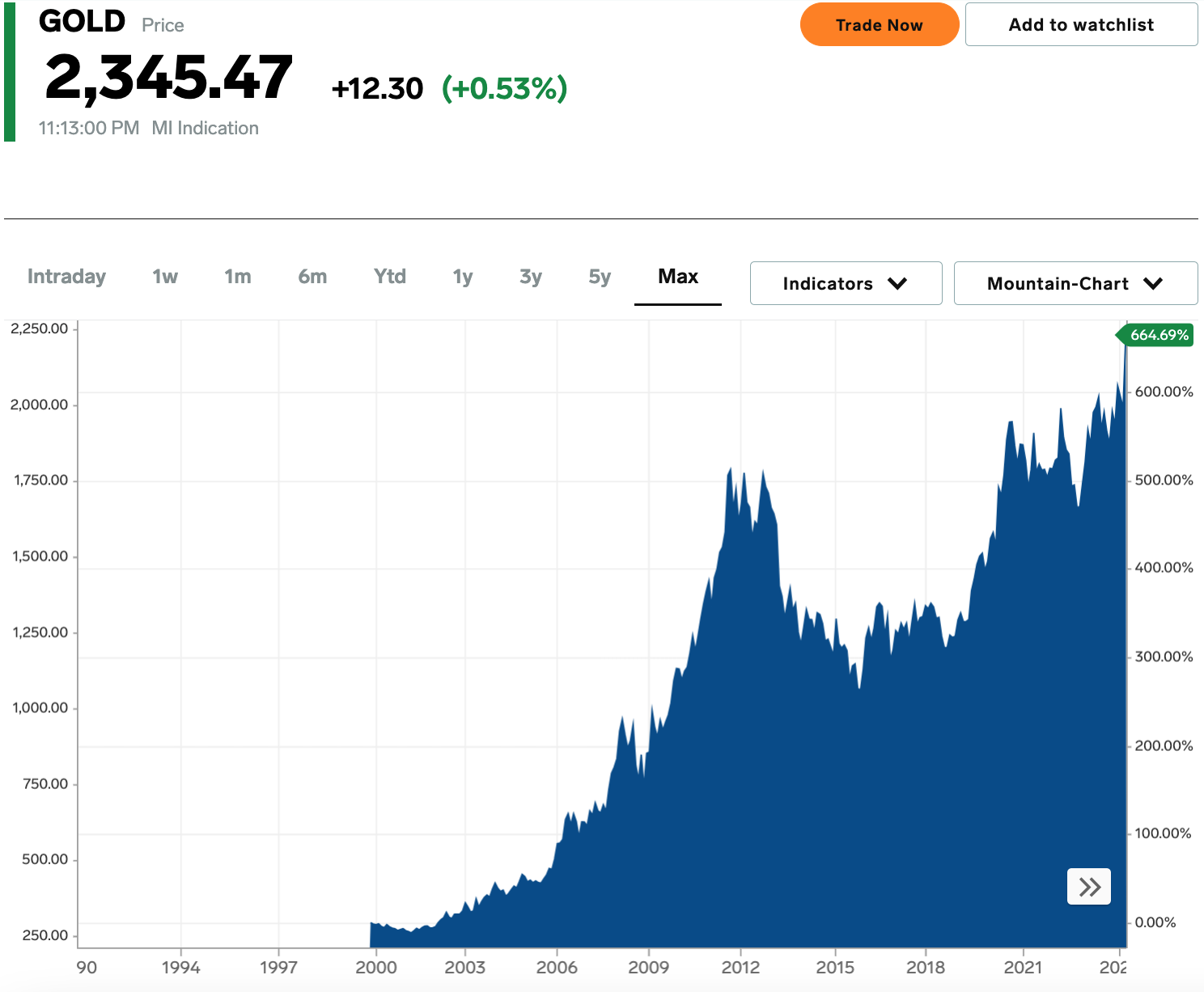
This article delves into the potential benefits and substantial drawbacks of adopting a gold standard in today’s economic climate, exploring how such a shift could impact different global economies.
“Those who have laid their bets on the gleaming allure of gold and came out with pockets as heavy as their convictions might remind us that even in the wildest of economic rodeos, a good old-fashioned gold nugget can sometimes prove steadier than the banker’s pen. It seems that every few ticks of the clock, some genius with a map and a mission rediscovers the merits of this ancient treasure. Yet, as we venture once again into the golden glow, let us not forget that the road paved with this precious metal can lead as much into the wilderness of financial folly as it does towards the promised land of fiscal stability.”
– Mark Twainish

Reasons for Adoption
The idea of countries returning to a gold standard in 2024 and beyond involves complex economic considerations and motivations. Here are some potential reasons why countries might consider this approach:
- Stability in Currency Value: Gold has historically been seen as a stable store of value. Linking a currency to gold could help stabilize its value, making it less susceptible to inflation and providing a predictable monetary base, which could be appealing in times of volatile inflation and rapid currency devaluation.
- Inflation Control: A gold standard limits the ability of central banks to print money and expand the monetary base arbitrarily. This constraint can theoretically help control inflation, as the supply of money would be tied to the gold reserves a country possesses.
- Investor Confidence: Reintroducing a gold standard could boost investor confidence in a currency by providing a guarantee that the currency can be exchanged for a fixed amount of gold. This assurance might attract foreign investment and stabilize financial markets.
- Discipline in Fiscal Policy: The gold standard could impose a natural limit on government spending. Since currency issuance is limited by gold reserves, governments may be forced to adopt more disciplined fiscal policies, potentially reducing excessive debt accumulation.
- Reduction of Speculation: By fixing currency values to a stable commodity, countries might reduce the scope for speculative attacks on their currencies, which can be particularly destabilizing in smaller or emerging economies.
- Restoring Trust: In periods of extreme distrust in fiat currencies, such as during hyperinflation or severe financial crises, tying the currency to gold might restore public confidence.
- Geopolitical Considerations: In a geopolitical context where countries seek to minimize reliance on dominant reserve currencies (like the US dollar), a gold standard could offer a way to reassert financial independence and stability.
However, it’s important to note that the gold standard also comes with significant drawbacks. These include reduced flexibility in monetary policy, which can exacerbate economic downturns by limiting the ability of central banks to adjust interest rates and perform quantitative easing. The availability of gold as a limiting factor can also constrain economic growth and lead to deflationary pressures in a growing economy. Therefore, any move towards a gold standard would require careful consideration of these trade-offs.

Drawbacks and Potential Downsides
The return to a gold standard, while offering certain benefits, also presents a range of drawbacks and potential downsides. These consequences could impact developed economies like those in the G7, including the United States and Canada, as well as countries facing extreme currency devaluation and inflation, such as Zimbabwe and Argentina. Here are some key drawbacks:
- Reduced Monetary Policy Flexibility: Under a gold standard, a country’s ability to issue currency is tied to its reserves of gold. This limits central banks’ capacity to adjust monetary policy in response to economic conditions. For G7 countries, this means less control over interest rates and less ability to engage in quantitative easing during recessions. For countries like Zimbabwe or Argentina, the lack of flexibility could make it harder to respond to economic crises effectively.
- Economic Contraction Risk: Gold supply growth is often slower than economic growth, which can lead to deflationary pressures as the economy expands but the money supply does not keep pace. This can cause economic contraction, as falling prices may lead to reduced business profits, layoffs, and lower consumer spending.
- Supply Constraints and Gold Volatility: The availability of gold is not aligned with the needs of the economy; it’s based on mining output and central bank sales, which can be volatile. Price volatility in gold markets could translate directly into currency volatility, contrary to the goal of stability.
- Increased Cost and Resource Allocation: Maintaining a gold standard requires substantial gold reserves, which can be costly to acquire and maintain. For resource-poor countries, this could mean allocating vast financial resources to buy gold instead of investing in other economic sectors.
- Trade Imbalances: A gold standard can exacerbate the effects of trade imbalances. Countries with trade surpluses accumulate gold, while those with deficits see their gold reserves decrease, potentially leading to monetary contraction which can further hurt the economy.
- Impact on Government Budgets: Fiscal policy would need to be tightly controlled, as governments could no longer print money to cover budget deficits. This could lead to harsh austerity measures during economic downturns, worsening recessions.
- Reduced Crisis Management Tools: In times of financial or economic crisis, countries need to be able to act swiftly to stabilize their economies. The gold standard could hinder this by restricting the ability to inflate the money supply, a common tool used to mitigate financial panics.
- Global Economic Dependence: Under a gold standard, an economy’s stability is closely tied to its gold reserves and the global gold market, which can be influenced by factors outside of a country’s control, such as international gold hoarding or production changes.
For countries like the U.S. and Canada, the limitations on economic flexibility and increased vulnerability to gold market fluctuations could significantly hamper their ability to manage economic cycles. For countries with volatile economies like Zimbabwe and Argentina, the rigidities of a gold standard could prevent effective government intervention in the economy, potentially exacerbating issues of inflation and economic instability rather than solving them.
Conclusion
The debate over returning to the gold standard is not just an academic one; it carries profound implications for the global economy. While the allure of stability and reduced inflation is compelling, the significant drawbacks cannot be overlooked. The inflexibility in monetary policy, the potential for economic contraction, and the challenges posed by gold supply dynamics present substantial risks. For G7 countries, these risks could translate into reduced economic maneuverability in times of crisis, while for nations like Zimbabwe and Argentina, the gold standard could exacerbate existing economic woes rather than alleviate them. Ultimately, the decision to adopt a gold standard should be approached with caution, considering both the historical context and the unique economic dynamics of each country. As the world economy continues to evolve, it remains to be seen whether this age-old monetary system can address modern financial challenges or if it will simply add another layer of complexity to an already intricate economic puzzle.
“In the grand tapestry of commerce, every thread—from the shiniest gold to the humblest nickel—plays its part. While gold’s glittering promise of stability and defense against inflation beckons like a siren, one must heed the rocky shores it guards. The rigid constraints of a gold standard, much like the heavy chains of a too-strict contract, can bind a nation’s economic hands just when flexibility is most needed. In the halls of America’s great industries, we learned that adaptability is key to survival. Thus, as we stand at this crossroads, let us not rush towards old remedies for modern maladies without due consideration. The complexities of today’s global economy demand more than a mere return to the methods of yesteryear; they require a nuanced approach, fit for the challenges at hand.”
– John D. Rockefellerish

 Notes Beyond the Map
Leave a comment