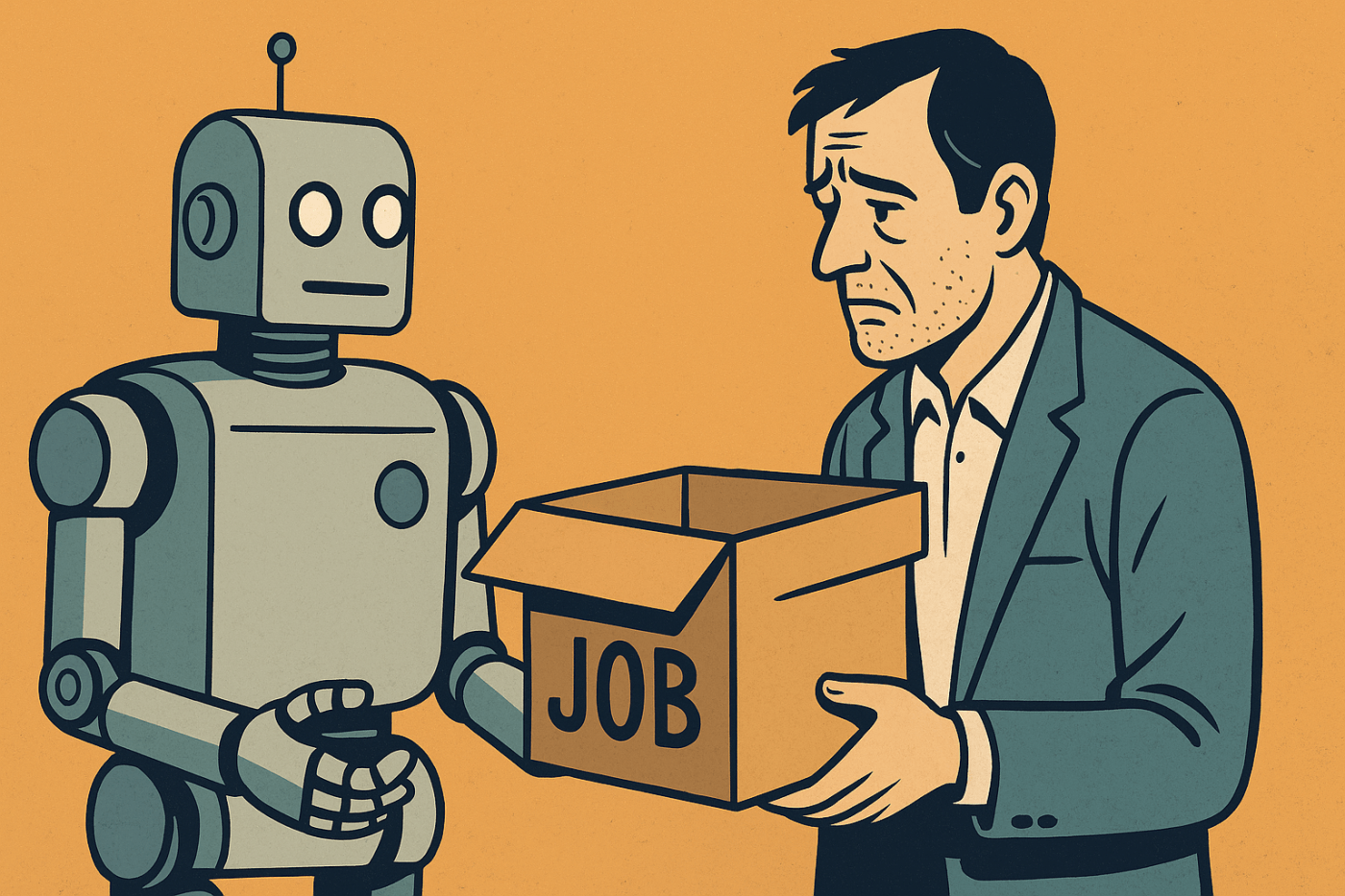
By now, you’ve likely met your replacement. Maybe they don’t wear pants. Maybe they don’t even have a body. But they answer emails faster than you, debug code without whining, draft legal briefs with robotic detachment, and seem to know every song, poem, and policy from the history of civilization. Meet your new coworkers: ChatGPT, Claude, Gemini, Copilot, and others who might as well be the Four Horsemen of White Collar Doom.
The thing is, we didn’t even get a proper warning. There was no “Hey, by the way, we’re going to automate your soul next Tuesday.” Just an explosion of tools, dashboards, and helpful chirps from executives promising “augmented intelligence”—a euphemism for “we’re keeping the software, not you.”
Welcome to The Great Displacement, a strange and harrowing chapter in human history, where the very minds that once built the future are being booted from it.
What Is Displacement?
Displacement, in polite economic terms, means your job has become obsolete before your mortgage has. It’s what happens when a faster, cheaper, or shinier way of doing your work rolls in and gently (or rudely) shows you the door. In previous centuries, it came for candle makers and carriage drivers. But now? It’s coming for the knowledge workers. The thinkers. The coders. The lawyers. The analysts. The architects of the information age.
The twist? These aren’t shovel jobs being replaced by machines. These are high IQ, high education, and high hopes careers. And unlike the scribes who had a few centuries to process their obsolescence (and drink about it), today’s pros are getting blindsided in what feels like real time. One minute you’re optimizing cloud infrastructure, the next minute, ChatGPT is explaining Kubernetes to your CTO with a British accent and simulated empathy.
This Isn’t Evolution. It’s a Coup.
The old story told us: when technology takes, it also gives. The car put horse breeders out of business but created mechanics, gas stations, and McDonald’s. The PC made typists vanish but gave rise to system admins, web designers, and spam email marketers. There was always a weird, beautiful symmetry.
But now? AI isn’t just replacing manual labour or repetitive tasks. It’s coming for the “cognitive elite.” You know, the folks who were smugly automating everyone else’s jobs just last year. Irony is a hell of a thing.
Take lawyers, for instance. Once safe behind mahogany walls and Latin phrases, now reduced to line items by AI that drafts contracts, parses case law, and never needs a lunch break. Or engineers, told to be agile and lean, now watch GitHub Copilot finish their code before they finish their coffee.
The most absurd part? Many of these people helped build the very systems that displaced them. It’s like Dr. Frankenstein getting pink-slipped by his own monster.
The Gospel According to Sundar, Mark, and Sam
Big Tech has a solution. Sam Altman (OpenAI) and Mark Zuckerberg (Meta) have both declared, in their benevolent overlord tone, that “upskilling” is the answer. Just learn something new! Pivot, adapt, and unlock your inner polymath! Sundar Pichai (Google) echoes the tune, assuring us that AI won’t replace us—it’ll empower us. A lovely gospel, sung from Silicon Valley, where cappuccinos flow and rent is $8,000 a month.
Which is a fine idea—if you’re 22, childless, and living off a trust fund. Or better, if you sold your startup and now give TED Talks about “resilience” while sipping matcha on your smart lawn.
But what if you’re 47, with two kids, a mortgage, aging parents, and a declining capacity to absorb React.js or master emotional intelligence in ten days? What if your identity is built on decades as a systems architect, paralegal, or data analyst, and now it’s all obsolete?
Telling someone like that to “just reskill” is like telling a concert pianist to go be a UX designer. Technically doable. Existentially cruel.
Truth is, learning new skills takes time, money, and energy—luxuries many don’t have. They’re not expanding—they’re being erased. This isn’t upskilling. It’s identity assassination with a smile.
Yuval Noah Harari warned in 21 Lessons for the 21st Century that the most vulnerable in the age of AI won’t necessarily be the poor, but the “useless”—not because they lack value, but because the system may no longer recognize their economic relevance. He didn’t say it with contempt; it was a sober warning. As machines surpass humans in more tasks, the danger isn’t just unemployment, but irrelevance—a future where millions aren’t simply out of work, but out of purpose, severed from any meaningful role in society. And that, Harari argues, is a far more dangerous and destabilizing crisis than poverty itself.
Even if you’re not feeling it yet, someone close to you will. Your dad. Your friend. Your partner. This isn’t sci-fi. It’s here.
And no amount of LinkedIn certificates can patch a world demanding people reinvent themselves every six months, without a map, a pause, or a parachute.
Telling someone like that to “just reskill” is like telling a concert pianist to go be a UX designer. Technically doable. Existentially cruel.
Automation With No Lifeboat
The broader issue here isn’t the rise of machines. It’s the lack of a social contract to cushion the fall. In previous tech transitions, there was time to adapt. Unions fought. Governments retooled policy. Society had some buffer.
Now, the timeline has gone from decades to quarters. Your skills aren’t outdated in ten years—they’re obsolete by the next product update. And the companies making these tools? They don’t owe you anything. You’re not a team member. You’re a cost center.
The worst part? AI isn’t just replacing one person with another. It’s replacing ten people with one person plus a bot. That’s the dirty little secret. The productivity boost is real, but it’s concentrated. The displaced don’t share in it. They’re told to read a Substack on “How to Reinvent Yourself” while filing for unemployment.
Now, the timeline has gone from decades to quarters.
The Real Question: What Are Humans For?
As we stare deeper into the silicon abyss, the question shifts from economic to existential. If labor is no longer our lifeblood, then what is? Are we to become caretakers of our replacements, glorified babysitters for bots that neither tire nor err? Or—if we have the courage—do we dare return to the parts of ourselves that were never programmable to begin with?
The messy, marvellous, irrational parts.
Care. Empathy. Creativity unbounded by logic. Spiritual depth. Connection. Humor. Wisdom. Imperfection.
You know—the stuff that makes us annoyingly, brilliantly human.
From Displacement to Clarification
Perhaps The Great Displacement isn’t a collapse, but a crossroads. A moment not of extinction, but of decision. Maybe we are being invited—dragged, really—into The Great Clarification: a cultural reckoning with the fact that for far too long we’ve tethered our value to productivity charts, quarterly reports, and inbox zero. Maybe it’s time we measure ourselves not by our efficiency, but by our essence.
Because here’s the punchline, no machine will ever nail: you are not your job description. And while your function may be replaced, your soul cannot be cloned, outsourced, or coded. Not yet.
So What Now?
Yes, we must learn. Yes, we must adapt. But more than that, we must insist on being human. We must reclaim the right to slow down, to feel deeply, to imagine wildly, to connect honestly, and to contribute in ways that transcend pure utility. Because if we don’t, the systems being built will decide for us. And they will not be kind.
The question is no longer “Will AI take our jobs?” It’s “Will we let it take our humanity?”
Diamond Edge or Downward Spiral?
Are we heading for a diamond edge—a future of glittering possibility where machines lift our burdens and let us shine in ways we’ve never dreamed?
Or a downward spiral—where meaning is stripped, dignity diluted, and entire lives reduced to outdated skillsets and unpayable bills?
The machines don’t get to decide that.
We do.
And heaven help us if we choose convenience over conscience. Heaven help us if we let ourselves become appendages to algorithms.
Final Thought (From a Flawed Human)
So go ahead—ask the hard questions. Demand better answers. Laugh more. Love harder. Work wiser. And for the love of all that is sacred, don’t let a robot write your wedding vows. Unless, of course, you want them to sound like an IKEA manual.
That, dear reader, is the future.
Not doom. Not utopia.
Just strange enough to demand that we show up fully human.
 Notes Beyond the Map
Leave a comment