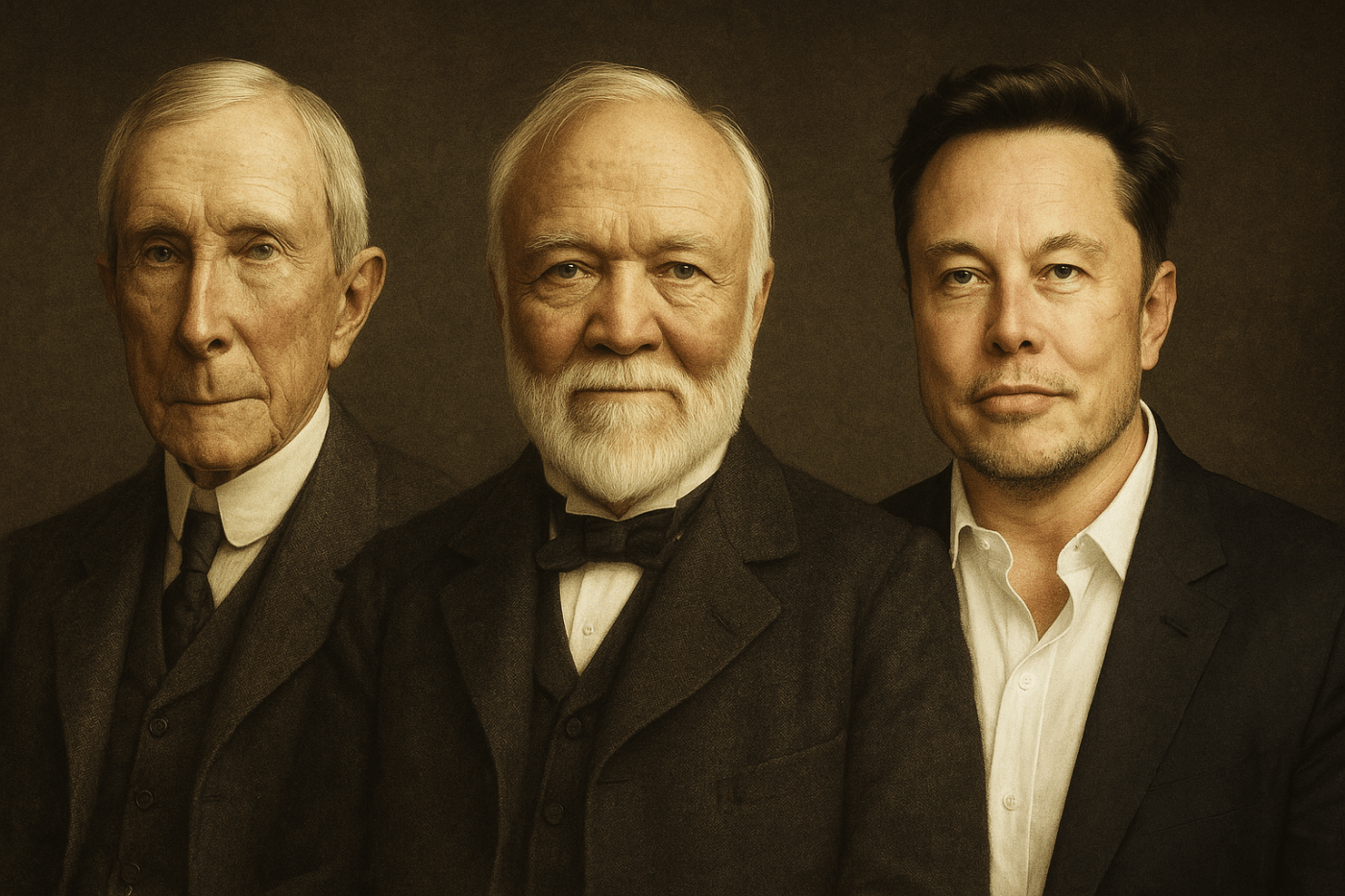
Somewhere between the Gilded Age and the Silicon Singularity, God—or at least the gods of industry—decided to play favourites. And play hard. They picked three men, slapped them with a cocktail of ambition, genius, and sheer gall, and let them loose on the unsuspecting world. Their names? John D. Rockefeller, Andrew Carnegie, and Elon Reeve Musk.
If you’ve ever pumped gas, crossed a steel bridge, or seen EVs wizzing by, you’re living in the world they made. Not one of them invented much—but they sure knew how to capitalize on other people’s inventions, break the rules, rewrite the game, and still come off as half-saviour, half-savage. Like Prometheus, but with dividends.
John D. Rockefeller: The Oil Pope of Cleveland
Let’s start with the most terrifyingly efficient man to ever count a nickel: Mr. Rockefeller. A devout Baptist who once said, “God gave me money,” which—if you’ve ever seen a Texas oil field at sundown—you know isn’t entirely wrong. Rockefeller didn’t just find oil; he refined it, monopolized it, squeezed it until it cried, and then politely prayed over the profits. Standard Oil wasn’t a company; it was a cartel dressed in a three-piece suit.
But here’s the thing the textbooks won’t say: Rockefeller didn’t win because he was ruthless. He won because he was disciplined. He understood vertical integration before it was cool. He made kerosene cheap enough for the poor to stop burning their curtains for heat. And while the courts eventually splintered Standard Oil into 34 baby giants, Rockefeller’s net worth actually increased after the antitrust breakup. His empire was the hydra: chop off a head, get ExxonMobil.
Without Rockefeller, we’d still be lighting our homes with whale fat and swearing at how expensive it is. The man didn’t invent modern capitalism—he just played it better than anyone else. Like a silent killer with immaculate bookkeeping.
Andrew Carnegie: The Chameleon King of Steel and Soul
Then there’s Carnegie. Not as memeable as Musk, not as dominantly feared as Rockefeller, but in many ways, more fascinating. Born in a one-room weaver’s cottage in Scotland, Carnegie dodged the poverty bullet by riding America’s industrial explosion like a streetcar named ambition. The real twist? He didn’t start rich, but he ended up filthy. And guilt-ridden.
Carnegie didn’t build the steel industry. He simply figured out how to mass-produce it without wasting time or money. He absorbed competition, out-negotiated the unions (until they revolted), and streamlined operations like a man possessed. But unlike the other robber barons, Carnegie had an existential crisis before he died. His late-life mantra? “The man who dies rich, dies disgraced.”
So he gave it all away. Or most of it. $350 million, in today’s money, that’s a few nuclear submarines and a fleet of Teslas. Public libraries, universities, and peace endowments. And no, this wasn’t just tax planning. This was a man who changed his entire philosophical outlook in old age, realizing that industrial conquest meant nothing if it wasn’t paired with social conscience.
Carnegie matters because he proved you could be a capitalist with a conscience. A wolf with a philosopher’s diary. And more importantly, he could read the room. When America changed, he adapted. When society began to revolt against the barons, he pivoted. The man didn’t just make steel—he made a playbook for legacy.
Elon Musk: The Court Jester of Mars
And then there’s Musk. Part Tony Stark, part Bond villain, part 2AM Reddit thread. The guy who makes you roll your eyes, then check your stock portfolio, then roll your eyes again. He’s the only man alive who can tank a stock and inflate a fanbase with a single tweet.
But don’t let the memes fool you. Musk is serious business. Literally, he didn’t invent electric cars, rockets, or brain interfaces—but he took ideas long dismissed as sci-fi lunacy and made them IPO-worthy. Tesla took an industry full of compliance cars and turned it into a status symbol. SpaceX made NASA look like a fax machine factory. Neuralink? We’re still not sure if it’s genius or Frankenstein—but we’re watching.
What sets Musk apart, though, isn’t just the tech. It’s the fact that he thrives in chaos. Regulatory minefields, PR disasters, global supply chain collapses—he surfs it all. Where Rockefeller mastered control, and Carnegie mastered transformation, Musk mastered disruption. He doesn’t play the system; he treats it like a beta version of a game he’s already rewriting.
And that’s why he matters, not because of what he’s done, but because of how he does it. He’s the only billionaire alive who still acts like he’s got something to prove. Maybe to his doubters. Maybe to his dad. Maybe to God.
What I’ve Learned from the Three Titans
Having read through their biographies and studied their lives with the curiosity of a raccoon and the tenacity of a caffeine-fueled history nerd, I’ve come to appreciate just how improbable each of their stories really is. These weren’t silver-spoon kids with cushy trust funds. They came from coal dust, kerosene lamps, and immigrant dreams. And they rose to wealth not just by climbing ladders, but by building them.
They were flawed. Oh, deeply. Carnegie once crushed unions with hired guns. Rockefeller wielded monopolies like a divine right. Musk is allergic to filters and may tweet us all into oblivion. But they forced the world forward. Without oil, without steel, without the audacity of breaking convention—we’d be riding horses to candlelit Facebook meetups.
Final Thoughts
I don’t idolize these men. But I do admire their nerve, their vision, and their refusal to accept the world as it was handed to them. They bent the arc of history toward something faster, harder, richer, and sometimes even better. And in that bending, they gave the rest of us something to study, question, and—if we’re lucky—build upon.
If we want to shape the future, we’d do well to learn from the past—warts, riches, and all.
 Notes Beyond the Map
Leave a comment