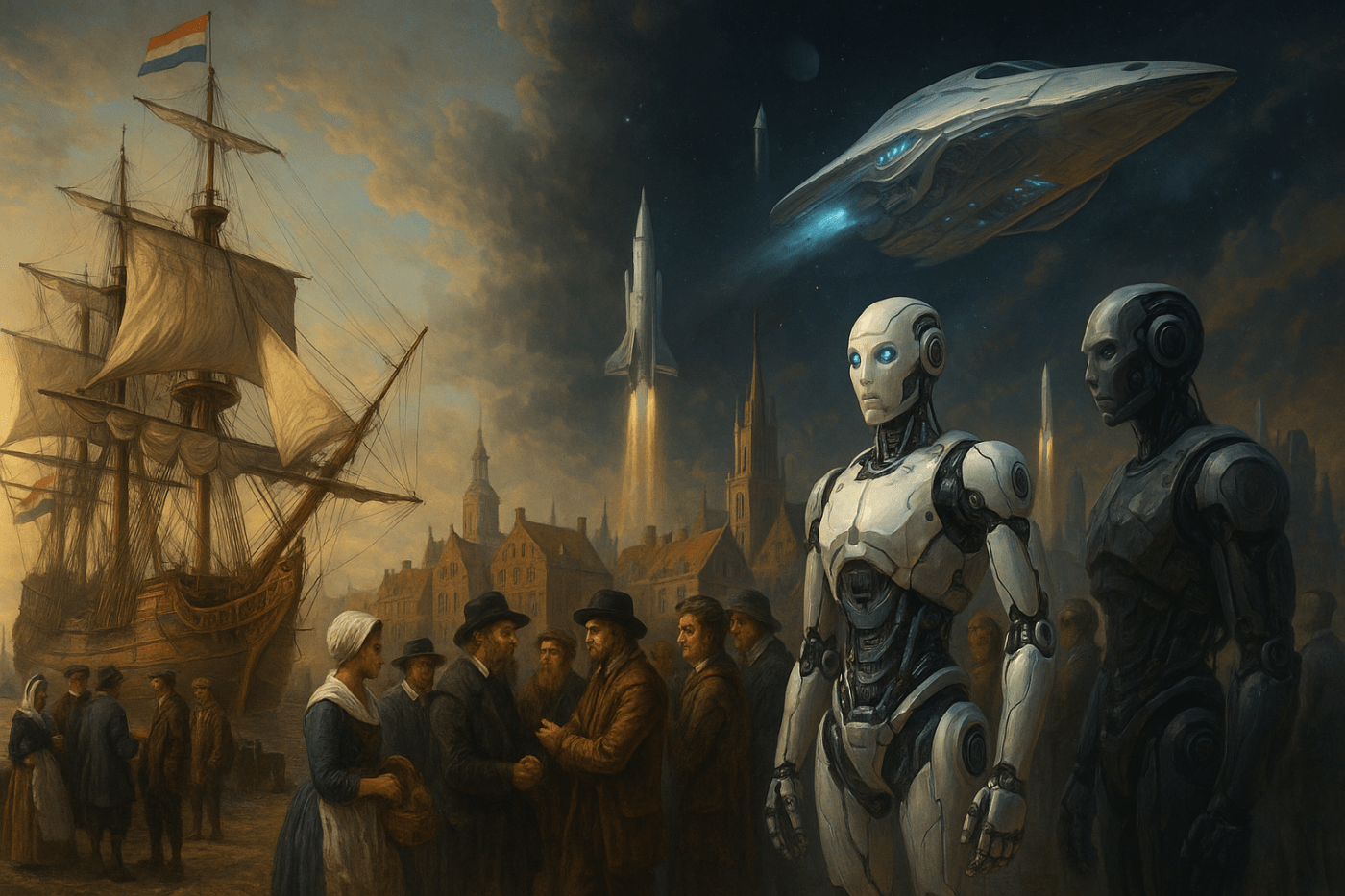
The class that built the world didn’t do it with crowns or cannons. They did it with ledgers, trade routes, and stubborn ambition. But now, they’re being quietly made redundant—not by warlords or kings, but by code.
Some revolutions come with guillotines. This one came with gigabytes.
And while we were distracted by memes and miracle serums, something quieter, and far more permanent, was unfolding. One not led by angry mobs but by neural nets. One not written with ink, but with code. Its target? The beating heart of modern civilization: the middle class.
This isn’t science fiction. It’s already happening. And if we don’t start paying attention, we’ll soon be nostalgic for the days when being overworked and underpaid was still a job.
Let’s start, as all great dystopias should, with the Dutch.
Dutch Cheese, Tall Ships, and the Birth of the Middle Class
In the 1600s, the Netherlands was the place. A pint-sized powerhouse punching well above its weight. It had the tallest ships, the cleverest merchants, and, for a hot minute, what you could reasonably call the world’s reserve currency. Dutch guilders flowed through the arteries of global trade like cholesterol through a Wall Street banker. Amsterdam wasn’t just a city—it was an empire in disguise, with its knobby fingers wrapped around parts of India, Indonesia, and Ceylon. All thanks to its trusty sidekick: the middle class.
Yes, the bourgeoisie, the ambitious not-rich-but-not-starving types, sprouted here. Shopkeepers, shipbuilders, brewers, painters, and moneylenders. They weren’t lords, but they weren’t peasants either. And unlike the aristocracy, they actually did things. They worked. They traded. They read books. And they built the world’s first stock exchange so they could invest in nutmeg and cannons from the comfort of a candlelit coffeehouse.
This accidental innovation, a third class, turned out to be dynamite. It gave rise to political power, philosophical thinking, voting rights, labour unions, and let’s face it, every useful invention from the Enlightenment to the Smartphone.
No middle class, no modern world.
But here’s the kicker: every empire built on the back of its middle class eventually forgets who carried it. The Dutch did. The Brits did. And now America’s repeating the same.
The AI Coup: Your Job Is Now a Dataset
I read Superintelligence by Nick Bostrom back in 2016. Changed my life. Scared me senseless. The kind of fear that doesn’t just make you want to stock up on canned beans, but makes you question the very idea of progress. Bostrom didn’t yell. He didn’t cry apocalypse. He just laid it out: once machines become smarter than us, there’s no off-switch. No bargaining. No guarantee they’ll keep us around for nostalgia’s sake.
We’ve built gods with keystrokes. And they’re hungry.
Today’s AI is a tricycle with rocket fuel. But Stargate, OpenAI’s supermodel-in-the-making? That’s a Ferrari in the garage, and it’s already warming up. These systems will do what ChatGPT and Gemini do now—only 10,000 times better and faster. They’ll manage hedge funds, diagnose cancer, negotiate treaties, write screenplays, and probably ghostwrite your next apology to HR.
If you think this only threatens cashiers, copywriters, and developers, bless your heart. Doctors, lawyers, engineers, scientists—you could be next. The middle class was once made up of skilled professionals. Now? Those skills are being liquefied and piped into large language models at scale.
We fed our minds to the machine, and now we’re watching it burp out better versions of us.
The Middle-Class Job Collapse Has Already Begun
This isn’t some distant threat—it’s already happening. In the past year alone, companies like IBM, Amazon, and Google quietly laid off thousands, citing “AI efficiencies” and “strategic rebalancing.” There are estimates that 300 million jobs could be affected by generative AI globally. Customer service roles are already disappearing. Legal assistants, paralegals, and junior analysts are next.
Over the next 24 to 36 months, expect to see copywriters, financial planners, radiologists, language translators, and even junior developers get squeezed—or quietly eliminated. By year four, sometime around 2029, even roles in education, project management, and mid-tier healthcare will feel the pressure.
This isn’t creative destruction. It’s creative erasure—and it’s carving through the middle class.
From Democracy to Technocracy to Something Else Entirely
Democracy was the crown jewel of the middle class. We fought for it. We died for it. We believed in it. But now, it’s being downgraded like an old iPhone. What we have today is a technocracy. A world ruled by nerds with God Mode access. Elon, Jeff, Mark and Bill and the rest rule the backend of our daily lives. Trump may think he’s in charge, but the real power now lives in data centers.
You didn’t vote for the algorithm that determines what news you read, what job you see, and what credit you get. You didn’t vote for the AI that auto-rejects your resume. And you certainly didn’t vote for the neural net whispering sweet nothings into the ears of global CEOs convincing them to automate your job.
You think you’re a citizen? No. You’re a user. We’re all users.
Education? Free now, thanks to AI tutors and open courses. But it’s a trap. Credentials are everywhere—but distinction is nowhere. We’re flooding the market with MBAs while the economy quietly says, “Actually, we only need five of you, and we already have three.”
It’s meritocracy without mercy. And innovation? That ship has sailed straight into the hands of trillion-dollar mega-corps. Google, Meta, Amazon, Apple, Tesla—they’ve built digital fortresses guarded by IP lawyers and server farms. You don’t innovate anymore. You subscribe.
Meanwhile, as jobs disappear and people cry uncle, the government will extend a gentle, algorithmically-tuned hand: monthly payouts. Basic income. Digital dignity.
But don’t be naïve—there will be strings. Behavioural nudges, usage monitoring, policy compliance. You’ll smile. You’ll click “Accept.” And your autonomy will quietly be bundled and sold back to you as a service.
Everyone’s smart, so no one’s exceptional.
The American Empire and the End of Escape
Like the Dutch before it, America rose on the back of innovation and a working middle class. It exported ideals and Coca-Cola. Now, it exports AI surveillance infrastructure.
Every major AI platform, from ChatGPT, Gemini, to Claude wears the Stars and Stripes beneath the hood. The U.S. isn’t just the global police—it’s the digital landlord of the 21st century. It holds the keys to the servers, the chips, the standards, and the data pipelines. Everyone else rents.
But here’s the twist: the endgame isn’t totalitarianism with boots and batons. It’s compliance by convenience. You’ll be offered the path of least resistance. And you’ll take it. Because resistance means being unemployed, uninsured, and disconnected.
In the past, when empires collapsed, you could run. Hop a ship. Find a new world. America was that new world once. But now? Now everything is tracked. You name it, from your spending and searches to your steps and secrets. The algorithm already knows what you’ll search before you type it—on Google, YouTube, Facebook, or ChatGPT. Soon, it won’t just predict your thoughts. It’ll redirect them.
These tools are not far away from knowing what you’ll think before you think it (and oftentimes they do).
There’s no frontier left. No digital Patagonia to vanish into. Only zones of compliance. Walled gardens with great UX and terrible terms. And the scariest part? You’ll ask for it. We’ll all pay for it and buy into it.
Final Thoughts from a Middle-Class Kid
I grew up believing that if I worked hard, stayed curious, and treated people well, I’d earn my spot in the middle. Not the top. Not the bottom. Just somewhere decent.
But that spot is shrinking. Eroding. By 40, I thought I’d own a home in Canada. Now at 43, that idea drifts further away like a red balloon—just close enough to torment, never close enough to touch. I’m not alone in this. And truthfully, I’m not even sure I want to own anymore. The weight of a million-dollar mortgage would keep me up at night, as it surely does for most.
Western civilization was once forged by Dutch merchants, building wealth with wooden ships bound for distant lands. Then came the American dreamers, crafting rockets and online empires out of thin air.
Now? We risk becoming clients of a machine that tolerates us only as long as we stay predictable. If you still believe in the middle class, take a good, hard look around. Because the class that built the world is vanishing. And the tech that’s tearing it down doesn’t care for nostalgia. Not in this timeline.
I remember seeing Nick Bostrom’s bell curve years ago—the one predicting the rise of machine intelligence and the singularity point where we lose control. It scared me. But I didn’t really believe it back then. I think I do now.
So here’s the real question—the kind only Oppenheimer or Einstein would dare ask:
If we’ve built a mind that outpaces our own, not to uplift humanity, but to unravel it, what comes next?
Do the overlords inherit the Earth while the rest of us slip back into digital serfdom?
Or does it all collapse under the weight of our own brilliance, taking the world the middle class built down with it?
 Notes Beyond the Map
Leave a comment