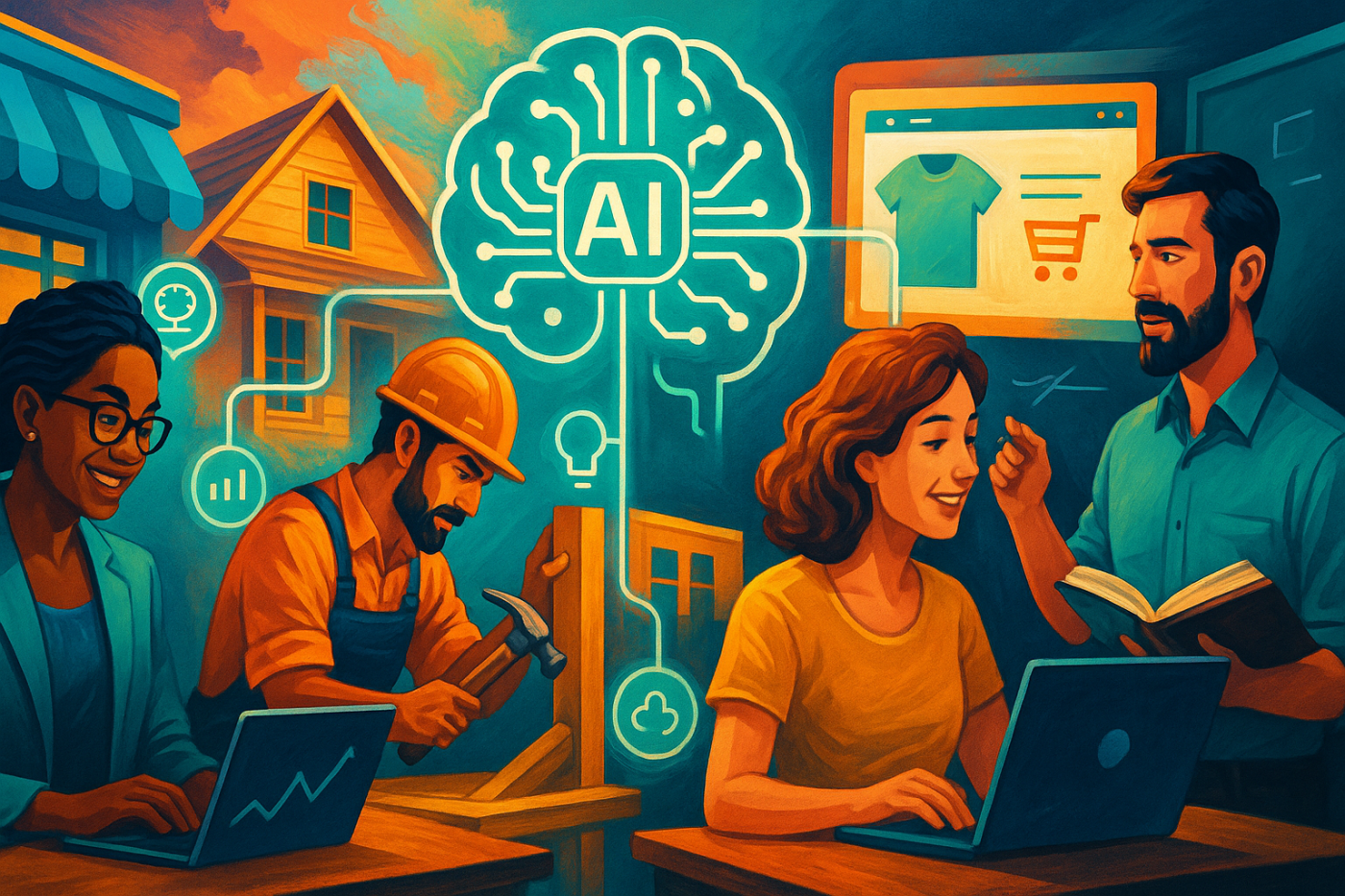
Some inventions just add convenience. Others rewrite civilization. The wheel. The printing press. Electricity. The internet. And now—Artificial Intelligence.
If you run a business today, you’re standing on the fault line of what’s being called The Transformational Era—a term coined not by marketers, but by those paying close attention to how civilization evolves. And evolve it must, because make no mistake: this isn’t just another trend. This is a reordering of how work, value, and intelligence itself are distributed.
And yet, most businesses are watching from the sidelines—unaware that this game has already started and the rules have already changed.
History’s Playbook: Adapt Early or Get Left Behind
Let’s rewind. The companies that survived the Industrial Revolution weren’t just the ones that bought machines. They were the ones who rebuilt their entire organizations around the machine. Same with electricity. Same with the internet.
IBM didn’t “adopt” the computer—they became the computer. Amazon didn’t “use” the web—they redefined commerce on it. And those who waited? They didn’t just lose. They vanished.
The same playbook is unfolding now—but at 10x speed.
We’ve entered an era where intelligence is no longer purely human. Tasks we thought required specialists—design, code, strategy, customer service—are being automated, accelerated, and redefined by AI tools that are becoming more capable by the week.
And here’s the kicker: we’re still early. That means the biggest wins—and the deepest risks—are still ahead. But only for those who understand what’s actually unfolding.
What It Means to Be AI-First (And Why It Changes Everything)
An AI-first company isn’t just one that uses AI—it’s one that thinks and builds with AI at the core. Like a business that restructured around electricity in 1910, or around software in the 90s, an AI-first organization rewires its operations, systems, and workflows for a world where machine intelligence is not a tool—but a co-pilot.
It means:
- Automating routine tasks so your people can do higher-value work
- Making faster, smarter decisions driven by real-time data
- Communicating at scale with personalization once reserved for 1:1 interactions
- Using tools that never sleep, never forget, and get better with every input
- Designing operations not around headcount—but around output
This isn’t about replacing people. It’s about amplifying them—removing the grunt work and unleashing potential.
AI is both the ultimate democratizer and the quiet executioner. It gives small teams the power to compete with giants, while quietly dismantling bloated structures that can’t adapt. It rewards clarity, speed, and intent—and punishes inertia. In the hands of the nimble, it’s rocket fuel. In the hands of the reluctant, it’s a reckoning.
Five Reasons AI-First Companies Will Overtake the Rest (While Others Sink Like a Stone)
Let’s get real. AI-first companies aren’t just winning. They’re creating a new game with rules that reward speed, precision, and adaptability. Meanwhile, companies stuck in the old way are burning cash, losing talent, and becoming less relevant by the day.
Here’s what separates the future-builders from the soon-to-be-forgotten:
1. Relentless Efficiency
AI-first companies automate everything from customer support to back-office operations. They don’t wait for reports—they generate them instantly. They don’t spend hours managing schedules—they let intelligent agents handle it. Output goes up, errors go down, and every second is optimized.
Meanwhile, companies that resist this shift are stuck spinning their wheels. Tasks are still passed around like hot potatoes. Meetings abound, reports are late, and productivity looks like a Jackson Pollock painting—messy, inconsistent, and hard to interpret. They waste time trying to do things manually that their competitors have already handed off to digital teammates. The result? Burnout, bloat, and budgets that bleed.
2. Superior Decision-Making
AI-first organizations are plugged into a constant feedback loop. Data flows in, insights emerge, and decisions are made with clarity and speed. These businesses adapt quickly because they see what’s happening before others do—and act while competitors are still “gathering input.”
Meanwhile, traditional companies are paralyzed by analysis. They rely on outdated dashboards, hunches, or last quarter’s numbers. Decision-makers are often several steps behind reality. By the time they react, the market has already moved on—and the opportunity is long gone. It’s like steering a ship with yesterday’s weather report.
3. 24/7 Capability
AI-first businesses run on a new rhythm—always on, always learning. Your website doesn’t just sit there; it converses, qualifies leads, and closes deals. Your systems don’t sleep—they optimize overnight. Customer support runs across every timezone. AI agents work tirelessly without breaks, shifts, or sick days.
Meanwhile, companies that don’t adapt still run on human hours. Leads sit cold over the weekend. Emails go unanswered. Teams are always “catching up” instead of getting ahead. The organization becomes sluggish and reactive—waiting on people who are already overwhelmed. Time becomes the enemy, not an ally.
4. Personalization at Scale
An AI-first company doesn’t send “blasts.” It sends signals. Content, products, and experiences are tailored to each individual—dynamic, relevant, and timed perfectly. The result? Customers feel seen, valued, and understood.
Meanwhile, old-world businesses keep lumping customers into buckets—demographics, personas, segments. Their messaging is generic, their offers stale, and their conversions drop. It’s the difference between being spoken to and being spoken at. As customer expectations rise, these companies fall further behind, mistaking volume for value.
5. Margin Expansion and Market Power
With leaner operations and higher output, AI-first businesses enjoy explosive margins. They deliver faster, better, and at lower cost. They invest those margins into growth, talent, and innovation—widening the gap every quarter.
Meanwhile, legacy companies are stuck in a trap of diminishing returns. Rising labour costs, clunky systems, and bloated org charts eat into every dollar. Innovation becomes risky. Scaling feels impossible. Their margins shrink, their relevance fades, and before long, they’re either bought, buried, or quietly forgotten.
Build Your Moat—While Others Stand Still
In business, timing isn’t everything—it’s the only thing. And here’s the truth most aren’t ready to hear: just 12 to 24 months of executing an AI-first strategy—starting today—can build a competitive moat that will be nearly impossible for slower players to cross.
Imagine automating 50% of your operational workload. Doubling your speed to market. Personalizing every customer touchpoint. Then imagine your competitors finally waking up two years from now… only to realize you’ve already moved on to your next play.
That’s not just an advantage. That’s compound acceleration—and it’s available now, not in some distant future.
The companies that move now aren’t just getting ahead. They’re building a lead that will be measured in years—not quarters.
The High Cost of Waiting
Here’s the cold truth: most businesses will miss this wave. A 2024 McKinsey report found that 68% of business leaders have no concrete AI integration plan. Most won’t take action until the gap is irreversible.
But history is clear—waiting is the most expensive choice you can make. The companies that dominated every previous revolution weren’t the biggest. They were the fastest to rethink how they work.
How to Move Now (Without Falling on Your Face)
You don’t need to tear it all down and start from scratch. What you need is a partner—someone who can help you transition intelligently and strategically.
This is where working with an AI consultant makes all the difference. A great one will help you:
- Identify where AI fits into your workflow
- Align your systems and people for long-term advantage
- Attract and retain higher-value clients
- Leverage powerful, affordable tools to enhance productivity
- Future-proof your business with practical, human-first AI integration
Firms like Aurisen Solutions specialize in this exact transformation. So do others. The important thing is not who you choose—but that you choose someone. This era won’t wait. Neither should you.
Final Thought: Don’t Miss Your Moment
Every generation is handed a turning point. This is yours.
Do not let companies willing to take the plunge into an AI-first future eat the lion’s share while you’re still “looking into it.” Pause. Recalibrate. Invest. Then move—quickly and boldly—into the new era, before the door to advantage quietly closes behind you.
Because in this Transformational Era, you don’t win by waiting.
You win by becoming what the future demands.
History doesn’t wait for permission. It rewards those who act before the page turns.
 Notes Beyond the Map
Leave a comment