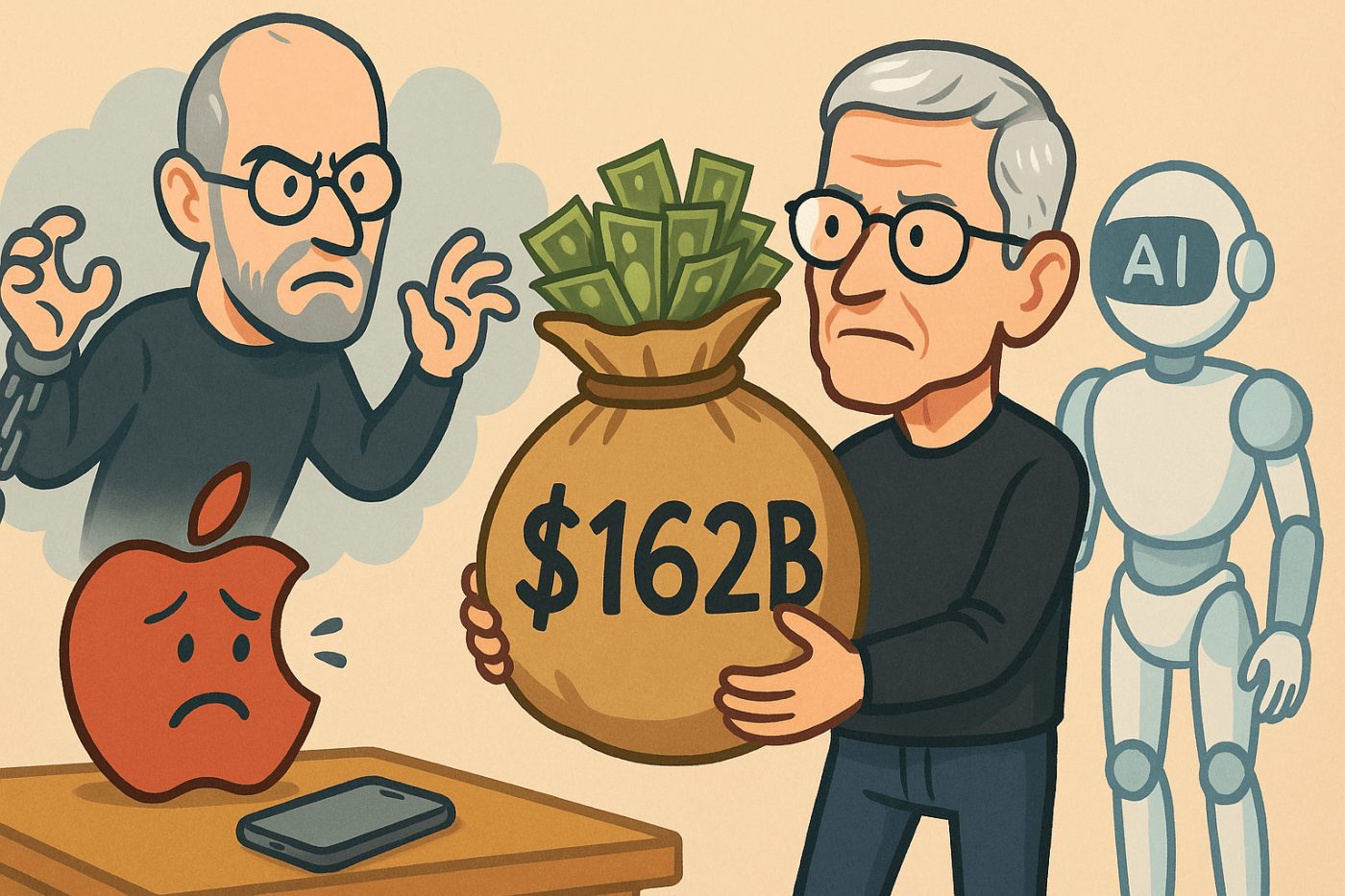
So here we are, in the year of our Lord 2025, watching Tim Cook wave around Apple’s $162 billion cash pile like a conductor’s baton, declaring with all the panache of a riverboat gambler that the AI revolution is “ours to grab.” Well, shoot. It only took them about five years behind everyone else to figure out that maybe, just maybe, their digital assistant shouldn’t sound like it’s perpetually confused about whether you asked for the weather or wanted to call your mother.
And oh, what a magnificent pile of money it is—$65.171 billion in cash on hand as of 2024, with total reserves reaching those dizzying heights that would make Scrooge McDuck weep with envy. That’s enough money to buy entire countries, or at least enough AI startups to finally make Siri stop asking “Did you mean ‘set a timer for 5 minutes’ when you clearly said ‘play some music’?”
The Ghost of Steve Jobs Rattles His Chains
Now, if old Steve were still kicking around, Lord knows he’d be madder than a wet hen at what his baby has become. Steve Jobs—that magnificent, tyrannical perfectionist who believed in building everything in-house like some kind of technological Amish craftsman—would take one look at Apple’s current AI situation and probably throw his black turtleneck clear across Cupertino.
You see, Steve had a philosophy simpler than pie: control everything, trust no one, and make it work so beautifully that people weep with joy. He didn’t much cotton to acquisitions—preferred to build his own kingdom brick by brick. But Tim Cook? Well, Tim’s got a different playbook entirely. Cook told shareholders that Apple has acquired more than 100 companies in the last six years—about three or four companies per week. That’s not a strategic acquisition; that’s corporate bulimia.
The big ones? Beats Electronics for $3 billion in 2014, Shazam for $400 million in 2018, and a parade of smaller fish that disappeared into Apple’s belly faster than you can say “synergy.” But here’s the kicker—for all that buying and acquiring, Apple Intelligence still can’t hold a candle to what Google’s been doing since the Obama administration.
The Siri Situation: A Comedy of Digital Errors
Let’s talk turkey about Apple’s current AI predicament, shall we? Siri, bless her digital heart, remains about as intelligent as a box of rocks in a thunderstorm. After more than a decade of development, she still can’t:
- Understand basic context in conversations
- Handle complex, multi-step requests without having a digital nervous breakdown
- Integrate properly with third-party apps (despite years of promises)
- Remember what you just asked her three seconds ago
- Distinguish between “call Mom” and “Paul Mom” with any reliability
- Set multiple timers without getting confused about which is which
- Understand accents that aren’t straight out of a California tech bro commercial
And Apple Intelligence? Sweet merciful heavens, it’s like watching a brilliant child who’s been hit in the head with a frying pan. It can summarize your notifications (sometimes), help with writing (when it feels like it), and occasionally manage to understand what you’re asking for in Photos. But intelligent? That’s like calling a tricycle a Ferrari.
Meanwhile, Google Assistant is out there having full conversations, Amazon’s Alexa is running smart homes like some kind of digital butler, and Microsoft’s AI is writing code better than half the programmers in Silicon Valley. Apple’s ecosystem, for all its supposed integration, works about as smoothly as a square wheel on a gravel road.
The $25 Billion Question: Perplexity and the Great AI Grab
Now comes the interesting part—the part that might actually matter. Word on the street, and by “street” I mean the whispered conversations in Cupertino boardrooms, is that Apple’s got its eyes set on Perplexity AI. And why wouldn’t they? Perplexity offers a polished, consumer-ready AI search product that aligns well with Apple’s design and privacy values, and recent reports confirm Apple executives have held internal talks about potentially acquiring Perplexity specifically to address their AI talent gap.
The price tag? A cool $25-30 billion, give or take a few billion for good measure. That’s real money, even for Apple, but it’s also exactly the kind of move that could transform their entire AI strategy overnight. Perplexity isn’t just another chatbot—it’s a genuine search revolution wrapped in a privacy-first package that would make Siri actually, you know, useful.
But let’s not put all our eggs in one basket, because Apple’s got options. The runner-ups in this high-stakes poker game are equally intriguing:
Mistral AI sits pretty as candidate number two—a French startup that’s built efficient, privacy-focused language models that could run on-device better than a Swiss watch. For a company that’s spent years preaching about privacy while secretly making deals with Google, Mistral represents the kind of European AI sophistication that could help Apple navigate regulatory waters while actually delivering intelligent features.
Anthropic rounds out the top three, bringing the kind of advanced AI research that could give Apple the foundational technology it desperately needs. Think of it as buying the smartest kid in class to help you with your homework—except the homework is worth several hundred billion dollars in market cap.
The Ecosystem That Forgot How to Think
Here’s the bitter truth that no Apple marketing executive wants to admit: for all their talk about seamless integration and ecosystem magic, Apple’s devices work together about as well as a bunch of strangers at a awkward dinner party. Your iPhone doesn’t really talk to your MacBook, your iPad exists in its own little universe, and your Apple Watch spends most of its time trying to figure out if you’re walking or having a heart attack.
Steve Jobs’s vision was simple: create devices so intuitive that your grandmother could use them, so integrated that they felt like extensions of your own mind. Instead, we got devices that require seventeen different apps to do what should be one simple task, and an AI assistant that still can’t figure out that when you say “remind me about this when I get home,” you don’t want to be reminded about “this” at 3 AM because your phone thinks your neighbor’s WiFi signal means you’re home.
The fragmentation is real, the intelligence is artificial in all the wrong ways, and meanwhile, Google, Microsoft, and Amazon are eating Apple’s lunch with AI systems that actually work in the real world.
The Reckoning Cometh
So here we stand, on the precipice of what could be Apple’s great AI awakening or its last waltz with relevance. Tim Cook’s “ours to grab” declaration sounds an awful lot like a company that just realized the party started five years ago and they’re still looking for their car keys.
But here’s the thing about Apple—they’ve been counted out before. They’ve made comebacks that would make Frank Sinatra jealous. And with $162 billion in cash burning a hole in their corporate pocket, they’ve got the resources to buy their way back into the conversation.
The question isn’t whether Apple can afford to make the big acquisition play—it’s whether they can afford not to. Because in the AI game, there are no participation trophies, no second-place ribbons, and no time-outs for companies that spent too long admiring their own reflection.
Will Perplexity be the magic bullet that finally makes Apple Intelligence actually intelligent? Will 2025 be the year our devices finally start working the way they were promised to work back when we first fell in love with that sleek Apple design?
Only time will tell. But one thing’s for certain—if Steve Jobs were still around, he’d either be leading this charge with the fury of a man possessed, or he’d be building something completely different that would make us all forget we ever cared about AI assistants in the first place.
The future, as they say, is ours to grab. Let’s hope Apple doesn’t drop it.
 Notes Beyond the Map
Leave a comment