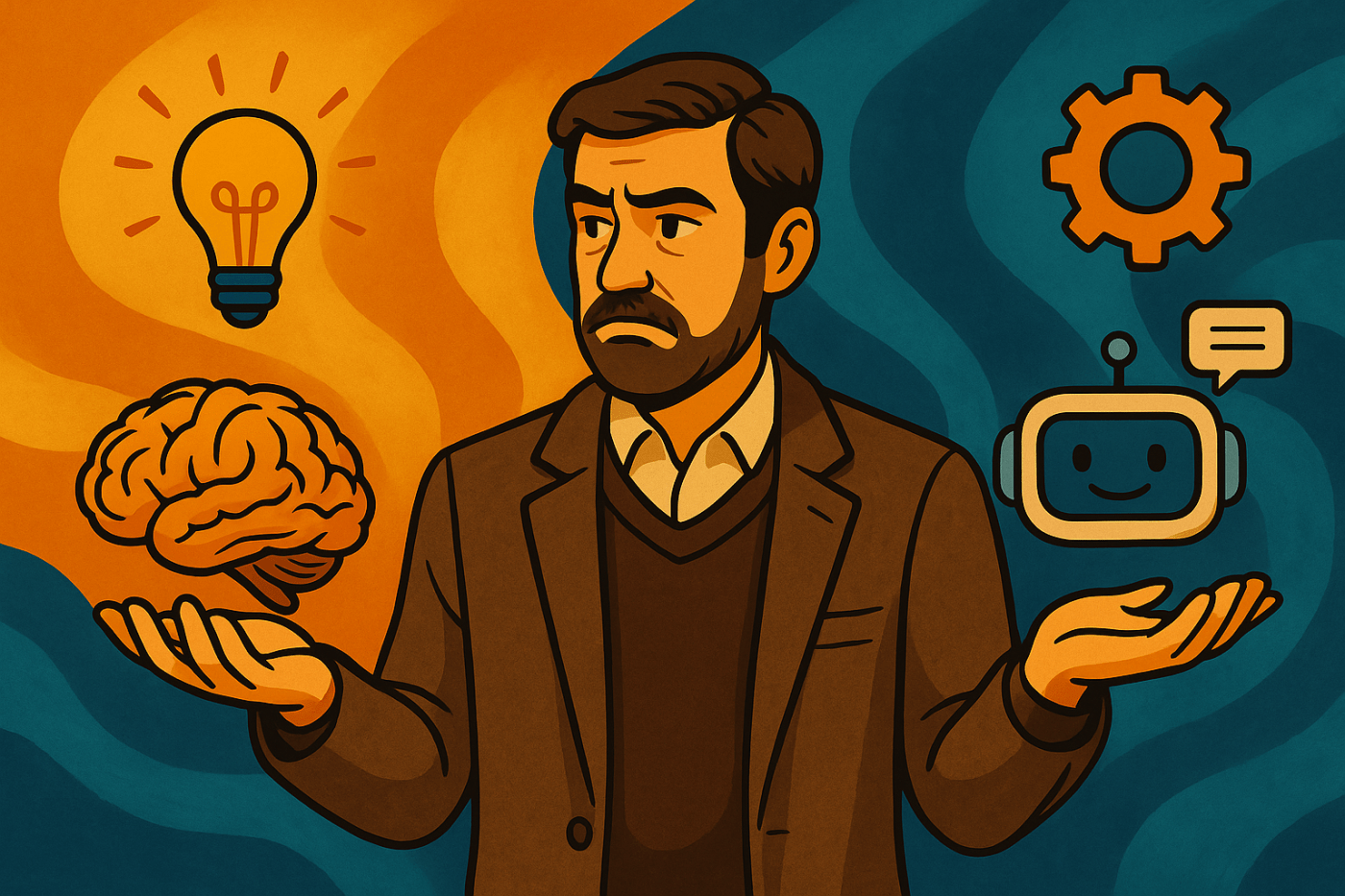
Or: How I Learned to Stop Worrying and Love the Robot
So it goes. Here we are in 2025, standing at the crossroads of human ingenuity and artificial intelligence, and wouldn’t you know it—half the world is having a proper existential crisis about whether asking ChatGPT for help makes you lazy, while the other half is busy automating their breakfast routine.
The skeptics have taken to CNBC like prophets of doom, proclaiming that those who lean on AI will find themselves intellectually flabby, unable to think their way out of a paper bag when the robots inevitably take a coffee break. Meanwhile, the AI enthusiasts are querying their digital assistants dozens of times daily, treating artificial intelligence like a Swiss Army knife for the soul.
Both camps, bless their hearts, might just be missing the forest for the trees.
Picture this: It’s 1890, and Henry is the finest blacksmith in three counties. His arms are like tree trunks, his mind sharp as the blades he forges. Then along comes the industrial revolution with its fancy machines, and suddenly, Henry’s grandson can’t change a tire without YouTube.
The Case Against AI Dependency: The Muscle Atrophy Theory
The AI skeptics aren’t entirely wrong, and their argument deserves more than a dismissive wave. They’re essentially making the “use it or lose it” case—that cognitive muscles, like physical ones, atrophy without regular exercise. When we outsource our thinking to machines, we risk becoming intellectual passengers in our own lives.
Consider the navigation example that’s become a modern cautionary tale. Before GPS, people developed genuine spatial intelligence. They understood cardinal directions, could read paper maps, and possessed an intuitive sense of geography. Now? Most folks couldn’t find their way home from the grocery store if their phone died.
The Skeptic’s Hypothesis: Humans who maintain intellectual independence from AI will retain superior problem-solving abilities, creative thinking, and adaptability when technology fails or falls short.
There’s wisdom in this wariness. The most innovative solutions often come from wrestling with problems directly, from that beautiful friction between the human mind and complex challenge. When we immediately reach for AI assistance, we might rob ourselves of those “aha!” moments that come from genuine intellectual struggle.
The Case for AI Integration: The Tool Amplification Theory
But hold your horses there, Luddites. Let’s not forget that humans have been tool-users since we figured out that rocks make excellent hammers. The wheel didn’t make us lazy—it made us mobile. The printing press didn’t destroy human memory—it democratized knowledge.
The AI advocates argue that intelligence augmentation, not replacement, is the real game. They’re not trying to think less—they’re trying to think better. When a marketing executive uses AI to generate initial campaign concepts, then applies human judgment to refine and strategize, that’s not intellectual laziness—that’s cognitive efficiency.
Consider the modern knowledge worker who uses AI for:
- Initial research and data synthesis
- Draft generation and ideation
- Routine task automation
- Pattern recognition in complex datasets
This person isn’t thinking less; they’re thinking at a higher level. They’ve liberated themselves from the cognitive equivalent of digging ditches so they can focus on architecture and design.
The Integrationist’s Hypothesis: Humans who skillfully combine AI capabilities with human insight will achieve superior outcomes, operating at higher levels of strategic and creative thinking than either could accomplish alone.
The internet didn’t make us stupid—it made information abundance the new challenge. Similarly, AI doesn’t threaten human intelligence; it shifts the battleground from raw processing power to wisdom, judgment, and the uniquely human ability to ask the right questions.
The Executive Paradox: The Hidden Hypocrisy of Help
Here’s where things get deliciously ironic. Walk into any C-suite, and you’ll find executives surrounded by layers of human intelligence amplification. The CEO has a Chief of Staff who synthesizes information, a team of analysts who crunch numbers, and consultants who provide specialized expertise. The CFO relies on financial advisors, the CMO leans on creative agencies, and the CTO depends on technical specialists.
These leaders aren’t considered lazy for leveraging help—they’re considered strategic. When a director asks their assistant to research market trends or when a VP has their team prepare talking points for a board meeting, nobody questions their competence. In fact, we call it leverage.
But somehow, when a middle manager uses AI to draft an initial project proposal or when a coordinator employs ChatGPT to brainstorm solutions, suddenly it’s an intellectual weakness? The cognitive dissonance is staggering.
The uncomfortable truth is that AI is democratizing what was once the exclusive province of those who could afford human assistance. For the first time in corporate history, everyone can have something resembling a personal think tank, research assistant, and creative collaborator rolled into one.
This is where the real tension lies: AI isn’t just changing how we work—it’s flattening the traditional hierarchy of intellectual privilege.
The executive who built their career on having better access to information and analysis suddenly finds their administrative assistant armed with the same AI tools. The consultant who charged premium rates for strategic thinking discovers that their frameworks are now accessible to anyone with a decent prompt. The knowledge worker who climbed the ladder by being the “smart one” watches as artificial intelligence makes intelligence itself more abundant.
No wonder there’s resistance. We’re not just debating productivity tools—we’re witnessing the democratization of cognitive advantage.
The Historical Echo: We’ve Been Here Before
This isn’t humanity’s first rodeo with transformative technology. When calculators emerged, mathematicians worried that students would lose their numerical intuition. When word processors arrived, writers fretted about the death of penmanship and thoughtful composition. When search engines proliferated, educators warned of the end of memorization and deep learning.
Yet here we are: mathematicians still think, writers still create, and students still learn. The tools changed, but human potential expanded rather than contracted. The key insight? It’s not about the tool—it’s about how we integrate it into our cognitive ecosystem.
Yet here we stand, human intelligence very much alive, simply learning new dance steps with artificial partners.
The Balance Imperative: Walking and Driving
The truth, as it often does, lies in the tension between extremes. Just as we shouldn’t exclusively drive everywhere (goodbye, physical fitness) or exclusively walk (goodbye, efficiency), we shouldn’t completely avoid AI (goodbye, competitive advantage) or completely depend on it (goodbye, intellectual autonomy).
The grocery store analogy illuminates this beautifully. Walking to the market connects you with your neighbourhood, provides exercise, and offers serendipitous encounters. Online grocery delivery saves time, reduces impulse purchases, and accommodates busy schedules. The wise person uses both strategically, depending on circumstances and goals.
Similarly, the future belongs neither to the AI-phobic nor the AI-dependent, but to the AI-literate—those who understand when to think independently and when to think collaboratively with artificial intelligence.
Society’s Crossroads: The Great Rewiring
This debate reveals something profound about our moment in history. We’re not just arguing about productivity tools; we’re wrestling with what it means to be human in an increasingly intelligent world. The stakes feel existential because, in many ways, they are.
Society is being rewired around artificial intelligence, and the transition is as bumpy as you’d expect. Some communities are racing ahead, integrating AI into everything from education to governance. Others are pumping the brakes, insisting on human-first approaches to preserve dignity and agency.
Both responses contain wisdom. The race-ahead folks are building tomorrow’s competitive advantages today. The pump-the-brakes crowd are protecting something precious about human experience and capability.
The danger lies not in either approach, but in the extremes: the breathless technophilia that sees AI as a cure-all, and the reflexive technophobia that sees it as exclusively threatening.
The Reader’s Choice: Your Cognitive Future
So what’s it going to be, dear reader?
Will you join the ranks of the AI-skeptical, maintaining your intellectual independence through manual labour of the mind? There’s honour in that path—the satisfaction of self-reliance, the preservation of cognitive muscles, the preparedness for technological failure.
Or will you embrace the AI-integrated future, amplifying your capabilities through intelligent collaboration with machines? There’s wisdom in that approach too—the efficiency of enhanced cognition, the competitive advantage of tool mastery, the exploration of new frontiers of human potential.
Perhaps the most subversive choice is the third path: becoming genuinely AI-literate. Not dependent, not avoidant, but skillfully adaptive. Learning when to think alone and when to think together with artificial minds. Understanding AI’s strengths and limitations. Maintaining both the ability to function without it and the wisdom to leverage it effectively.
The future won’t be won by the pure technologists or the pure humanists, but by the synthesis thinkers—those who can dance between worlds, using every tool available while remaining fundamentally, irreplaceably human.
The question isn’t whether you’ll use AI. The question is: what kind of human will you be when you do?
So it goes.
The choice, as always, remains gloriously, terrifyingly, completely yours.
 Notes Beyond the Map
Leave a comment