
Picture this: You live in a house built on top of an oil well, surrounded by rushing rivers, blessed with 300 days of sunshine a year—and yet, you’re still paying your neighbour’s cousin’s friend’s landlord just for the privilege of turning on your lights.
You’re not short on energy. You’re drowning in it.
But the system? It’s built to make you feel broke, powerless, and grateful to get what’s already yours.
Welcome to the modern energy paradox—where scarcity is manufactured, abundance is hoarded, and common sense seems to have taken a permanent vacation.
As I write this on a crisp evening in early September 2025, millions of families across North America are bracing for another brutal winter—forced to choose between heating their homes and feeding their children. It’s the kind of choice that would’ve made even Charles Dickens throw his pen across the room.
Here in Canada—land of endless forests, roaring waterfalls, and enough wind to power a small galaxy—many households still pay $200 to $300 a month just to keep the lights on. Larger homes or higher usage? Try $400 to $800 or more. And that burden has only grown as square footage ballooned, tech got thirstier, and wages sat around doing nothing.
That’s not just inflation. That’s highway robbery with a green ribbon tied around it.
The Magnificent Absurdity of Our Current Predicament
Let’s pause for a moment and appreciate the sheer audacity of our situation. Canada, a nation so rich in natural resources that it practically trips over them, somehow manages to make energy more expensive than a Broadway show ticket. We’ve got hydroelectric dams that could light up half the continent, natural gas reserves that make Texas weep with envy, and enough wind to blow away our collective common sense—which, come to think of it, might explain a few things.
Yet here we are, in 2025, watching utility bills climb faster than a cat up a curtain while politicians scratch their heads and wonder why people are upset. It’s like owning a grocery store and starving to death because you can’t figure out how to open the cash register.
The housing market presents an equally bewildering spectacle. Canada has more land than you can shake a hockey stick at—approximately 3.8 million square miles of it—yet somehow building a decent home costs more than launching a space shuttle. We’ve engineered artificial scarcity with the precision of a Swiss watchmaker and the empathy of a parking meter.
The Ripple Effect: When Energy Costs Eat Everything
But energy prices don’t exist in a vacuum—they’re the invisible tax on everything else. When it costs a fortune to power factories, heat warehouses, and fuel transportation, every single item in your shopping cart becomes a luxury purchase. Your morning coffee isn’t just coffee anymore; it’s coffee plus the cost of growing it under expensive artificial lighting, processing it in energy-hungry facilities, and shipping it in trucks that burn liquid gold.
Education, healthcare, and manufacturing—every sector of our economy is being strangled by energy costs that would make a medieval lord proud. We’ve created a system so efficient at extracting money from ordinary people that P.T. Barnum would tip his hat in admiration.
Meanwhile, the irony is thick enough to cut with a knife. We live in an age where a computer in your pocket can access the sum of human knowledge, yet we can’t figure out how to make electricity affordable in a country literally swimming in energy resources. It’s like having a PhD in astrophysics but being unable to tie your shoes.
Enter the Vision: Tesla’s Master Plan IV and the Promise of Sustainable Abundance
Just when you thought the situation was hopeless enough to make a saint swear, along comes Tesla with Master Plan Part IV, boldly proclaiming that sustainable abundance isn’t just possible—it’s inevitable by 2030. According to their vision, we’re standing on the precipice of a transformation so profound it’ll make the Industrial Revolution look like a warm-up act.
The concept is elegantly simple and audaciously ambitious: combine artificial intelligence, robotics, renewable energy, and human ingenuity to create a world where scarcity becomes as outdated as a horse-drawn buggy. Tesla’s plan suggests that autonomous robots, self-driving vehicles, and cheap renewable energy—all orchestrated by advanced AI—will slash costs across every sector of the economy.
Imagine factories that run themselves, transportation that costs pennies per mile, and energy so abundant and cheap that meter readers become museum exhibits. It’s a vision where your monthly energy bill becomes smaller than your coffee budget, and building a house costs less than buying a luxury car.
The Technology Revolution: Why This Time Might Actually Be Different
Now, before you dismiss this as another Silicon Valley fever dream, consider the trajectory we’re already on. Solar panel costs have dropped by 85% in the last decade. Battery storage has become 90% cheaper. AI can now design more efficient systems in minutes than teams of engineers could in months.
The convergence of these technologies isn’t just additive—it’s exponential. When AI optimizes energy grids in real-time, autonomous vehicles reduce transportation costs by 80%, and robots handle manufacturing with precision that makes human error obsolete, we’re not talking about incremental improvements. We’re talking about a complete restructuring of how wealth is created and distributed.
Tesla’s humanoid robot, Optimus, represents more than just cool technology—it’s a potential solution to the labour shortage that drives up costs across every industry. When robots can build houses, manufacture goods, and maintain infrastructure at a fraction of current costs, the economics of everything changes.
The AI Advantage: Intelligence as Infrastructure
Artificial intelligence isn’t just another tool in this transformation—it’s the conductor of the entire orchestra. It can optimize energy distribution, predict maintenance needs before failures occur, and coordinate complex systems with a precision that makes human management look like a dress rehearsal.
When Tesla talks about sustainable abundance, they’re not simply talking about having enough—they’re envisioning a world with so much excess capacity that waste becomes irrelevant. I think of it like a water fountain that never runs dry in the middle of the desert.
AI doesn’t just replace human effort—it amplifies it. It unlocks creativity at scale and supercharges ingenuity. Suddenly, we’re not just surviving—we’re designing smarter systems to meet real human needs.
Imagine this:
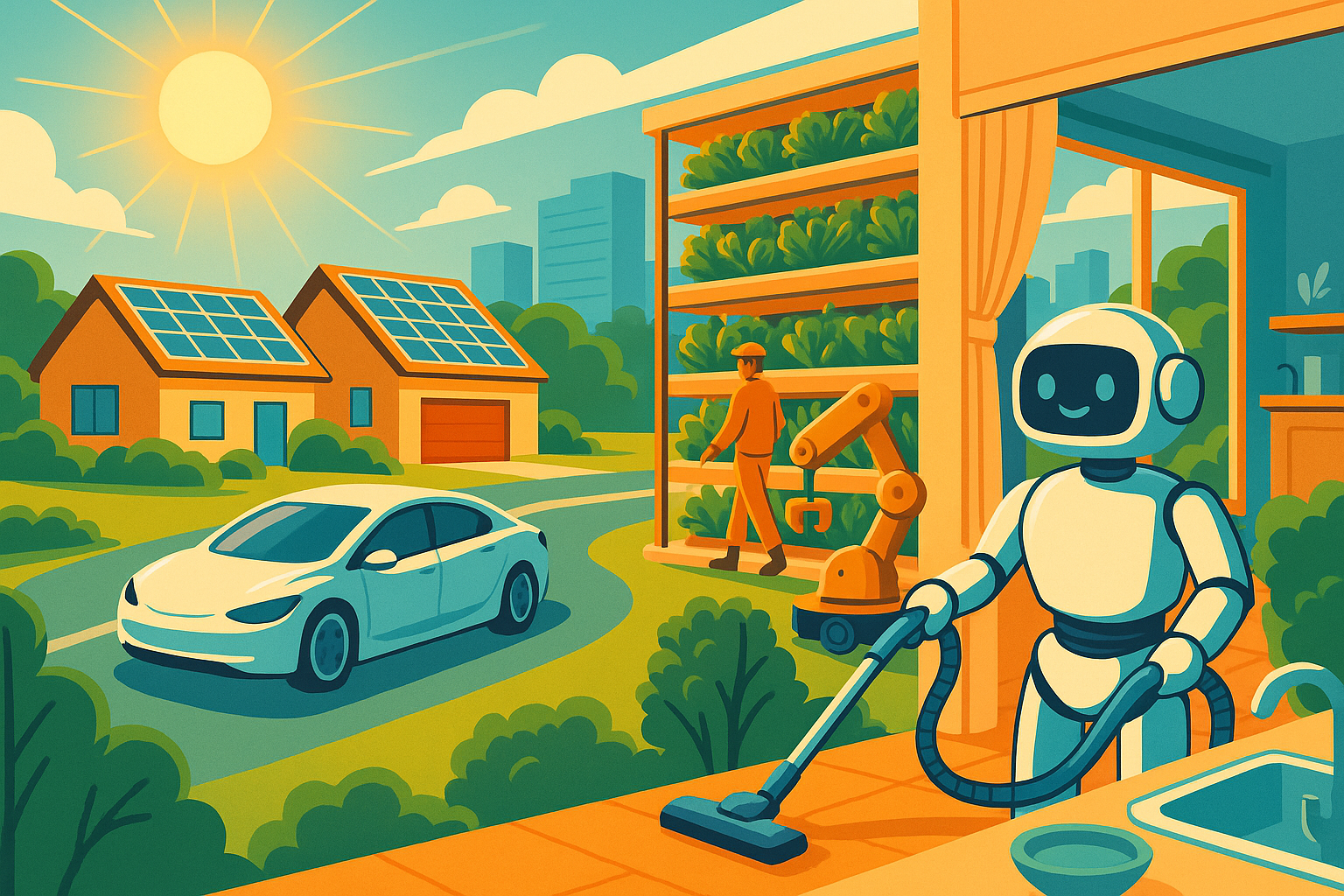
Vehicles powered by sunlight travel millions of miles without a drop of gasoline.
Food is grown in urban warehouses, stacked four stories high and managed by a handful of people—thanks to intelligent machines—making fresh lettuce cheaper than a bag of chips.
In your home, robots built to serve your family clean the floors, do the dishes, and handle the chores, freeing you up to focus on meaningful work that improves lives and communities.
This isn’t sci-fi. It’s a beautiful, achievable future. And it’s already knocking on the door.
The Human Element: Ingenuity Unleashed
Here’s where it gets really interesting: this future isn’t about technology replacing human effort—it’s about technology amplifying human potential. When robots take care of the dangerous, repetitive, and mind-numbing tasks, our creativity and problem-solving can finally be unleashed on the problems that actually matter.
Picture a world where engineers aren’t spending their days tweaking efficiency margins, but instead working on climate solutions, deep space exploration, or designing art that stirs the soul. When intelligent machines take care of survival, humanity is freed to focus on growth, purpose, and meaning. We finally get to act like a civilization instead of a species scrambling for resources.
And this shift isn’t just for the privileged. In a world where capability is democratized, the playing field starts to level. A kid from Kolkata with a laptop and grit can build something world-changing just as easily as a kid from Seattle. Access to opportunity will no longer be dictated by zip code, social class, or infrastructure—it’ll be driven by imagination, perseverance, and the tools that are now available to almost anyone.
The limits we’ve lived with for centuries—geography, wealth, infrastructure—start to fade. And what we’re left with is a new kind of possibility: one where greatness isn’t reserved for the few, but open to the many.
The sky won’t just be the limit—it’ll be the launching pad.
The Path Forward: From Scarcity to Abundance
The transition won’t happen overnight, and it won’t be without a fight. Entrenched industries will resist, governments will fumble to reinvent their tax codes, and certain folks will cling to the scarcity model like a security blanket soaked in nostalgia and lobby money.
But the momentum is undeniable. When solar becomes cheaper than coal, when self-driving trucks slash delivery costs, when AI systems eliminate waste from farm to factory, the old world begins to crack. The idea of managing lack becomes laughable in a world overflowing with capacity.
Even global institutions are catching on. The World Economic Forum, the United Nations, and more are aligning their 2030 development agendas around this very idea: that sustainable abundance isn’t just morally right or technologically possible—it’s economically inevitable. The winners of the next decade won’t be the biggest or loudest. They’ll be the ones that adapt the fastest.
As we navigate 2025, still seeing families forced to choose between heating and eating—while literally sitting on top of vast energy potential—we’re watching the last gasp of a system that’s run its course. A system so obsessed with control that it forgot how to serve.
But that’s changing. Fast. The vision coming out of labs, classrooms, basements, and bold boardrooms isn’t theoretical—it’s operational. It’s live. And it’s reshaping the way we think about work, value, growth, and human dignity.
We’re shifting from:
- Scarcity to surplus
- Gatekeeping to open systems
- Fear-based decisions to opportunity-based design
For the young person who’s stopped dreaming of ever owning a home, this new era offers AI-designed, robot-built dwellings that cost less than your annual phone bill. For the family crushed by energy bills, it offers systems so efficient and overbuilt that the very idea of “usage fees” starts to look like a joke from a previous century.
The question is no longer if sustainable abundance is possible. It’s already happening—right now.
Some questions I leave with you, and I believe need to be asked with urgency:
- Will we rethink the institutions still designed to ration what no longer needs to be rationed?
- Will we update our laws, our economies, and our politics to reflect the realities our engineers have already built?
- Will we have the courage to let go of a world shaped by struggle—and build one grounded in stewardship?
- Will we trust ourselves to lead with generosity, once survival is no longer the baseline?
- And when the grind finally ends—what becomes of the human spirit, set free at last?
The reports of scarcity’s necessity have been greatly exaggerated. The new era isn’t on the horizon—it’s shimmering right in front of us. The future isn’t just abundant—it’s becoming inevitable.
If we’re brave enough to build it, will we be wise enough to share it?
 Notes Beyond the Map
Leave a comment