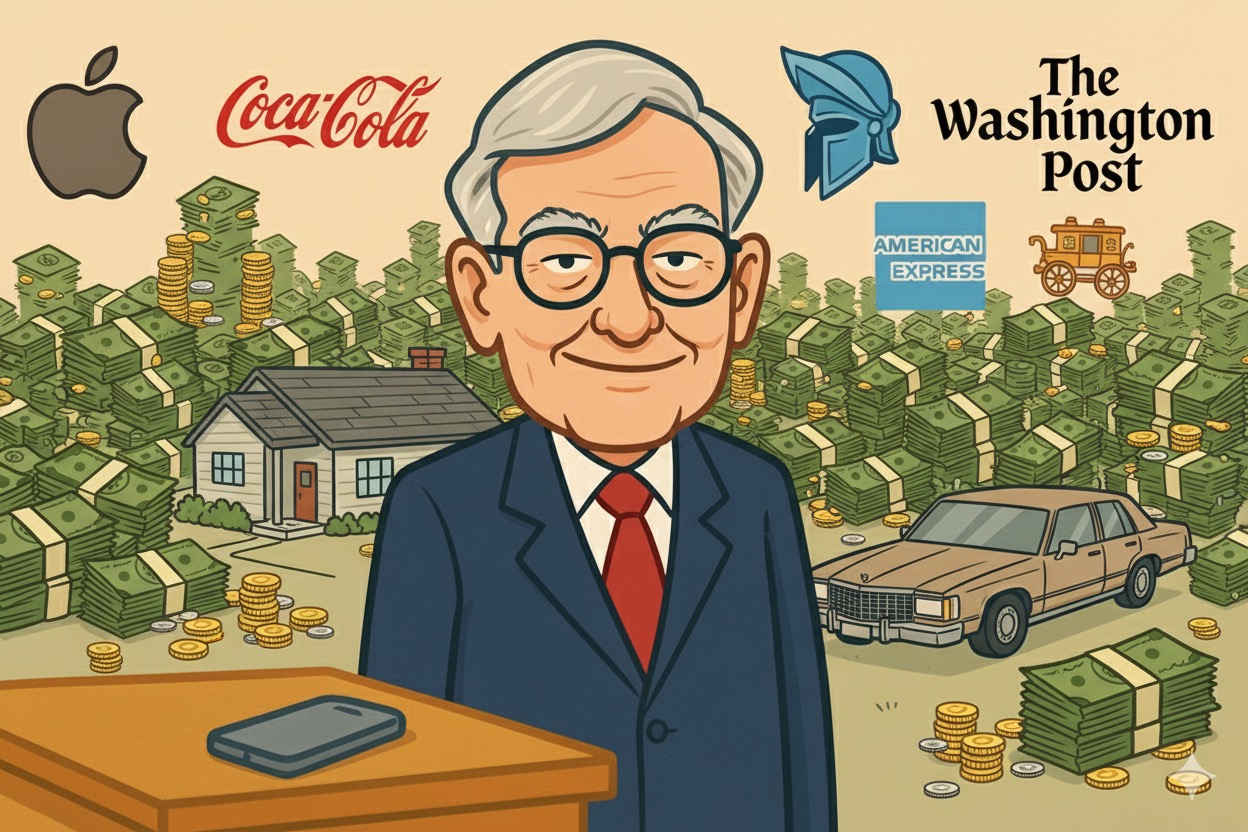
Warren Edward Buffett—the sage of Omaha, the Oracle of compound interest, the man who transformed modest early investments into a fortune that could buy small nations—has sent fewer emails than your grandmother. And yet, this analog fossil just pulled off the most ironic investment coup of the century.
But here’s the delicious irony: the greatest tech investor of all time doesn’t know a microchip from a poker chip, has sent fewer emails than digits on his hands, and didn’t even own an iPhone until 2018. Yet somehow, this analog fossil in a digital world just pulled off the most spectacular tech trade in market history—a $127 billion masterpiece painted with the brush of beautiful contradiction.
The Berkshire Phenomenon: 5,500,000% and Counting
Let’s pause here and genuflect before that number: 5,500,000%. That’s not a typo—that’s what happens when you rode alongside Warren from the beginning of his Berkshire journey. When he first bought shares at $7.50 in December 1962, few could have imagined that a single share would eventually be worth over $400,000. Early believers who invested even modest amounts became multimillionaires many times over.

This wasn’t luck. This wasn’t timing. This was Benjamin Graham’s value investing principles refined through the crucible of Buffett’s peculiar genius—buying wonderful companies at fair prices, then sitting on them like a patient spider waiting for the market to recognize their true worth.
The Washington Post in the 1970s? $11 billion—brilliant. Bank of America? $13 billion—masterful. Coca-Cola? $20 billion—pure poetry in carbonated form. Yet even the man who seemed immortal at compounding wasn’t immune to stubbed toes: IBM, a $10.7 billion swing and miss; the airlines, a turbulent ride to nowhere; Kraft Heinz, proof that even ketchup kings can sour. The lesson? Buffett’s bruises weren’t fatal—they were reminders of discipline. He admitted mistakes quickly, never let pride write the next check, and lived to compound another day.
The Apple Paradox: Teaching an Old Dog Digital Tricks
But Buffett’s genius wasn’t just multiplying money—it was spotting monopolies before the rest of the world caught on. Which brings us to Apple: the deal that rewrote his own rulebook. It’s the story that turned Buffett from a mere mortal investor into a figure of market folklore. At the spry age of 86—two decades past the age most people retire—he greenlit the greatest public market tech investment in history.
The setup reads like a financial fairy tale. In 2016, Berkshire’s portfolio managers Todd Combs and Ted Weschler approached their boss with an idea so audacious it bordered on the absurd: let’s bet $36 billion on Apple. Not just any tech company, mind you, but the very epitome of the digital revolution that Buffett had spent decades avoiding like a Victorian gentleman avoiding ankle exposure.
Buffett’s tech phobia was legendary, almost a running gag in financial circles. This was the man who once compared semiconductors to the “mating habits of Polish beetles,” yet somehow greenlit the biggest tech trade of all time. It was like your granddad thrashing Magnus Carlsen at chess after losing track of the pawns. For decades, he insisted he couldn’t value Amazon (too complicated), Google (too unpredictable), or Microsoft (too conflicted, thanks to his friendship with Bill Gates).
Yet here was Apple, and suddenly the old dog learned the most profitable new trick of his career.
The Monopoly Whisperer
What Buffett lacked in technological sophistication, he more than compensated for with an almost supernatural ability to recognize monopolies and economic moats. While he couldn’t tell you how an iPhone processes data, he could instantly grasp the psychological prison it creates for its users.
“You become a sticky consumer,” explained Ted Weschler, one of the architects of the Apple play. Once you’re trapped in the ecosystem—with your photos in iCloud, your apps carefully arranged, your muscle memory trained to iOS—switching becomes not just inconvenient but psychologically traumatic.
This was Buffett’s sweet spot: not the technology itself, but the human behaviour it created. Apple wasn’t just selling phones; it was selling addiction, habit, and digital dependency wrapped in elegant aluminum. The company had built the most beautiful prison in corporate history, and customers were queuing up to lock themselves inside.
By 2018, Buffett had backed up the proverbial Brinks truck, loading $36 billion into Apple. The stake would eventually peak at $178 billion in December 2023—a position so large it represented roughly 6% of Apple’s entire market capitalization.
The Tim Cook Connection: When CEOs Become Wealth Partners
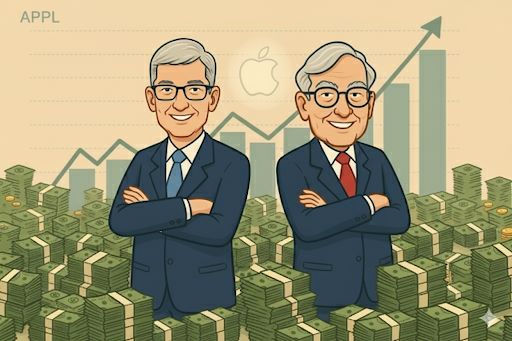
The relationship between Buffett and Apple CEO Tim Cook exemplifies something deeper than mere investor relations—it’s a masterclass in how great capital allocation creates compound wealth. When Cook cold-called Buffett in 2012 seeking advice on Apple’s growing cash pile, the Oracle’s response was characteristically direct: “If you believe your stock is undervalued, you should buy your stock.”
This simple advice launched Apple’s historic buyback program—over $700 billion in share repurchases that continuously increased Berkshire’s ownership percentage without costing Buffett a penny. It was financial alchemy at its finest: Apple’s capital allocation strategy was literally making Berkshire richer by the quarter.
The ultimate compliment came in 2025 when Buffett admitted, “I’m somewhat embarrassed to say that Tim Cook has made Berkshire more money than I’ve ever made for Berkshire Hathaway.” This from a man who built a trillion-dollar empire.
The Perfect Exit
But perhaps the most impressive aspect of Buffett’s Apple odyssey isn’t the entry—it’s the exit. In 2024, with the prescience that has defined his career, Buffett began unloading two-thirds of Berkshire’s Apple position, realizing roughly $90 billion in gains at what increasingly looks like the perfect moment.
The timing appears supernatural in hindsight. Apple now faces a trinity of challenges that would terrify lesser investors: escalating US-China tensions threaten the company’s manufacturing base, antitrust pressure targets the App Store monopoly, and innovation has stalled with the Vision Pro disaster and fumbled Apple Intelligence rollout.
Even Apple’s own executives seem nervous. SVP Eddy Cue recently suggested in court testimony that “you may not need an iPhone in 10 years from now as crazy as that sounds.” When your own executives are questioning the permanence of your most profitable product, it might be time to book profits.
The Coca-Cola Classic: When Addictive Products Meet Forever Holdings
But Apple wasn’t Buffett’s first dance with addictive consumer products. That honour belongs to a trade so perfect it should be taught in business schools alongside case studies of military strategy: the Coca-Cola acquisition of 1988-1989.
Picture this: It’s 1987, and Coca-Cola stock has just crashed 25% following Black Monday. While other investors were nursing their wounds and questioning the stability of consumer stocks, Buffett saw something different—a company that had trained the human race to crave sugar water at a profit margin that would make drug cartels envious.
Buffett began accumulating Coca-Cola shares for an average price of about $2.50 per share (split-adjusted). His total investment? A relatively modest $1.3 billion. By the time the position peaked, it was worth over $25 billion—nearly a 20x return that generated more than $700 million in annual dividends alone.
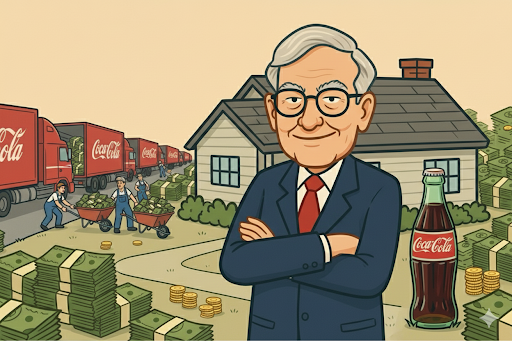
The genius wasn’t in the timing (though buying after a crash helped); it was in recognizing the permanence of the moat. While Peter Lynch was hunting for the next big growth story and other investors were chasing trendy stocks, Buffett understood that Coca-Cola had achieved something nearly impossible in capitalism: global brand dominance that improved with time rather than eroded by competition.
“I can understand Coca-Cola,” Buffett said with characteristic understatement. What he understood was that humans had been conditioned over decades to associate happiness, refreshment, and social connection with a particular taste that only one company could deliver legally.
The Five Buffett Secrets: What Made the Oracle Different
While his investing peers were busy being brilliant in predictable ways, Buffett cultivated five practices that would seem counterintuitive to most financial minds—and downright heretical to the hedge fund crowd.
1. The Art of Strategic Indolence
While Carl Icahn was rattling boardrooms and Bill Ackman was crafting elaborate activist presentations, Buffett perfected what he calls “aggressive inactivity.” His investment philosophy wasn’t just buy-and-hold; it was buy-and-hibernate.
“Lethargy bordering on sloth remains the cornerstone of our investment style,” he once wrote, in what might be the only instance where laziness was rebranded as genius. When most fund managers were making hundreds of trades per year, Buffett would make perhaps a dozen major moves per decade. This wasn’t procrastination—it was compound interest in human form.
2. Reading Like a Machine, Thinking Like a Human
Here’s what might shock you: Buffett reads 500+ pages daily—more than most PhD candidates. But unlike Peter Lynch, who visited companies obsessively, or the modern quant funds with their algorithmic models, Buffett’s research method is decidedly analog. He sits in his Omaha office, reading annual reports like bedtime stories, newspapers like sacred texts, and trade publications like mystery novels.
No Bloomberg terminals. No complex financial models. No armies of analysts. Just a man, a chair, and an insatiable appetite for understanding how businesses actually make money.
3. The Anti-Networking Philosophy
While other investment legends were schmoozing at Sun Valley conferences or dining with CEOs, Buffett cultivated what we might call “productive hermitism.” He deliberately avoided the Wall Street social circuit, choosing instead to operate from Nebraska—about as far from the financial epicenter as you can get without leaving the continental United States.
This geographical isolation wasn’t accidental; it was strategic. Distance from the market’s daily hysteria allowed for the kind of long-term thinking that made his Apple trade possible. While others were reacting to quarterly earnings beats and Twitter rumors, Buffett was contemplating what the world would look like in 2030.
But perhaps most remarkably, despite amassing a personal fortune worth roughly $130 billion, Buffett still lives in the same modest Omaha house he bought in 1958 for $31,500. He drives simple cars (his current ride is a 2014 Cadillac XTS), eats at local diners, and maintains a lifestyle that wouldn’t seem out of place for a successful middle manager.
This isn’t performative frugality—it’s philosophical consistency. Buffett understands that wealth’s power isn’t in consumption but in compound growth and societal impact. Which explains his ultimate plan: through the Giving Pledge, he’s committed to donating 99% of his wealth to charitable causes, primarily through the Gates Foundation. He’s not accumulating billions to buy islands or rockets; he’s building a war chest for humanity’s biggest challenges.
As he puts it with characteristic wit: “I can’t eat more than one steak at a time, or wear more than one suit at a time.” The man who taught the world about compound interest is applying the same principle to philanthropy.
4. The Price Anchoring Superpower
Here’s a practice that separates Buffett from growth investors like Peter Lynch or momentum players: he never pays retail for anything, including stocks. While Lynch famously bought stocks of companies whose products he encountered in daily life (Dunkin’ Donuts, Hanes), Buffett insisted on buying wonderful companies only when they were on sale.
This created a paradox: the more successful a company became, the less interested Buffett often was in owning it. While Bill Ackman might pay premium prices for “high-quality” businesses, Buffett would rather wait years for Mr. Market to offer him a discount on excellence.
5. Teaching While Investing
Perhaps most surprisingly, Buffett turned investor education into a competitive advantage. While his contemporaries hoarded insights like state secrets, Buffett broadcast his entire investment philosophy through annual shareholder letters that read like masterclasses in business analysis.
This transparency would seem self-defeating—why teach your competitors your secrets? But Buffett understood something profound: most people can’t execute what they intellectually understand. Knowing the principles of diet doesn’t make you thin; knowing value investing doesn’t make you rich. The execution gap is everything.
His annual letters became the most widely-read documents in finance, creating a cult of personality that actually benefited Berkshire. CEOs wanted to sell to him because of his reputation for fairness and permanence. The best companies came to Buffett because they knew he’d be a partner, not a predator.
The End of an Era
Buffett is retiring at what may well be Berkshire’s peak—a $1.1 trillion colossus with $350 billion in cash, waiting like a coiled spring for the next market dislocation. His successor, Greg Abel, is undoubtedly competent, but let’s be honest: lightning doesn’t strike twice in the same cornfield. The days of discovering the next Warren Buffett, of turning $1,000 into generational wealth through a single stock pick, are likely over.
The Oracle’s retirement marks the end of an investing era that began when Eisenhower was president and television was still a novelty. It’s the conclusion of a story so improbable that if you pitched it as fiction, editors would reject it for being too far-fetched: a Nebraska insurance salesman who became the world’s greatest investor by refusing to invest in anything he couldn’t understand, then capped his career with a tech trade so brilliant it redefines what “understanding” means.
Warren Buffett proved that wisdom beats intelligence, patience conquers complexity, and sometimes the best way to navigate the future is to stick religiously to principles forged in the past. While his legendary peers—Icahn with his boardroom theatrics, Lynch with his mall-walking research, Ackman with his PowerPoint presentations—each found their own path to greatness, Buffett’s path was uniquely contrarian: he got rich by doing less, not more.
He leaves behind more than just wealth—he leaves a philosophy, a methodology, and a reminder that in a world obsessed with the next big thing, the biggest thing of all might just be the discipline to wait for the right pitch. His five unconventional practices—strategic laziness, analog research, geographical isolation, price discipline, and radical transparency—created a template that countless investors have tried to copy but few have successfully executed.
The Oracle has spoken his final earnings call. The stage is empty. The compound interest keeps compounding. And somewhere in Omaha, a man who never loved technology retires as the greatest tech investor of them all.
What a ride it’s been.
 Notes Beyond the Map
Leave a comment