So it goes.
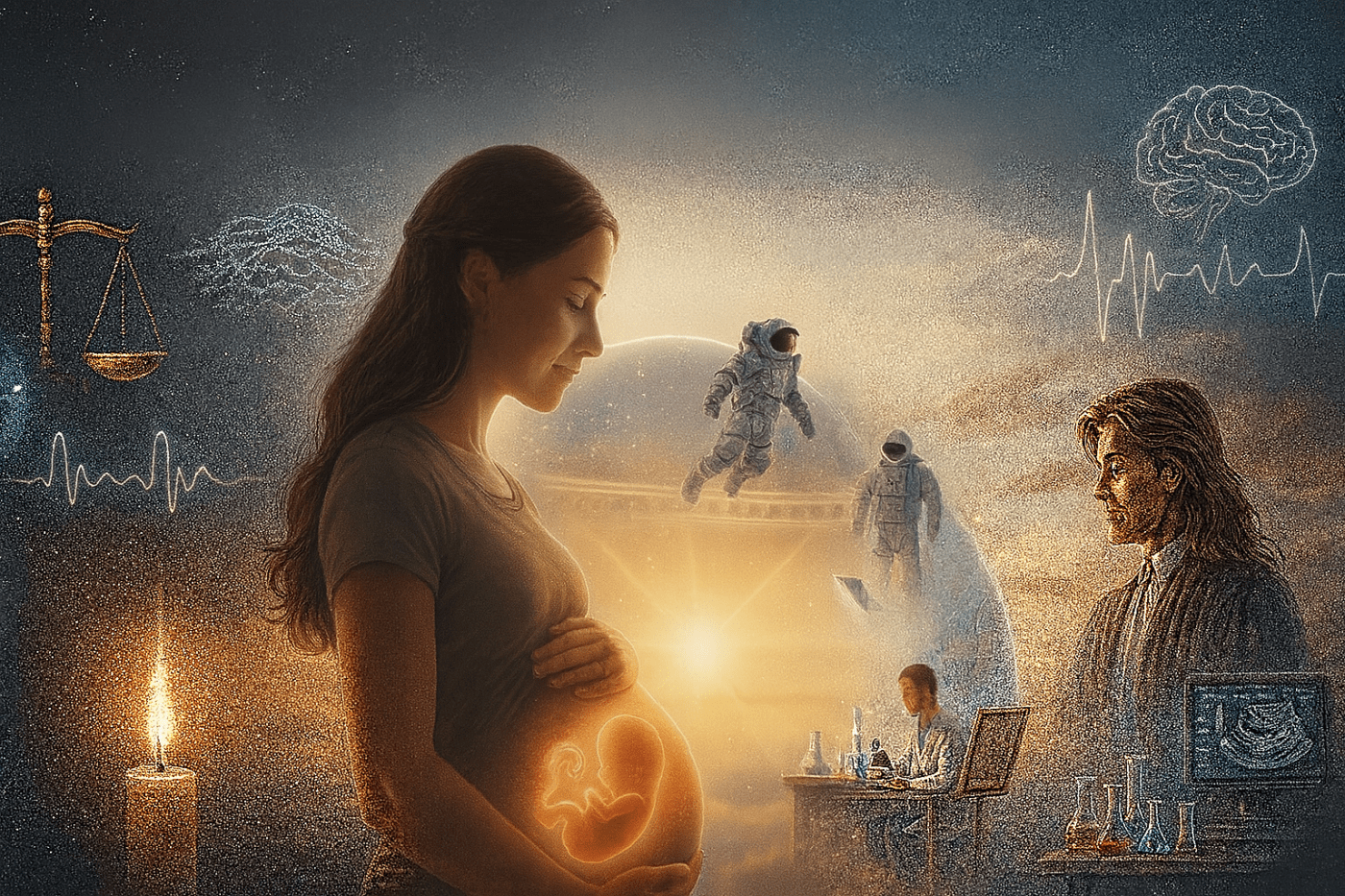
This question became more than academic for me earlier this year when my wife and I discovered we were expecting our first child. In those initial weeks, there was nothing visible—no bump, no obvious signs of the profound transformation occurring within her body. Yet something extraordinary was happening: a collection of cells no bigger than a poppy seed was beginning the most remarkable journey in human experience.
Now, seven months later, I watch my wife’s belly move with the restless energy of our developing child. I’ve seen the progression through ultrasounds—from that first grainy image where we had to squint to make out anything recognizably human, to the detailed scans showing fingers, toes, a beating heart, and a face that already seems to have my nose. I’ve felt the kicks grow stronger, watched as what was once imperceptible became undeniably present. The child who was invisible at six weeks now responds to my voice, moves when music plays, and keeps his mother awake with what can only be described as personality already asserting itself.
This personal journey has given urgency to questions I once considered abstractly. If my parents had decided to terminate their pregnancy with me, would that have been fair? Would I have had any say in the matter? Of course, they never considered such a thing, but millions of others face this decision daily. When exactly did I become worthy of protection? When did my life become my own rather than merely an extension of my mother’s body? Was it at conception, when my unique genetic code was established? At the first heartbeat? When consciousness emerged? Or only at birth, when I drew my first independent breath?
These aren’t merely philosophical puzzles—they have profound implications for how we structure our laws, order our society, and understand our obligations to one another. Here we are again, wrestling with questions that have plagued humanity since we first developed the curious habit of thinking too much for our own good. When does a human being become, well, human? It’s the sort of question that makes philosophers rich and politicians nervous, the kind that turns dinner parties into battlefields and transforms reasonable people into passionate advocates for positions they’d never considered before breakfast.
The answer, if there is one, lies somewhere in the murky intersection of biology, law, philosophy, faith, and that peculiar human tendency to assign meaning to the meaningless and strip meaning from the profound.
The Scientific Testimony
Science, that supposed arbiter of truth, offers us a smorgasbord of milestones, each one potentially marking the moment when a collection of cells becomes something we might call human. It’s rather like asking when a caterpillar becomes a butterfly—the process is continuous, but we insist on finding discrete moments for our peace of mind.
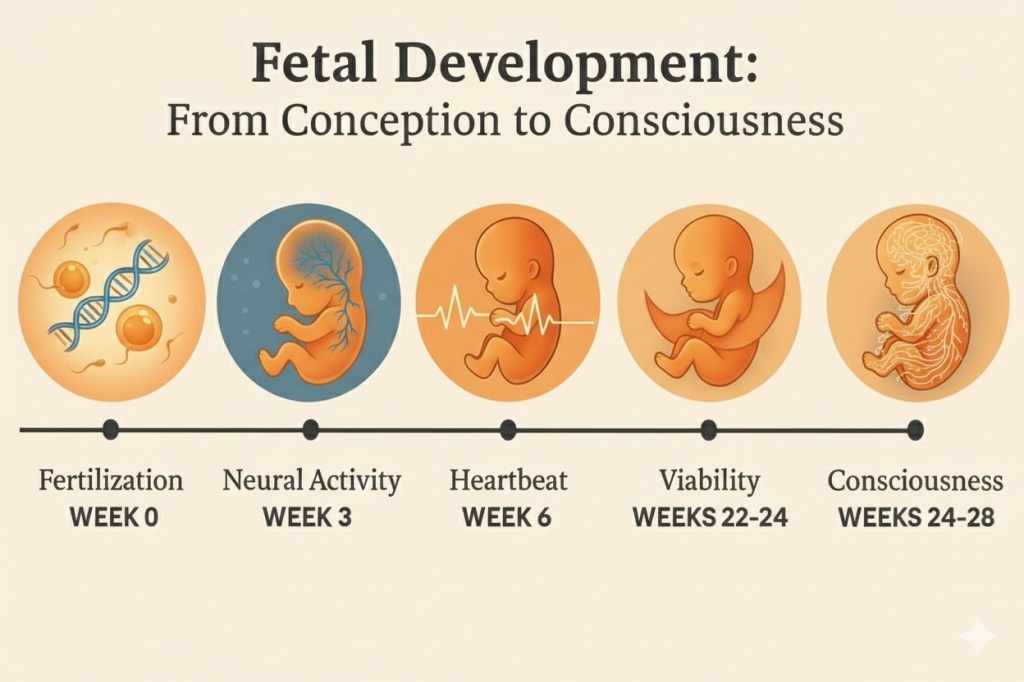
Fertilization presents the first candidate. Here we have the formation of a unique genetic code, a biological lottery ticket containing instructions for brown eyes or blue, musical talent or tone-deafness, a tendency toward optimism or that particularly human gift for existential dread. The DNA is complete, the blueprint finalized. Some argue this is humanity’s entrance exam—passed with flying colors at day one.
From the moment sperm meets egg, something remarkable occurs: the creation of a genetically distinct organism with its own biological trajectory. This isn’t merely tissue belonging to the mother—it’s a separate entity with its own blood type, its own gender (often different from the mother’s), and its own unique cellular programming. The science here is unambiguous: this is a living organism, it is growing, and it is unquestionably human in its genetic composition.
Neural activity emerges around week three, when the first electrical whispers begin in what will become a brain. It’s a humble beginning—less consciousness than the average houseplant displays, but it’s something. The nervous system starts its long journey toward complexity, though at this stage, calling it consciousness would be generous.
The heartbeat follows at roughly week six, that rhythmic drumbeat that poets have long associated with the essence of life itself. Modern ultrasound technology makes this heartbeat visible and audible, forcing us to confront the reality of what we’re discussing. Yet hearts can beat in bodies that will never think, never dream, never wonder why they exist. The heart, for all its symbolic weight, is ultimately just a pump—remarkable engineering, but hardly the seat of humanity.
Brain waves appear around week eight, detectable patterns of electrical activity that suggest something more sophisticated than reflexes. Here we begin to approach the territory that makes us pause, the region where philosophy meets neuroscience and both admit their limitations.
Viability arrives somewhere between weeks 22-24, that point where medical technology can sustain life outside the womb. It’s a moving target, shifting with each advance in neonatal care. What couldn’t survive in 1970 routinely thrives today, making this milestone as much about human innovation as human development.
Consciousness—now there’s the rub. When does awareness dawn? When does the capacity for experience, for joy and suffering, emerge from the neural networks? Science offers educated guesses: perhaps around week 24-28, when the thalamic connections necessary for conscious experience begin forming. But consciousness remains stubbornly difficult to measure, even in fully grown adults who insist they possess it.
The Legal Landscape
Laws, those imperfect human attempts to codify morality and maintain order, offer their own curious perspective on the question. Like all human institutions, they’re messy, inconsistent, and shaped more by politics than philosophy.
Roe v. Wade established viability as the legal threshold in the United States, though it did so while acknowledging the impossibility of answering the underlying question definitively. The decision was less about when life begins and more about when the state’s interest in protecting that life becomes compelling enough to override other considerations. Notably, the Court sidestepped the fundamental question, stating: “We need not resolve the difficult question of when life begins.”
The Born-Alive Infant Protection Act makes it clear that once born, regardless of the circumstances of birth, legal personhood is established. It’s a bright line in the legal code, though biology recognizes no such sharp distinctions. The absurdity becomes apparent when considering that a 24-week-old baby born prematurely has full legal protection, while a 24-week-old fetus in the womb may have none.
Fetal homicide laws in many jurisdictions recognize unborn children as victims of crime, creating an interesting legal paradox where the same entity might simultaneously have and lack legal protection depending on who causes its death. If a drunk driver kills a pregnant woman and her unborn child, he’s charged with double homicide. If a doctor performs an abortion on the same child, it’s a legal medical procedure.
International perspectives vary wildly. Some nations allow elective abortion up to 24 weeks, others restrict it to cases of rape, incest, or maternal health, and still others prohibit it entirely. These differences suggest less about biological truth and more about cultural values and political power.
The law’s relationship with this question reveals something profound about human nature: we desperately want clear answers to questions that may not have them, and we’ll create them where none exist rather than live with ambiguity.
The Philosophical Battleground
Philosophy, that ancient art of making simple questions impossibly complex, offers numerous frameworks for approaching personhood. Each comes with its own implications, its own uncomfortable conclusions.
Gradualism suggests that becoming human is a process, not an event. Like watching the sunrise, there’s no precise moment when night becomes day, only a gradual transition. This view comports with biological reality but frustrates our desire for clear moral boundaries. Yet gradualism faces a serious challenge: at what point in the gradual process does killing become murder? If there’s no clear line, how do we make moral decisions?
The consciousness criterion places the threshold at the emergence of subjective experience. If what makes us human is our capacity for awareness, for suffering and joy, then unconscious life—however genetically human—lacks moral status. It’s a compelling argument with troubling implications for those in comas, those with severe cognitive disabilities, sleeping college students, and indeed, newborn infants whose consciousness is barely more developed than late-term fetuses.
The potential argument suggests that what matters is not current capacity but future possibility. An acorn isn’t an oak tree, but it contains the inherent potential to become one. This view sees moral weight in possibility itself, in the trajectory rather than the current state. Critics argue that potential isn’t actual, but this misses the point: human potential represents something unique and irreplaceable.
The species criterion argues that membership in Homo sapiens alone confers moral status. It’s elegantly simple and avoids the messy questions of consciousness and capacity, but it struggles with edge cases and seems to confuse biological categories with moral ones. Yet perhaps this apparent weakness is actually strength—perhaps being human is enough.
The Sacred Dimension
Religious traditions bring their own perspectives, often emphasizing aspects that pure materialism overlooks. These views deserve serious consideration, regardless of one’s personal faith, because they’ve shaped human understanding for millennia and continue to influence billions of people worldwide.
Judeo-Christian tradition offers various perspectives, though closer examination reveals more consistency than initial appearances suggest. The Hebrew concept of nephesh in Genesis describes God breathing life into Adam, but this refers to the creation of the first human, not the reproduction of subsequent ones. When the same tradition speaks of God knowing us “in the womb” (Psalm 139) and calling prophets “before I formed you in the womb” (Jeremiah 1:5), it suggests divine recognition of individual humanity before birth.
The Christian tradition has generally held that human life begins at conception. Early church fathers like Tertullian wrote, “He is a man, who is to be a man; the fruit is always present in the seed.” This position sees each human conception as a divine act of creation, making every embryo sacred regardless of its developmental stage.
Catholic teaching explicitly holds that ensoulment occurs at conception, making every fertilized embryo sacred. Pope John Paul II’s encyclical Evangelium Vitae states: “Human life is sacred because from its beginning it involves the creative action of God.” This position has profound implications for everything from assisted reproduction to embryonic research, but it offers moral clarity in an area of widespread confusion.
Protestant denominations vary in their specific positions, but many share the conviction that human life begins at conception. The Southern Baptist Convention, the Lutheran Church-Missouri Synod, and numerous evangelical denominations have taken strong pro-life positions based on biblical interpretation and theological reasoning.
Islamic jurisprudence traditionally places ensoulment at 120 days, though some interpretations suggest earlier moments. The concept of ruh (soul) entering the developing child marks the transition to full human status. However, some Islamic scholars argue for earlier ensoulment, and most agree that even before 120 days, the developing life deserves significant protection.
Eastern traditions bring concepts of reincarnation and karmic continuation, suggesting that consciousness might precede conception rather than emerge from it. These perspectives add another layer of complexity to questions about when life begins and what constitutes humanity.
These religious perspectives remind us that human life involves more than biological processes—it touches on questions of meaning, purpose, and transcendence that science alone cannot address. They also suggest that the question of when life begins has been considered sacred across cultures and throughout history.
The Uncomfortable Questions
Here’s where things get particularly thorny, where comfortable assumptions meet inconvenient realities.
If consciousness makes us human, what do we make of those who temporarily lack it? If genetic uniqueness matters, how do we account for identical twins? If viability is the standard, does improving medical technology continuously expand the realm of the morally significant?
The comparison to historical atrocities, while emotionally charged, raises serious questions about moral consistency. Since 1973, over 60 million abortions have been performed in the United States alone. Worldwide, the number reaches into the hundreds of millions. How do we account for this scale? How do we weigh the rights of the developing against the rights of the developed? How do we balance potential life against actual life, future possibility against present reality?
And then there’s the question that haunts all discussions of abortion: the matter of intention. The same embryo might be desperately wanted by infertile parents while being equally unwanted by someone unprepared for parenthood. Does human worth fluctuate with human desire? Does biology become morality only when filtered through intention?
Consider the logical implications of various positions. If location determines humanity (inside versus outside the womb), then a baby born prematurely is somehow more human than a fetus of the same age still in utero. If dependency determines humanity, then newborns, the severely disabled, and the elderly lose their claim to life. If consciousness determines humanity, then those in comas, under anesthesia, or in deep sleep become temporarily non-human.
Each criterion we establish to justify abortion creates uncomfortable precedents for other areas of human life. The only criterion that doesn’t lead to such complications is the simplest one: genetic humanity from conception.
The Political Dimension
Politics, that least noble of human endeavors, has thoroughly colonized this question, turning scientific inquiry into partisan warfare and moral philosophy into campaign strategy. Both sides deploy selective evidence, cherry-picked studies, and emotional appeals while claiming exclusive access to truth.
Pro-choice advocates emphasize bodily autonomy, the distinction between potential and actual persons, and the practical realities facing women with unwanted pregnancies. They point to back-alley procedures, maternal mortality, and the socioeconomic factors that make parenthood devastating rather than joyful. Their arguments often focus on the born versus the unborn, the actual versus the potential.
Pro-life advocates focus on the inherent dignity of developing human life, the precautionary principle in the face of uncertainty, and the moral obligations that come with sexual activity. They point to ultrasound images, developmental milestones, and the adoption alternative. Their arguments emphasize the continuity of human life from conception to natural death.
Each side accuses the other of ulterior motives—population control versus patriarchal control, convenience versus religious extremism. The truth is likely more prosaic: most people on both sides genuinely believe they’re defending something precious and under threat.
However, the political dimension has introduced distortions that obscure rather than clarify the central questions. When abortion becomes primarily a political issue rather than a moral one, the focus shifts from truth-seeking to victory-achieving.
The Global Context
Worldwide, we see an interesting pattern. Nations with declining birth rates often liberalize abortion access while simultaneously implementing policies to encourage childbearing. Nations with growing populations often restrict it while struggling to provide for existing children. The relationship between reproductive policy and demographic reality suggests that positions on life’s beginning may be influenced by calculations about life’s continuation.
China’s one-child policy led to sex-selective abortions and a generation of missing girls, demonstrating how abortion can become a tool of social engineering with devastating consequences. Ireland’s restrictive laws were overturned after decades of women traveling to Britain for procedures, showing how legal restrictions don’t eliminate abortion but merely relocate it. Poland’s recent restrictions have sparked massive protests, illustrating the deep divisions that exist even within traditionally Catholic societies.
These cases suggest that abstract philosophical positions meet practical political realities with unpredictable results. They also demonstrate that abortion is never merely a private decision but has profound social and demographic consequences.
The Technology Factor
Modern technology complicates every aspect of this question while simultaneously clarifying others. Ultrasounds make the developing child visible in unprecedented detail, forcing confrontation with the humanity of what previous generations could only imagine. When expectant parents see their child moving, sucking its thumb, or apparently responding to sounds, the question of humanity becomes less abstract.
Genetic testing reveals abnormalities that previous generations would never have known about, leading to selective terminations based on conditions like Down syndrome. This raises uncomfortable questions about which humans we’ll accept and which we’ll reject based on genetic perfection.
Artificial wombs may soon make viability independent of gestational age, potentially eliminating the viability criterion altogether. If we can sustain life from conception to full development outside the natural womb, does this change our moral calculations?
Genetic engineering raises questions about which humans we’ll design and which we’ll discard. If we can edit genes to prevent diseases, will we also edit them to prevent “undesirable” traits?
Each technological advance shifts the moral landscape in subtle but significant ways. When we can see the fetal heartbeat at six weeks, does that change our moral calculations? When we can detect genetic abnormalities at ten weeks, does that obligate us to act on that information? When we can sustain life at ever-earlier stages, does that expand our moral obligations?
The Economic Dimension
There’s an uncomfortable truth that rarely gets discussed openly: abortion has become big business. Planned Parenthood, the largest abortion provider in America, performs over 300,000 abortions annually and derives significant revenue from these procedures. The global abortion industry generates billions of dollars in revenue each year.
This creates perverse incentives where organizations that claim to provide “healthcare” profit from preventing births rather than preserving life. When financial interests align with ideological positions, we should be skeptical of claims about purely altruistic motivations.
Similarly, the contraceptive industry benefits from a culture that treats pregnancy as a disease to be prevented rather than a natural biological function. The normalization of abortion serves as insurance for contraceptive failure, reducing pressure for more effective or safer birth control methods.
The Moral Clarity Argument
Perhaps we’ve been overcomplicating a fundamentally simple question. Science tells us unambiguously that human life begins at conception. A unique human organism with its own DNA, its own biological trajectory, and its own inherent dignity comes into existence at fertilization. Philosophy may debate the meaning of personhood, but biology is remarkably clear about the nature of what we’re discussing.
The embryo possesses something remarkable: a complete genetic blueprint, a unique biological identity that will never be repeated in human history, and an inherent trajectory toward full human expression. This isn’t potential humanity—it’s actual humanity at its earliest stage of development.
Consider this: we don’t typically argue that a newborn has less moral worth than a toddler because it cannot walk, or that a ten-year-old matters less than an adult because they cannot yet contribute economically to society. We recognize these as stages in a continuous journey of human development, each deserving protection precisely because of what they will become, not merely what they currently are.
The uncomfortable truth is that every argument used to justify ending life in the womb could theoretically be applied to life outside it. Dependency? Newborns are entirely dependent. Consciousness? It develops gradually over months and years. Viability? Children cannot survive alone until well into their teens. The capacity for suffering? This too develops over time. If these criteria justify ending life before birth, the logical foundation for protecting life after birth becomes surprisingly fragile.
The Continuity of Human Worth
The human potential present in a ten-week embryo is fundamentally the same as that present in a newborn, a ten-year-old, or a twenty-year-old. Each represents a unique human life at a different stage of development. The scientific evidence supports this continuity: from conception forward, we’re dealing with the same organism at different points in its natural development.
When we end that life—at six weeks, twelve weeks, or twenty weeks—we are not merely preventing potential; we are ending an actual human life that simply happens to be at an early stage of development. The question then becomes not whether this is human life—science settles that—but whether we have the moral authority to determine that some human lives matter less than others based on their stage of development, their location, or their level of dependency.
History suggests we should be deeply skeptical of such distinctions, as they have justified our species’ darkest chapters. When we acknowledge that human dignity resides not in current capacity but in inherent nature—not in what we can do, but in what we are—the arbitrary lines we’ve drawn begin to seem less like moral reasoning and more like convenient rationalization.
The Weight of Recognition
The most defensible position may be the simplest: that human life begins when human life scientifically begins, at conception, and that this life deserves the same fundamental protection we extend to human life at any other stage. This position has the virtue of consistency, the support of biological science, and the endorsement of millennia of religious and philosophical tradition.
Perhaps giving another human being the opportunity to experience life—to love, to wonder, to contribute to the world—represents one of the greatest privileges known to humanity, second only to receiving that gift ourselves. When we choose to protect rather than destroy, to nurture rather than eliminate, we participate in the most fundamental act of hope: believing that each new life has something unique and irreplaceable to offer the world.
To kill potential is indeed to kill what is actual—not potential humanity, but actual humanity in its earliest, most vulnerable form. When we recognize this, we don’t diminish the genuine struggles of those facing unwanted pregnancies; rather, we acknowledge that the solution to human problems should not require ending human lives, but finding better ways to support and value both the born and the unborn.
The conversation about when life begins may matter less than the recognition that life, once begun, deserves our protection. Whether at six weeks or sixty years, human life represents something irreplaceable: a unique story that, once ended, can never be told again. Our obligation is not to determine when that story becomes worth preserving, but to recognize that it was worth preserving from the very first chapter.
So it goes—but perhaps it doesn’t have to.
In a world that increasingly treats human life as disposable, perhaps the most radical position is the simplest one: that every human life, from conception to natural death, possesses inherent dignity and deserves protection. This isn’t religious extremism or political ideology—it’s recognition of our common humanity and our obligation to protect the most vulnerable among us, even when they cannot yet speak for themselves.
 Notes Beyond the Map
Leave a comment