What if I told you that the worst chapter of your life was actually the most important one? What if your biggest failures were really just your most expensive education?
Here’s a question that’ll mess with your head: What do Moses, Steve Jobs, and that person you know who seems impossibly resilient have in common? They all got their butts kicked by life before they became legends.
Everyone knows Moses spent forty years leading the Israelites through the desert. That’s Sunday School 101. But here’s what they don’t tell you in those neat little flannel board lessons: Moses spent another forty years in the desert before that—as a young man in Midian, learning the ropes, getting his hands dirty, figuring out how to survive when everything goes sideways.
Eighty years. Eighty years in the wilderness. Those first forty years weren’t wasted time—they were boot camp for the impossibly harder forty years that would follow.
So there I was, wrestling with another challenging stretch in my entrepreneurial journey, when it hit me like a divine two-by-four to the skull: Maybe those past failures and setbacks weren’t detours. Maybe they were preparation.
You see, Moses knew a thing or two about spectacular career pivots. And his story—well, it’s got more plot twists than a soap opera written by a caffeinated theologian.
The Prince Who Had Everything (And Lost It All)
Picture this: Moses, circa 1400 BC, living his best life in the most powerful empire on Earth. We’re talking about a man who had servants for his servants, who probably had gold-plated chamber pots and breakfast served on dishes worth more than most people’s annual income. He was Egyptian royalty, educated in all the wisdom of Egypt, which, at the time, was like having simultaneous degrees from Harvard, MIT, and Juilliard, with a minor in Applied Godhood.
Moses had it made. He could have spent his days lounging by the Nile, ordering around architects to build him bigger pyramids, and generally being the ancient equivalent of a trust fund baby with delusions of grandeur.
But here’s the thing about comfortable situations: they’re about as useful for character development as a chocolate teapot.
God looked down at this pampered prince and thought, “Well, that won’t do at all.” Because God had plans for Moses—plans that involved leading the most stubborn, complainy group of people in human history through forty years of desert camping. And you can’t learn those kind of leadership skills while sipping wine from golden goblets and having your grapes peeled by servants.
The Great Unravelling
Moses’ comfortable world came crashing down faster than a house of cards in a hurricane when he decided to play vigilante justice warrior. He killed an Egyptian taskmaster who was beating a Hebrew slave, and suddenly found himself with the ancient equivalent of a federal manhunt on his hands.
Pharaoh wanted Moses deader than disco, and our former prince found himself running for his life into the wilderness of Midian—trading silk sheets for sand dunes, palace walls for endless sky, and royal feasts for whatever he could scrounge up in the desert.
Talk about your career change.
Forty Years of Divine Preparation (Or: How God Makes Leaders in the Desert)
Now, here’s where the story gets interesting. Moses didn’t just stumble around the desert for forty years eating locusts and talking to himself (though there may have been some of that). No, sir. This was God’s leadership boot camp, and the curriculum was brutal.
- Lesson 1: Humility. Moses went from commanding armies to herding sheep. And let me tell you, sheep don’t care about your royal pedigree. They’ll wander off a cliff just to spite you, and they certainly won’t bow when you enter their presence. Moses learned that real leadership isn’t about the crown on your head—it’s about the calluses on your hands and the wisdom in your heart.
- Lesson 2: Survival Skills. You try navigating the desert for four decades and see if you don’t pick up a few tricks. Moses learned where to find water, how to read the stars, which plants won’t kill you, and how to keep moving when everything looks the same. Pretty handy skills when you’re later leading two million people through that exact same wilderness.
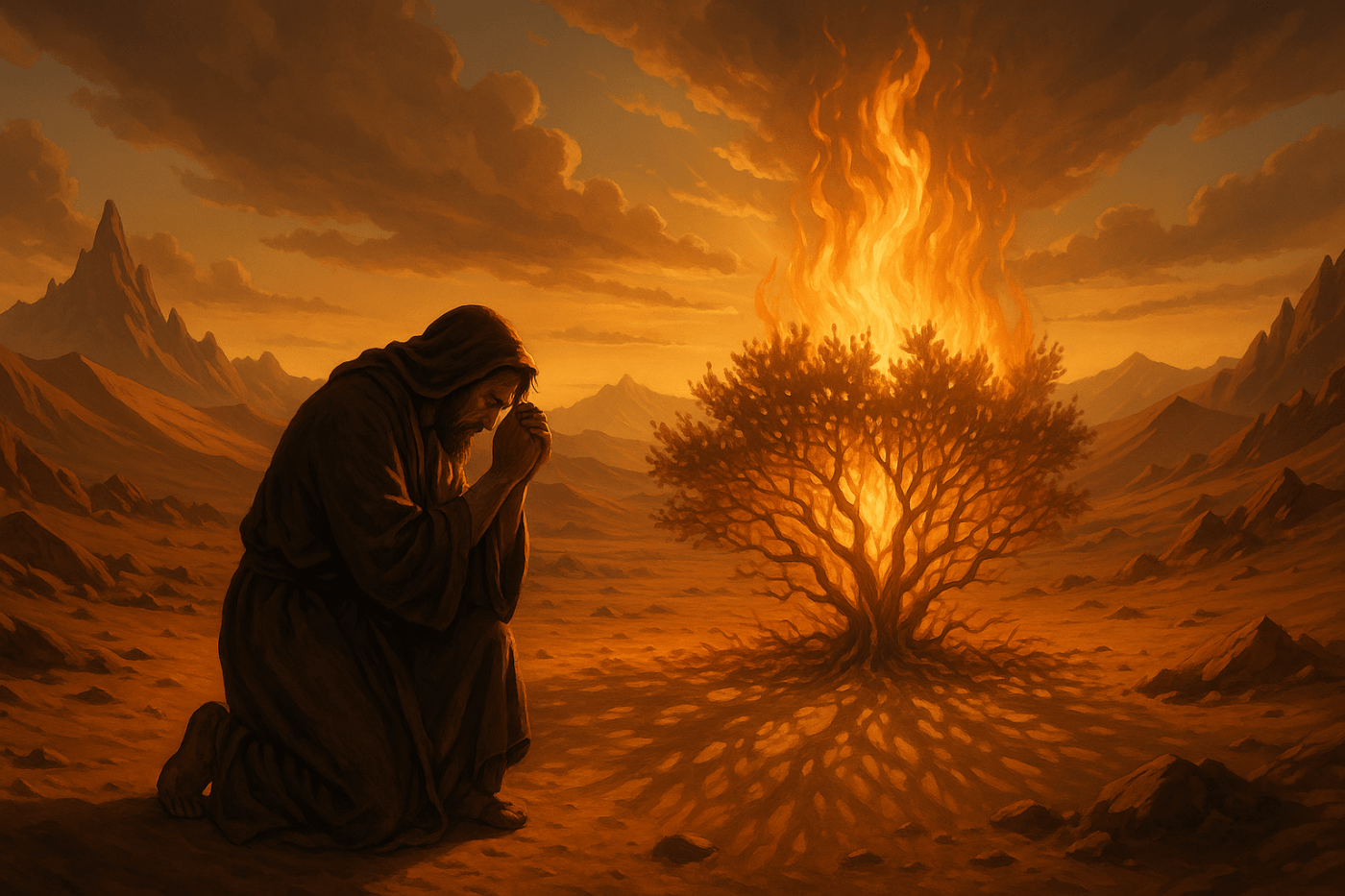
- Lesson 3: Spiritual Sensitivity. Here’s the kicker that changes everything: Moses didn’t encounter the burning bush while lounging in Pharaoh’s palace. All those years of marble floors and golden goblets, and God was silent. But forty years into his wilderness exile, shepherding sheep in the middle of nowhere, suddenly he’s having divine conversations with flammable shrubbery.
- Lesson 4: Patience. Sheep will teach you patience or drive you completely insane. There is no middle ground. Moses chose patience, which served him well when dealing with the Israelites, who made sheep look like model citizens.
The Burning Bush Moment
After four decades of this desert MBA program, God showed up in a burning bush (because subtlety was never the Almighty’s strong suit) and basically said, “Congratulations, graduate. Time for your final exam: Go back to Egypt and tell the most powerful man in the world to let my people go.”
Moses, now sufficiently humbled and prepared, tried to talk his way out of it. “Who am I to do this?” he asked. Which was exactly the right question. He wasn’t the pampered prince anymore. He was a broken-down shepherd who knew his own limitations.
Perfect leadership material.
The Payoff: Forty Years of Desert Leadership
And here’s the beautiful irony: Those forty years of wilderness preparation perfectly equipped Moses for forty years of wilderness leadership. He knew every trick for finding water in the desert because he’d been finding water in the desert for forty years. He knew how to navigate by the stars, how to keep people moving when they wanted to quit, and how to survive on almost nothing.
The man who parted the Red Sea, who received the Ten Commandments, who led the greatest liberation movement in human history—he was forged in the furnace of failure and refined in the workshop of the wilderness.
The Pattern of Preparation
This isn’t just Moses’ story. It’s the story of every leader worth following. Abraham left everything comfortable for the unknown. David went from shepherd to fugitive before becoming king. Joseph went from daddy’s favourite to prison before becoming Pharaoh’s right-hand man.
Even Jesus Himself spent forty days in the wilderness before beginning His ministry.
The suffering, the endurance, the forced simplicity—it stripped away all the noise. In the quiet of the desert, away from the distractions of Egyptian court life and the constant hum of privilege, Moses finally developed ears to hear. The wilderness had become God’s megaphone.
It is in the dry place that your soul is finally able to listen.
God will use solitude to produce surrender and silence to produce strength. God does his best work in the quiet.
God is not looking for the loudest; he is looking for the yielded, the obedient heart.
This wasn’t coincidence. Comfort makes us deaf to the deeper frequencies of life. We’re too busy managing our image, climbing ladders, and accumulating stuff. But hardship? Hardship tunes our antenna to pick up signals we never knew existed.
The pattern is clear: God doesn’t call the qualified. He qualifies the called. And that qualification process usually involves some quality time in the wilderness—literal or metaphorical.
The Entrepreneur’s Wilderness
Think about it: That promotion you didn’t get at 28 that forced you to look elsewhere—suddenly, you’re in an industry that becomes your goldmine. The layoff at 35 that felt like professional death—turns out it was the push you needed to start that side hustle that becomes your main thing. The divorce that shattered your world at 42—cleared the path for the relationship that actually fits. The market crash that wiped out your portfolio at 50 taught you risk management that made you a better investor for the next twenty years.
Every industry titan has their wilderness years. Steve Jobs got fired from Apple—the company he founded—only to return and create the iPhone. Oprah was fired from her first television job for being “too emotionally invested.” Colonel Sanders was 65 when he franchised KFC, after failing at dozens of other ventures.
Your failures aren’t disqualifications. They’re your curriculum. Your setbacks aren’t sentences. They’re your seminary. That career that imploded? That’s you learning resilience. That business partnership that went toxic? That’s you learning discernment. That moment when you realized you don’t have it all figured out? That’s you learning humility.
Every great leader has their wilderness years. The question isn’t whether you’ll have them—the question is whether you’ll let them make you or break you.
Moses could have stayed bitter about losing his royal lifestyle. He could have spent forty years feeling sorry for himself, nursing his grievances like a fine wine. Instead, he let the desert strip away everything that wasn’t essential, until all that was left was the man God needed him to be.
The Long View
And here’s the kicker: When Moses finally led the Israelites out of Egypt, when he parted the Red Sea and walked on dry ground between walls of water, when he climbed Mount Sinai and came down with the Law of God written in stone—all of that was possible because of those forty years in the wilderness.
The comfortable life would have ruined him for greatness. The palace would have made him soft. The privilege would have made him deaf to the voice of God and blind to the needs of his people.
But the wilderness? The wilderness made him ready.
When Moses finally passed the torch to Joshua, he was handing over a people who were no longer slaves but a nation. And Joshua? Well, Joshua took that nation and conquered the Promised Land, because Moses had done his job—not in spite of his wilderness years, but because of them.
The Making of You
So to you, navigating career transitions and wondering if you’re on the right path: You probably are, even when it doesn’t feel like it. The detours often become the destinations.
To you, rebuilding after a major life disruption and wondering if you should just play it safe: Don’t. Not yet. Because somewhere in the rubble of what was, life is building something better. Something stronger. Something that can only be forged in the fire of difficulty.
To you, watching peers seem to have it all figured out while you’re still figuring it out: remember that everyone’s timeline is different, and the people who appear to have it easiest often haven’t been tested yet.
Your wilderness years aren’t wasted years. They’re your most valuable years if you let them be.
Because here’s what Moses learned, and what every great leader learns: The greatest gift God can give you isn’t success. It’s the capacity to handle success when it comes.
And that capacity? That’s built in the wilderness, one difficult day at a time.
The desert doesn’t make you weaker. It reveals how strong you really are. And sometimes, it reveals that you’re stronger than you ever imagined.
 Notes Beyond the Map
Leave a comment