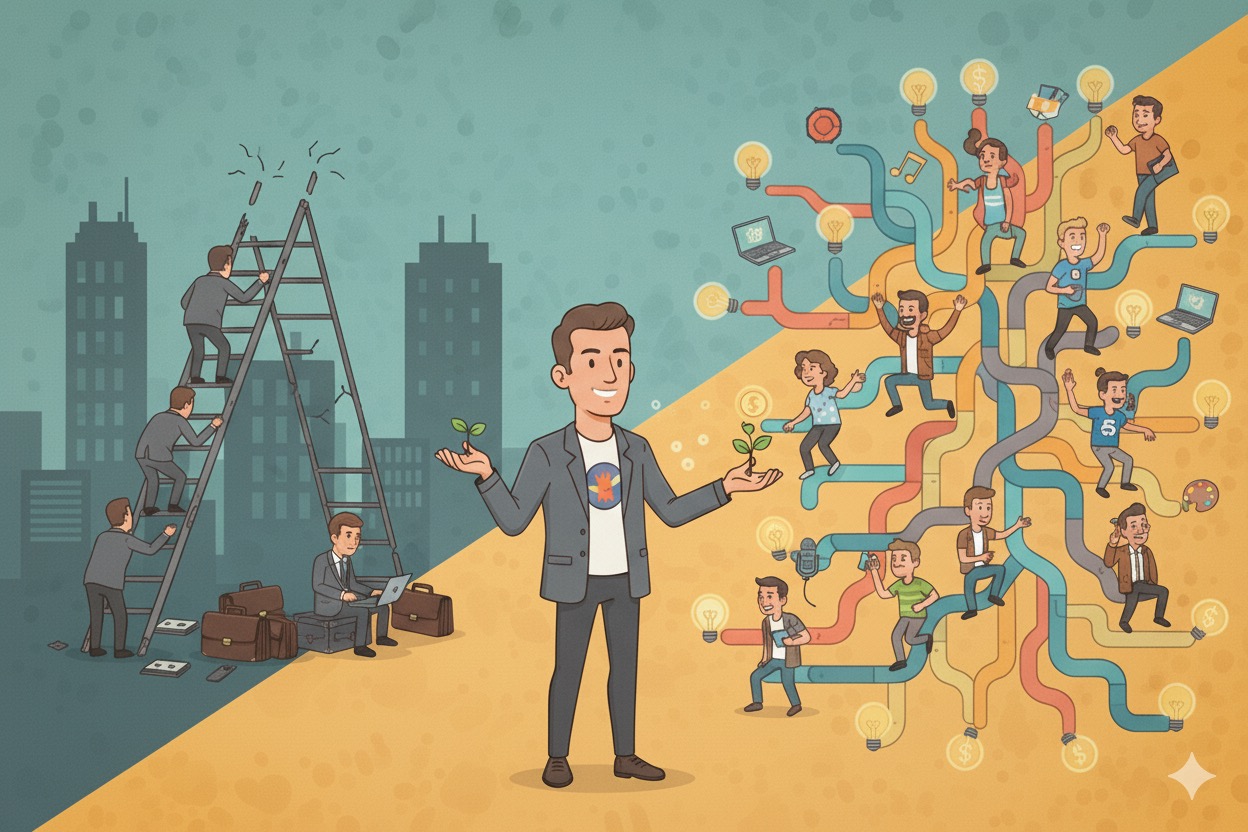
The most expensive real estate in corporate America is now worth exactly nothing—because nobody’s there to use it.
Picture this: It’s 9:47 AM on a Tuesday morning in downtown Chicago. Sarah, a 34-year-old marketing director, sits in her corner office—the one she fought for, the one with the view of Lake Michigan and the framed diploma that took six years and $80,000 to earn. Her laptop hums with the familiar rhythm of corporate productivity: Outlook pinging with meeting requests, Excel spreadsheets demanding attention, PowerPoint presentations awaiting their weekly sacrifice to the conference room gods.
But here’s the twist—Sarah hasn’t been to that office in eighteen months.
Instead, she’s typing from a café in Barcelona, where it’s 4:47 PM and the afternoon light slants through ancient windows onto her MacBook screen. She’s just finished a video call with clients in Tokyo, scheduled a strategy session with her team in Denver, and used an AI tool to draft three campaign concepts that would have taken her department a week to produce just five years ago. In six months, she’ll quit that corner office job entirely to launch her own consultancy, serving clients she’s never met in person, using tools that didn’t exist when she graduated college.
Sarah isn’t an outlier. She’s the new normal.
So it goes. Here we are in 2025, and the office buildings that once hummed with the predictable rhythms of corporate life now echo with something altogether different—the sound of people figuring things out for themselves. The sound of Zoom calls at midnight connecting minds across continents. The sound of AI assistants handling the mundane while humans focus on the magical. The sound of traditional career paths crumbling like old concrete, making way for something more organic, more personal, more alive.
Welcome to the age of agency, friends, where your career path looks less like a corporate ladder and more like a jazz improvisation—unpredictable, creative, and occasionally brilliant. And if that makes the old guard nervous, clutching their org charts and employee handbooks like life preservers on a sinking ship, well, that’s rather the point. The ship isn’t just sinking; it’s been replaced by a fleet of individual vessels, each one navigated by someone who decided they’d rather chart their own course than wait for permission to leave port.
Agency: Your Professional Superpower
Agency, in its modern incarnation, is the radical notion that you—yes, you, sitting there in your hybrid workspace or kitchen-table office—are the CEO of your own professional destiny. It’s not just having choices; it’s having the audacity to make them, the skills to execute them, and the gumption to pivot when the winds change. Agency means you don’t wait for permission to solve problems, create value, or reinvent yourself. You simply do it, because in this brave new world of work, waiting for someone else to hand you a career is about as effective as waiting for a horse and buggy in rush hour traffic.
Powered by AI tools that can draft your proposals in minutes rather than days, Zoom meetings that connect you with clients across time zones as easily as walking down the hall, and platforms like LinkedIn that turn networking into a 24/7 global conversation, agency has never been more accessible—or more necessary. It’s the difference between being a passenger on someone else’s career train and being the engineer of your own professional locomotive, complete with GPS, autopilot, and the ability to change tracks at will.
The Great Corporate Unraveling
Now, let me tell you a little story about the last seventy years, because context, dear reader, is everything. Picture this: From roughly 1950 to 2020, the American Dream came with an instruction manual so simple a golden retriever could follow it. You went to school, got a degree, found a company (preferably one with a pension), and stayed put for thirty years like a loyal barnacle on a ship’s hull. The company took care of you, you took care of the company, and everyone went home satisfied, if not exactly thrilled. It was industrial-age thinking applied to knowledge work—efficient, predictable, and about as inspiring as a tax form.
But here’s the thing about comfortable arrangements: they tend to fall apart right when you need them most. The 2008 financial crisis whispered the first warnings. COVID-19 shouted them through a megaphone, forcing millions to discover that their laptop and a decent WiFi connection could replace forty years of commuting and conference room small talk. Meanwhile, artificial intelligence started eating entire job categories for breakfast—first the simple tasks, then the complex ones, then the ones we thought were uniquely human.
And now? Now we’re living through the great unbundling of traditional employment, where loyalty flows both ways or not at all, where algorithms can replace middle management faster than you can say “performance review,” and where the question isn’t “What do you do?” but “What can you do that a machine can’t—yet?” The old contract is broken, and frankly, it needed breaking. What’s emerging in its place is something far more interesting: a world where value creation matters more than time served, where skills trump seniority, and where your network is your net worth.
Five Forces Reshaping Everything
Why is agency not just important but absolutely essential in this new era? Let me count the ways—five ways, to be precise, because humans love numbered lists almost as much as they love complaining about change.
First, the job market has become a game of musical chairs, except the music never stops and new chairs keep appearing in rooms you didn’t know existed. You need agency to navigate this chaos with grace instead of panic, leveraging AI tools to spot opportunities and remote platforms to access them from anywhere.
Second, technology is evolving faster than fashion trends in Milan, and the skills that made you valuable yesterday might be as useful as a chocolate teapot tomorrow. Agency means you’re always learning, always adapting, always one step ahead of obsolescence—whether that’s mastering the latest no-code platform or understanding how to prompt AI effectively.
Third, the traditional career ladder has been replaced by what I call the “career jungle gym”—you climb sideways, backwards, and sometimes hang upside down, but you’re always moving toward something interesting. Remote work has turned this jungle gym global; your next pivot might involve collaborating with teams in three different time zones.
Fourth, the new economy rewards problem-solvers, not just task-followers. Companies don’t want employees who need detailed instructions; they want partners who can spot opportunities, create solutions, and drive results using whatever tools are available. That’s agency in action: the ability to see what needs doing and then figure out how to do it.
And fifth, the democratization of powerful tools has leveled the playing field like never before. A freelancer with Figma and AI writing assistants can compete with established agencies. A consultant with video conferencing and cloud storage can serve global clients from a coffee shop in Prague. The barriers to entry have crumbled, but only for those with the agency to walk through the rubble.
From Developer to Founder: A Modern Odyssey
Consider my own journey—a perfectly ordinary tale of professional shape-shifting. I’ve been a developer crafting code like a digital blacksmith, back when debugging meant actual bugs. A solutions architect building technological bridges between problems and possibilities through late-night video calls with stakeholders scattered across continents. A project manager herding cats with spreadsheets, gradually replacing status meetings with Slack workflows and AI-powered project tracking. A product manager translating customer dreams into actionable reality using data analytics tools that didn’t exist five years earlier. A consultant bringing outside wisdom to inside challenges through screens that carried more impact than any boardroom ever could. And now, a founder building something from nothing, supported by AI tools that handle everything from market research to content creation.
Each role taught me something the previous ones couldn’t. Each transition was enabled by technology that made the impossible merely difficult, then made the difficult routine. The through-line wasn’t loyalty to any single company—it was curiosity, adaptability, and the willingness to bet on myself when the safe path felt like a slow death.
I’m not unique in this journey; I’m typical. Look around your network, and you’ll find stories just like mine, each one a testament to the power of professional reinvention powered by tools our parents couldn’t have imagined.
Freedom’s Beautiful Burden
But let’s not get carried away with our own cleverness, shall we? This new world of agency isn’t all sunshine and unicorns. It’s beneficial, yes—liberating, even—but it comes with its own special brand of challenges.
On the sunny side, agency gives you freedom to pursue work that actually matters to you, powered by AI assistants that handle mundane tasks while you focus on creative strategy. You can diversify your income streams like a savvy investor, with platforms like Upwork, Gumroad, and Substack making monetization as simple as clicking “publish.” You have the power to work with people and organizations that align with your values, connecting with them through digital networks that span the globe. You can build a career that reflects who you are, not just what you studied twenty years ago.
But—and this is a big, Kurt Vonnegut-sized “but”—agency also means the safety net of traditional employment is gone, replaced by the thrilling uncertainty of entrepreneurial life. No more company-sponsored healthcare, though telemedicine has made individual coverage more accessible. No more predictable paychecks, though digital payment systems mean you can get paid instantly. No more clear promotional paths, though AI-powered career platforms can now model thousands of potential futures.
The psychological adjustment is perhaps the most challenging part. Agency requires you to become comfortable with ambiguity, to find security in your skills rather than your job title, and to view failure not as a career-ending catastrophe but as expensive education. You need to develop what I call “portfolio thinking”—managing multiple projects, relationships, and income streams simultaneously while staying sane and focused.
The New Rules of Connection
The networking game changes too, transformed by social platforms that never sleep and AI algorithms that surface unexpected connections. It’s no longer about climbing the corporate ladder within one organization; it’s about building bridges across industries, disciplines, and geographies through LinkedIn conversations, Twitter threads, and Discord communities that feel more intimate than most office relationships ever did.
Your next opportunity might come from a conversation in a virtual coworking space, a comment on a Medium article, or a recommendation from someone you helped three years ago in a Slack channel you barely remember joining. This requires a different kind of social intelligence—one that values authentic relationships over transactional connections.
Perhaps most importantly, agency demands that you develop a tolerance for continuous learning. You can’t master something once and ride that knowledge for decades. Instead, you’re perpetually a beginner in something, always stretching toward competencies you don’t yet possess, aided by AI tutors and online communities that can answer your 2 AM questions with equal enthusiasm and expertise.
It’s humbling and energizing, frustrating and fulfilling—sometimes all in the same afternoon, often all in the same Zoom call.
Your Revolutionary Tuesday
So here we are, friends, standing at the crossroads of work and life, holding the keys to our own professional destiny—keys that happen to be digital, cloud-based, and powered by algorithms that learn faster than we do but still need our uniquely human wisdom to know what problems are worth solving.
Agency isn’t just coming to your industry—it’s already there, rearranging the furniture while you weren’t looking, installing AI assistants in the corner office and replacing the water cooler with Slack channels that buzz with ideas at all hours. The question isn’t whether you’ll need to adapt; it’s whether you’ll do so gracefully, with intention and purpose, or get dragged along kicking and screaming.
The old world of work is dead, killed by a perfect storm of artificial intelligence, global connectivity, and a pandemic that proved most meetings really could have been emails, and most jobs really could be done from anywhere with decent WiFi and strong coffee. Long live the new world of work, where your laptop is your office, your network is your safety net, your ability to learn is your currency, and your willingness to adapt is your superpower.
And if that sounds like a revolution, well, maybe that’s because it is. Just remember: revolutions are only scary if you’re trying to preserve something that was already broken beyond repair. For everyone else—for the curious, the adaptable, the ones willing to bet on themselves—they’re just another Tuesday in the office, wherever that office happens to be.
The age of agency is here. The question is: What are you going to build with it?
So it goes.
The future belongs to those who show up for it—laptop charged, mind open, ready to write the next chapter of their own story.
 Notes Beyond the Map
Leave a comment