AI isn’t making us less intelligent or lazy. It is amplifying our creativity and curiosity.
The Fear Factory Is Open for Business
There’s a question making the rounds lately, whispered in faculty lounges and shouted in LinkedIn comment sections, a question that carries with it the same quivering terror that accompanied the printing press, the calculator, and the spell-checker before it: “If we continue to use AI, will we stop thinking altogether?” The question itself is a marvel of human insecurity, really. It assumes we were doing all that much thinking to begin with, which is generous. It also assumes that thinking is some fixed commodity, like crude oil or Bitcoin, that can be depleted or transferred to machines through some cosmic exchange program. One day, you’re pondering the nature of existence, the next day ChatGPT is doing it for you while you drool into your morning coffee. Poof. Brain gone.
But here’s the thing about fear—it makes terrible predictions. When Gutenberg fired up his printing press in 1440, the intellectual elite clutched their illuminated manuscripts and shrieked that reading would become meaningless if any fool with a few coins could own a book. When calculators appeared in classrooms, mathematics teachers predicted the death of numeracy. When spell-check arrived, English professors mourned the extinction of proper spelling. And yet, somehow, we’re still here, thinking away, arguably more than ever, though admittedly about different things. The panic over AI is just the latest edition of humanity’s favourite pastime: catastrophizing change. But this time, the catastrophizers have it precisely backward. AI doesn’t make us stop thinking. It demands that we think better. And that, my friends, is what terrifies people most—not the death of thinking, but the exposure of how poorly they’ve been doing it all along.
When the Advantage Evaporates
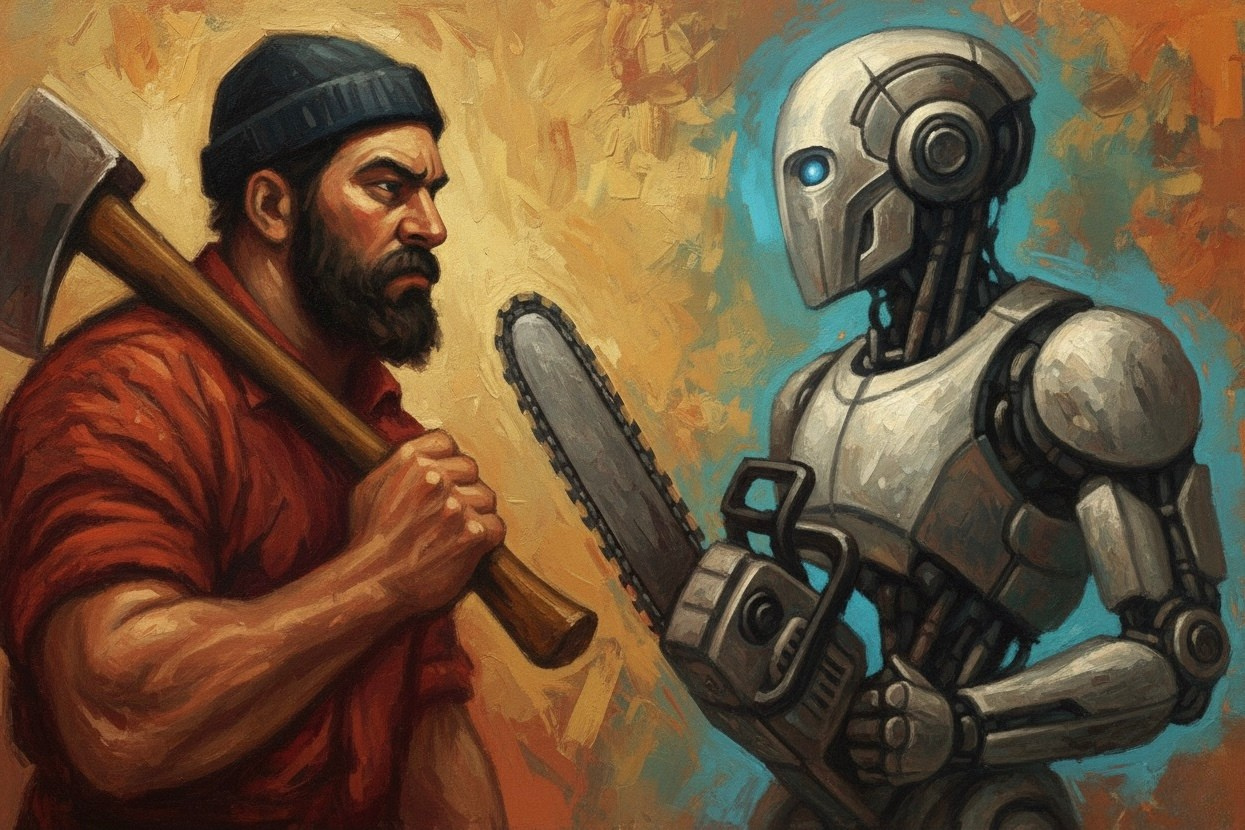
Picture this: There’s a kid on the playground who owns the monkey bars. Let’s call him Brad. Brad has been swinging across those bars since kindergarten, arms like steel cables, grip like a vice, backwards, blindfolded, while reciting state capitals. His YouTube channel has forty thousand subscribers. If you want to cross the monkey bars with any credibility, you study Brad. Then one day, a scrawny kid shows up wearing robotic prosthetic arms—sleek, efficient, powered by algorithms and actuators. This kid, who couldn’t make it past the third rung last week, now glides across the entire structure in half the time it takes Brad, doing things Brad never imagined—rotating mid-swing, changing directions, exploring patterns and movements that organic arms simply cannot execute. Brad is not amused. Brad feels cheated. Brad starts a petition to ban robotic arms because they’re “not authentic.” It’s the same story with Paul Bunyan, that beast of a logger who could fell a hundred trees before breakfast. His axe was an extension of his soul, his biceps had their own weather patterns, and when Paul swung, forests trembled. Then some scrawny salesman shows up with a chainsaw and suddenly that legendary lumberjack gets out-chopped by a guy eating a sandwich. Was Paul happy? Let’s just say Paul didn’t throw a parade. Here’s what both Brad and Paul misunderstand completely: The monkey bars and the forest didn’t belong to them in the first place. They were just there, waiting for whoever had the capability to cross them or fell them. And now that capability has democratized. The scrawny kids didn’t become dumber—they had to learn entirely new skills about trajectory, timing, strategic movement, fuel ratios, blade maintenance, and operational efficiency. The nature of expertise shifted from brute execution to directional thinking. Brad and Paul aren’t mad that thinking is dying. They’re mad that their advantage is dying, and they built their entire identities around those advantages. This is the AI moment we’re living through, and it’s not really about thinking at all—it’s about who gets to do what, and whether the barriers that protected certain people should continue to exist just because they’ve always existed.
The Mirror Doesn’t Negotiate
Here’s where we need to get brutally honest about what AI actually does. AI is not a magical thinking machine that transforms your half-baked ideas into Pulitzer-worthy prose. It’s not a get-out-of-thinking-free card. What AI actually is—and this is the part that should terrify and exhilarate you in equal measure—is a mirror for the quality of your thinking. And mirrors don’t negotiate. They don’t flatter. They don’t make excuses. They show you exactly what you are. Give AI a weak prompt and you’ll get weak output. Feed it vague instructions and watch it generate vague garbage. Approach it with lazy thinking and it will lazily think right back at you. The old programmer’s axiom “garbage in, garbage out” has never been more brutally, nakedly true. AI will expose your intellectual laziness faster than a pop quiz in a philosophy seminar, and it will do so without mercy or apology.
I’ve been using AI tools daily since January 2023. I’ve been paying for ChatGPT Plus since November of that year. And here’s what I’ve learned: Every single person who complains that “AI just produces generic garbage” is telling on themselves. They’re announcing, loudly and publicly, that their thinking is generic garbage. Because AI doesn’t have opinions about your work. It doesn’t have moods or agendas. It simply reflects the quality of thought you bring to it. When someone shows me bland, useless AI output and declares that “this is what AI does,” what they’re actually showing me is the ceiling of their own capability. They’re showing me that they don’t know how to frame problems, provide context, ask precise questions, or evaluate results critically. And then they blame the tool for their own inadequacy.
But here’s the flip side, the beautiful, empowering, revolutionary flip side: Give AI clarity and it gives you brilliance. Provide proper context and watch it build worlds. Ask the right questions, and it will help you find answers you didn’t know existed. Frame your problem precisely, and it becomes your most powerful thinking partner. This is what actually happens when you use AI well: Your thinking gets exposed. Your mental models become visible. Your assumptions become testable. Your ideas become executable. You can’t hide behind credentialism or jargon or the protective buffer of “I would do this if I only had time.” AI removes every excuse and leaves you naked in front of your own capability—or lack thereof.
The Skills That Actually Matter Now
So what determines whether you’re Brad on the playground, clutching his organic arms and complaining about cyborgs, or whether you’re actually building things that matter? What separates mediocre AI users from exceptional ones? The answer is uncomfortable because it reveals that we’re not moving away from thinking—we’re moving toward different thinking, harder thinking, thinking that can’t hide behind memorization and credential signalling.
Critical thinking is the first frontier, and not the kind they taught you in Philosophy 101, but the real kind—the ability to evaluate information, question assumptions, identify logical flaws, construct sound arguments, and determine whether something is actually good rather than just grammatically correct. AI can generate content infinitely, but you need to determine whether that content is accurate, relevant, strategically sound, and valuable in context. Weak thinkers accept whatever AI produces at face value and wonder why their results are mediocre. Strong thinkers interrogate every output, refine it through multiple iterations, and sculpt it toward excellence. The difference in outcomes is staggering.
Contextual framing separates the amateurs from the professionals. AI doesn’t read your mind. It doesn’t know your business, your audience, your constraints, your goals, your competitive landscape, your brand voice, or your strategic vision unless you tell it—clearly, completely, and with precision. The ability to provide rich, relevant context is what separates powerful prompts from useless ones. This requires deep understanding of your domain, comprehensive knowledge of your challenges, and clarity about your desired outcomes. People who can’t frame context well get generic results because they’re asking generic questions. This is sophisticated intellectual work that draws on experience, expertise, and strategic thinking.
Question formulation is an art form that most people have never developed because they’ve never needed to. The quality of your answers depends entirely on the quality of your questions, and most people are remarkably bad at asking questions. Asking “Write me a blog post about marketing” will get you garbage. Asking “Write a 1,500-word blog post for B2B SaaS founders about the three biggest mistakes in customer acquisition strategy, using a conversational but authoritative tone, with specific examples from the fintech industry, structured around a problem-solution framework, and concluding with actionable next steps” will get you something worth reading. This is pure intellectual work that requires clarity about what you actually want, why you want it, and how it should be structured.
Iterative refinement is where the magic actually happens, and it’s where most people give up because it requires sustained cognitive effort. First drafts from AI are rarely perfect, and accepting them as such is the mark of someone who doesn’t understand what they’re doing. The magic happens in the revision, the refinement, the back-and-forth dialogue where you guide the AI toward your vision through multiple iterations. This requires taste, judgment, domain expertise, and the ability to articulate precisely what’s wrong and how to fix it. Weak users take the first draft and call it done. Strong users treat the first draft as raw material for something exceptional.
These aren’t soft skills or nice-to-haves. These are the only skills that matter now. And here’s the kicker: These are all cognitive skills. They’re all forms of thinking. They’re just different forms of thinking than what we were rewarded for in the previous economy. We’re moving from an economy that rewarded execution capability to one that rewards directional capability. The person who can write clean code is less valuable than the person who can architect systems that solve real problems. The person who memorized frameworks is less valuable than the person who knows which framework to apply when and can explain it clearly enough for AI to operationalize it.
What Actually Changes (The Cyborg Advantage)
Let me be direct about my experience, because abstract theorizing only gets us so far. I’ve been using these tools daily for nearly two years. I’ve integrated them into every aspect of my work. And the results aren’t hypothetical—they’re real, measurable, and transformative.
I can now build web applications despite having limited coding knowledge. Not toy applications, but functional, complex applications that solve real problems for real users. Has AI done the thinking for me? Absolutely not. I still need to understand user experience principles, system architecture, data flow, security considerations, and functionality requirements. I still need to make hundreds of decisions about what to build, how it should work, and what problems it should solve. The difference is that my thinking now translates directly into working code instead of dying in my notebook because I lacked the technical execution skills to implement it. The bottleneck has shifted from execution capability to directional capability. Before AI, I had ideas that died because I couldn’t execute them. My thinking was constrained by my technical limitations. Now, my thinking is constrained only by my ability to think clearly, frame problems precisely, and direct execution strategically.
I can create complex analytical frameworks for businesses I’m building—frameworks that would have required hiring expensive consultants or spending months learning advanced analytical methods. But AI doesn’t create these frameworks magically. I need to understand my business model, my market dynamics, my competitive positioning, my customer segments, and my strategic objectives. I need to know what I’m trying to analyze and why. I need to evaluate whether the frameworks AI generates actually make sense for my specific context. The thinking is more intense than ever; it’s just focused on strategy and application rather than mechanical execution.
I can produce written content at a volume and quality that would have been impossible before. But this doesn’t mean AI writes for me. Every piece requires me to understand my audience deeply, structure arguments strategically, evaluate tone and voice carefully, and refine endlessly. The difference is that I can now execute on ideas that would have languished in my drafts folder. My thinking capacity hasn’t decreased—it’s been amplified into productivity. I can explore ideas across disciplines I never studied formally and apply them to my work in ways that create genuine competitive advantages. But accessing this knowledge isn’t passive consumption. It requires me to ask sophisticated questions, evaluate information critically, connect concepts across domains, and apply them strategically.
This hasn’t made me lazier—it’s made me ambitious in ways I couldn’t afford to be before. The cyborg advantage isn’t that machines do our thinking for us. It’s that they remove the execution barriers that prevented our thinking from becoming reality. And that changes everything about what’s possible, who can build it, and how quickly ideas can become impact.
The Uncomfortable Truth About Resistance
Let’s address why certain people are so threatened by AI, because we need to be honest and it’s not because they genuinely care about the future of human cognition. The resistance to AI comes primarily from people who built their careers on artificial scarcity. They spent years—sometimes decades—acquiring skills that were valuable primarily because they were rare and difficult to obtain. They paid for expensive educations, suffered through tedious apprenticeships, memorized vast amounts of information, and developed technical capabilities that served as moats around their economic value. And now those moats are draining before their eyes.
When they say “AI will make us stop thinking,” what they mean is “AI will make my specific skills less valuable, and I’ve invested too much in those skills to accept their obsolescence gracefully.” When they say “this is cheating,” what they mean is “this violates the social contract that said I should be rewarded forever for my past efforts.” When they say “there’s no substitute for human expertise,” what they mean is “please don’t notice that much of what I called expertise was actually just mechanical execution that AI can replicate.” This isn’t universal, of course. Plenty of skilled professionals are adapting brilliantly, using AI to amplify their expertise and operate at levels they couldn’t reach before. But the loudest voices against AI? They’re almost always people whose advantages are threatened, whose gatekeeping power is eroding, whose protected positions are suddenly exposed as less essential than they claimed.
And here’s the brutal truth they don’t want to acknowledge: Their resistance reveals exactly what they feared all along—that their thinking wasn’t actually that sophisticated, that their value came from scarcity rather than excellence, that they were protected by barriers rather than distinguished by capability. The people who are thriving with AI are the people who were always thinking hard questions, who were always curious and creative, who were always limited by execution capability rather than intellectual capacity. For them, AI is liberation. For the gatekeepers, it’s exposure.
So It Goes (But Hopefully Forward)
The question “Will AI make us stop thinking?” is the wrong question asked by the wrong people for the wrong reasons. The right question is: “What kind of thinking will AI demand from us?” And the answer is: Better thinking. Clearer thinking. More strategic thinking. More creative thinking. Thinking that translates into action rather than dying in notebooks. Thinking that solves real problems rather than demonstrating credential compliance. Thinking that creates real value rather than protecting artificial scarcity.
AI hasn’t killed thinking. It’s killed the illusion that memorization, credentialism, and gatekeeping were ever substitutes for actual thinking. It’s exposed the difference between people who were genuinely smart and people who were just good at playing the game. It’s revealed who was actually adding value and who was just protecting their territory. It’s democratized capability and terrified everyone whose advantage depended on artificial barriers.
For those of us who’ve embraced these tools—who’ve spent the hours learning to prompt effectively, who’ve integrated AI into our workflows, who’ve discovered the profound leverage that comes from combining human creativity with machine capability—there’s no going back. We’re the cyborgs on the monkey bars now, and we’re not apologizing for our robotic arms. We’re the salesman with the chainsaw. Now there’s an analogy that Elon Musk would appreciate. We’re building things that matter, solving problems that count, and creating value that’s real. The playground is open to everyone. The barriers are down. The tools are available. The only question is whether you’ll use them to think better or whether you’ll join Brad and Paul in their petition to ban progress while the rest of us build the future.
As for me? I’m thinking harder than ever, creating more than I imagined possible, and building things that once existed only in my dreams. The mirror shows me clearly who I am and what I’m capable of. And every day, that reflection gets stronger. And if that makes me a cyborg, well—so it goes.
Welcome to the future. Your thinking is required.
 Notes Beyond the Map
Leave a comment