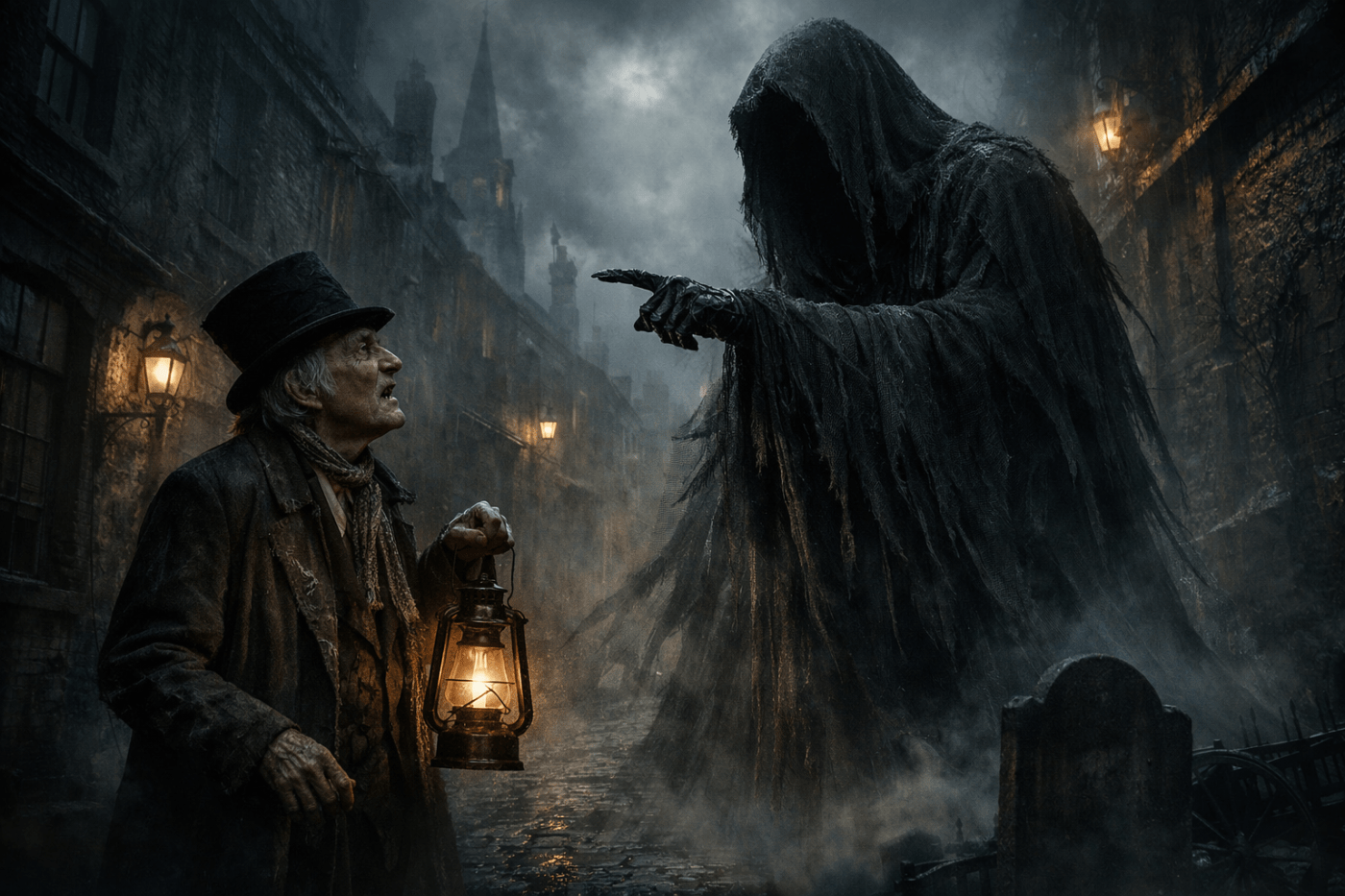
Charles Dickens didn’t invent Christmas. He didn’t even particularly like it at first. What he did—and this matters more than tinsel or turkey—was weaponize a holiday nobody cared much about and aim it straight at England’s cold, grinding heart.
The year was 1843. Victoria was on the throne. The factories were eating children. And Christmas? Christmas was a Tuesday you worked through, maybe with slightly better beer.
Dickens came from nowhere worth mentioning—Portsmouth, a crummy port town where his father went to debtor’s prison and young Charles got sent to a blacking factory at twelve to paste labels on shoe polish. He knew what it meant to be invisible. He knew what it meant when society decided you were disposable.
So when he sat down in October 1843 and hammered out A Christmas Carol in six weeks flat, he wasn’t writing a holiday story. He was writing a knife. A sharp, glittering, Victorian knife aimed directly at the people who had decided that poverty was a moral failure and that the poor should simply have the decency to die and decrease the surplus population.
Scrooge wasn’t a character. He was a diagnosis.
And the ghosts? The ghosts were the cure.
Where Christmas Actually Came From (Spoiler: It Wasn’t Dickens)
Let’s get one thing straight before we start draping garland everywhere: Christmas in 1843 was not Christmas as we know it.
There was no Santa Claus. Not in England, anyway. That jolly fat man in red? Pure Nordic mythology filtered through Dutch tradition and eventually Coca-Cola advertising. The British had Father Christmas, sure—a gaunt, green-robed figure more Druid than department store, who represented feasting and wassailing but definitely didn’t slide down chimneys with a sack of consumer goods.
Christmas trees? A German import via Prince Albert, just catching on with the upper crust. Christmas cards? Invented the same year Dickens published his book. Christmas carols? Existed, but mostly in dusty hymnals and rural villages, not in the cities where most people lived.
In other words, Christmas was a cultural fossil. A leftover pagan winter festival that Christianity had plastered over, and that the Industrial Revolution was actively trying to ignore because it cut into productivity.
What Dickens did—and this is the magic trick—was take that dying holiday and pour morality into it. He made Christmas mean something again. Not just feasting, not just tradition, but transformation. Redemption. The possibility that even the cruelest man could wake up and choose differently.
He gave England a new mythology. One where kindness wasn’t weakness, where generosity wasn’t foolish, and where the measure of a society was how it treated its Tiny Tims.
And then, over the next 181 years, we kept remaking that mythology on screen. Over and over and over.
Because apparently, we still need the ghosts.
The Story That Keeps Getting Remade (Because We Keep Needing It)
Here’s the thing about A Christmas Carol: it’s not really about Christmas.
It’s about fear. It’s about what you become when you stop feeling. It’s about the seductive logic of cruelty—how easy it is to justify turning away from suffering when you’ve convinced yourself that suffering is earned.
Scrooge isn’t a villain. He’s a defense mechanism. He’s what happens when you survive hardship by deciding never to be vulnerable again. He’s the guy who looked at a system designed to crush people and said, “Fine. I’ll be the crusher.”
And the ghosts—those beautiful, terrifying ghosts—don’t argue with him. They don’t lecture. They just show him. Past. Present. Future. Here’s what made you. Here’s what you’re ignoring. Here’s where you’re headed.
It’s the oldest story structure in the world: Look. See. Change.
But it works. God help us, it works.
Which is why filmmakers keep coming back to it like Marley’s ghost rattling chains. Every generation needs its own Scrooge. Every era needs to decide what it’s afraid of, what it’s ignoring, and what redemption might actually cost.
Let’s look at how they’ve done it.
The Films: A Century of Scrooges
Here’s the map. The visual history of how we’ve kept reimagining this story, bending it, stretching it, sometimes breaking it, but never quite letting it go.
A Christmas Carol on Screen: The Major Adaptations
| Year | Title | Scrooge | Critical Distinction | Strength | Historical Accuracy | Book Accuracy | Spookiness |
|---|---|---|---|---|---|---|---|
| 1901 | Scrooge, or, Marley’s Ghost | Daniel Smith | First-ever Dickens film | Established visual language of ghosts | Low | Low | Medium |
| 1938 | A Christmas Carol | Reginald Owen | Cemented “warm” Scrooge | Family-friendly lightheartedness | Medium | Medium | Low |
| 1951 | Scrooge | Alastair Sim | Definitive classic | Psychological depth | High | High | High |
| 1970 | Scrooge | Albert Finney | Musical reinvention | Emotional accessibility | Medium | Medium | Low |
| 1984 | A Christmas Carol | George C. Scott | Dark, austere Scrooge | Moral severity | High | High | High |
| 1988 | Scrooged | Bill Murray | Modern capitalist satire | Cultural relevance | Low | Low | Medium |
| 1992 | The Muppet Christmas Carol | Michael Caine | Most faithful script | Emotional clarity | Medium | High | Medium |
| 2009 | A Christmas Carol | Jim Carrey | Photoreal CGI spectacle | Visual ambition | Medium | Medium | High |
| 2019 | A Christmas Carol | Guy Pearce | Psychological deconstruction | Brutal, haunting honesty | High | Medium-High | Very High |
Each one of these adaptations bent the story toward the anxieties of its moment. The 1951 version came out of post-war Britain and asked: can we rebuild moral order? The 1988 Scrooged came out of Reagan’s America and asked: what if capitalism is the ghost? The 2019 miniseries came out of late-stage everything and asked: what if Scrooge’s bitterness actually made sense?
But three of them—three—transcend their moments and become something else entirely. Let’s talk about those.
The Three That Matter Most
1. Alastair Sim (1951): The One That Understood
This is the version that gets it.
Alastair Sim doesn’t play Scrooge as a monster. He plays him as a man who made a series of small, reasonable decisions that led to a completely unreasonable life. You watch this Scrooge and you understand how it happened. How love became too risky. How kindness became too expensive. How isolation became armor.
And when he breaks—when the Ghost of Christmas Yet to Come shows him his own grave and he realizes he’s been building his own tomb—it’s not melodrama. It’s archaeology. You’re watching a man excavate his own heart.
The 1951 version also nailed the Victorian setting. The grime. The cold. The casual cruelty. This is Dickens’s London, not a theme park version of it. And the ghosts? Genuinely unsettling. Christmas Present ages visibly as the night progresses. Christmas Future is a silent, hooded void. These aren’t special effects. They’re dread.
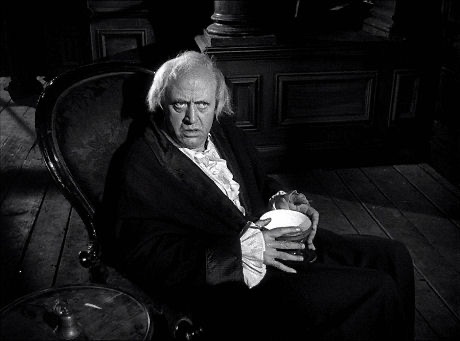
This version understood that A Christmas Carol is a ghost story first and a redemption story second. The redemption only works because the fear is real.
2. The Muppet Christmas Carol (1992): The One That Loved
Let me tell you something strange and true: the Muppets made the most faithful adaptation.
Yes, there are felt frogs. Yes, Gonzo narrates as Charles Dickens himself (with Rizzo the Rat as his skeptical companion). Yes, it’s funny and warm and occasionally breaks into song.
But the script—the actual dialogue—is lifted almost verbatim from Dickens. More so than most “serious” adaptations. And Michael Caine, playing Scrooge opposite puppets, treats the material with absolute reverence. He doesn’t wink. He doesn’t condescend. He plays it straight, and the movie becomes devastating because of it.
The Muppets understood something crucial: you don’t need to be grim to be serious. You can wrap truth in whimsy and it still cuts. When Tiny Tim dies in the Ghost of Christmas Yet to Come sequence, and Kermit—Kermit the Frog—sits by the empty chair and weeps, it breaks you. Because you weren’t expecting it. Because the movie earned it.
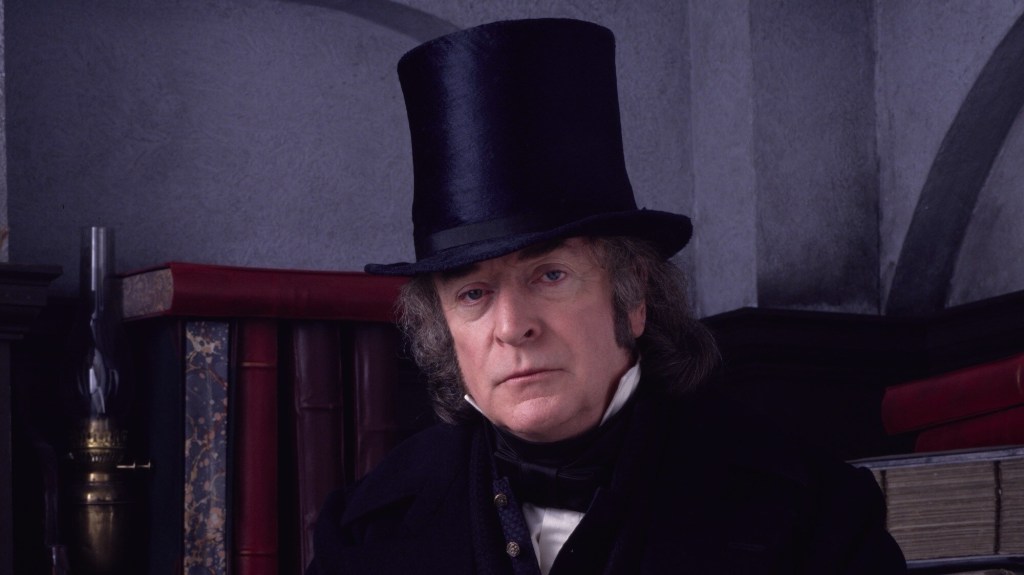
This version also gave us the clearest articulation of why the story matters: “There are some upon this earth of yours who claim to know us, and who do their deedless deeds of passion, pride, ill-will, hatred, envy, bigotry, and selfishness in our name… Remember that, and charge their doings on themselves, not us.”
That’s Dickens. That’s the whole point. And the Muppets delivered it with absolute clarity.
3. Guy Pearce (2019): The One That Won’t Let You Go
And then there’s this one.
I watched it late at night. Alone. A few glasses of wine in. What I expected was another Christmas Carol—familiar beats, comforting redemption, maybe some updated special effects.
What I got was a psychological thriller that wouldn’t let me sleep.
The BBC/FX miniseries starring Guy Pearce is the most uncomfortable Christmas Carol ever made. It’s also the most important. And it’s my favorite, which tells you something about why I watched six versions of this story in one Christmas season—because I needed to understand why this particular adaptation haunted me in ways the others didn’t.
The lighthearted versions—the Reginald Owen adaptation from 1938, for instance—give you a Scrooge you can dismiss. He’s a caricature. A cartoon villain. He’s mean because he’s meant to be mean, and when he changes, it’s like watching a switch flip. Evil to good. Dark to light. Roll credits, pass the figgy pudding.
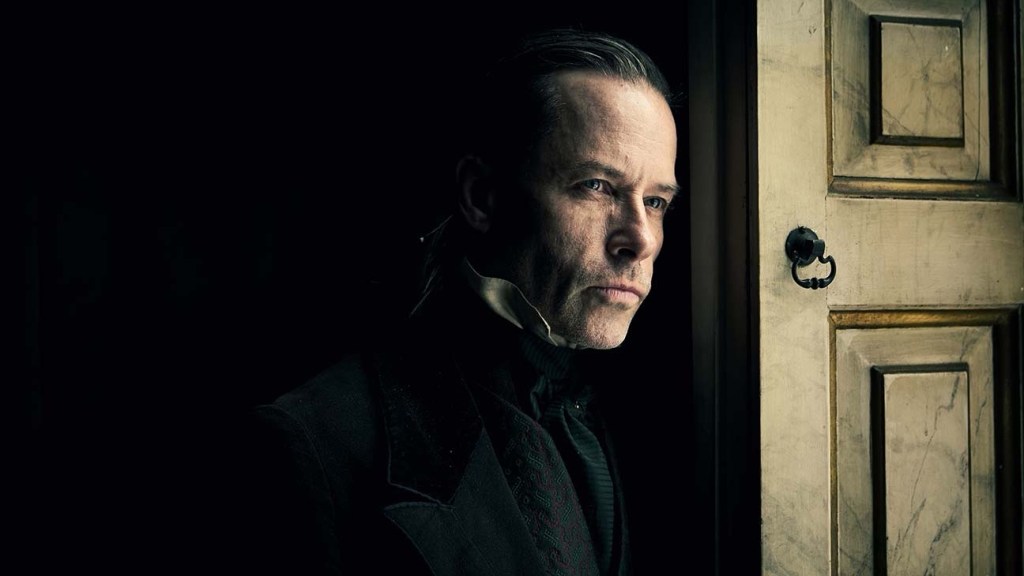
But Guy Pearce’s Scrooge? That Scrooge is terrifying because he’s recognizable.
Somewhere around the second glass of wine, when Pearce’s Scrooge justified his cruelty with cold, airtight logic, I felt something uncomfortable twist in my chest. Because I’d used that exact logic. Maybe not about money, but about protecting myself. About deciding who deserved my time, my empathy, my care. About building walls and calling it boundaries. About choosing isolation and calling it independence.
The armor Scrooge wore? I’d been building my own version, brick by brick, and calling it wisdom.
Why I Keep Watching
This Christmas alone, I watched six versions of A Christmas Carol.
Six.
Different actors. Different decades. Different levels of spookiness and historical accuracy and fidelity to Dickens’s text. But all of them circling the same essential truth: we are capable of being better than we are. We are capable of seeing past our fear and our greed and our justified bitterness. We are capable of waking up and choosing differently.
That’s not sentimental. That’s survival.
Because the alternative—the world where Scrooge wins, where cruelty is efficient and kindness is weakness—that world is the one we keep building by accident. The one where Tiny Tim doesn’t get his goose. Where Bob Cratchit freezes. Where the surplus population quietly decreases and we all agree not to notice.
Dickens wrote A Christmas Carol because he looked around 1843 London and saw that world taking shape. And he decided to fight it with a ghost story.
We keep remaking it because we keep needing that fight.
The Guy Pearce version understands this fight in the most visceral way. It doesn’t give you the comfort of thinking you’re nothing like Scrooge. It makes you wonder if maybe, just maybe, you’re more like him than you’d care to admit. And then it asks: what are you going to do about it?
That’s the question that kept me up at night. That’s the question that made me watch five more versions, searching for different answers, different angles, different ways of understanding what it means to change.
Because here’s the thing: transformation is hard. Waking up and choosing differently is hard. It’s easier to stay asleep. Easier to keep the armor on. Easier to justify the small cruelties and the reasonable bitterness and the self-protective isolation.
But the ghosts keep coming.
They come for Scrooge. They came for Dickens. And they come for us.
The only question is: what do we do when they arrive?
The Ghost of Christmas Present Is Santa Claus (And Other Heresies)
Let’s talk about a few things the movies got wrong—or right in unexpected ways.
“God bless us, every one!” The most famous line from the story. Tiny Tim’s benediction. Except… it’s not quite how Dickens wrote it. In the novel, Tim says it once, quietly, at dinner. The films turned it into a refrain, a thesis statement, a moral crescendo. And honestly? That’s fine. Because it should be the thesis statement. Dickens just didn’t know it yet.
The Ghost of Christmas Present is Santa Claus. Not literally, but symbolically, absolutely. The jolly giant surrounded by abundance, crowned with holly, dispensing generosity—this is Dickens creating the visual language that would eventually crystallize into the modern Santa Claus myth. Father Christmas existed, sure. But the Spirit of Christmas Present is what gave him a personality. A theology. The idea that Christmas is about radical, joyful generosity. That abundance isn’t for hoarding but for sharing.
Dickens was writing mythology in real time. And the films kept building on it.
The Guy Pearce version does something interesting with the Ghost of Christmas Present. He’s still abundant, still crowned with holly, but he’s also weary. Disappointed. He shows Scrooge not just joy but also the suffering that exists alongside it. The poverty, the hunger, the desperation. He doesn’t let Scrooge—or the audience—look away. He’s Santa Claus with his eyes open, seeing both the beauty and the horror of the world he’s meant to celebrate.
That feels right. That feels true. Because Christmas is complicated. It’s a holiday of abundance in a world of scarcity. A celebration of generosity in an economic system built on exploitation. The tension is real. The cognitive dissonance is real.
And maybe that’s why we keep remaking this story. Because we haven’t figured out how to reconcile those contradictions yet. We’re still trying to answer the question Dickens asked in 1843: what does it mean to live morally in an immoral world?
Why the Story Won’t Let Us Go
Here’s the thing about ghosts: they don’t haunt houses. They haunt people.
And A Christmas Carol haunts us because it refuses to let us off the hook. It keeps asking the same uncomfortable questions: What are you ignoring? Who are you failing? What would it cost you to care?
Every generation remakes this story because every generation needs to answer those questions again. In 1951, it was about rebuilding after war. In 1988, it was about surviving greed. In 2019, it was about confronting systemic cruelty and recognizing our own capacity for it.
And in 2024? In 2025?
Maybe it’s about all of that. Maybe it’s about recognizing that Scrooge isn’t out there—he’s in here. In the easy cruelty of scrolling past suffering. In the justified bitterness of giving up. In the seductive logic of deciding that nothing can change so why bother trying. In the slow, imperceptible process of armoring ourselves so thoroughly that we forget we’re human underneath.
The Guy Pearce version showed me that. It held up the mirror and didn’t look away. And neither could I.
The ghosts come for us, too.
And the only way out—the only redemption—is to wake up and choose differently.
That’s what makes this story immortal. Not the Christmas setting. Not the Victorian nostalgia. Not even the ghosts themselves.
It’s the possibility that we can change. That we can see what we’ve become and decide to become something else. That we can break the chains we’ve been forging, link by link, yard by yard. That it’s never too late to wake up.
Even when it feels impossible. Even when we’re tired. Even when the world has ground us down and we’ve built fortresses around our hearts and we’ve forgotten what it feels like to be vulnerable.
Even then.
Especially then.
So it goes. So it must go.
Merry Christmas. God help us, every one.
 Notes Beyond the Map
Leave a comment