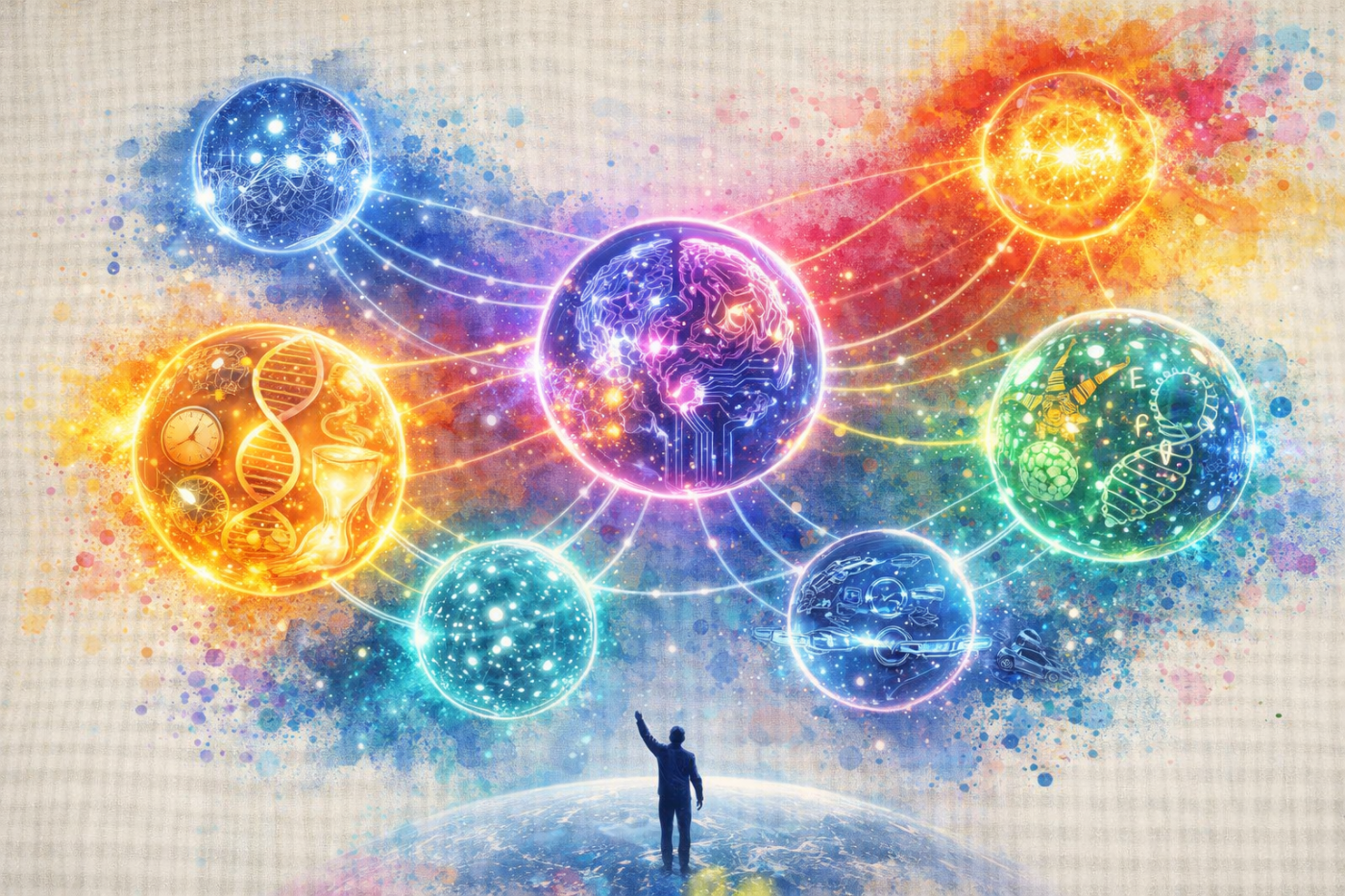
Or: How Brain Chips, Fusion Reactors, and Designer Genes Will Transform Everything (And Probably Make Someone Obscenely Rich)
The giants want in on this.
Google, Apple, Meta, Microsoft, Tesla—they’re all positioning themselves for the next wave of world-changing innovation. Google’s pouring billions into longevity research through Calico. Meta’s betting the company on brain-computer interfaces. Microsoft’s hedging every bet from quantum computing to fusion energy. Tesla thinks they’ll solve autonomous everything.
They might succeed. They have the capital, the talent, the infrastructure.
But history suggests otherwise.
IBM dominated computing until two kids in a garage built Apple. Microsoft owned software until two Stanford students created Google. Nokia ruled mobile phones until Apple made them obsolete. Blockbuster owned video rental until Netflix destroyed the entire category.
The pattern repeats: the incumbents see the future coming, invest heavily, and somehow still miss it. The world-changing companies usually come from somewhere else—some obsessed founder working on something the giants think is too small, too risky, or too crazy.
So while the tech behemoths maneuver for position, the real action is happening in labs, garages, and startups you haven’t heard of yet. The next seven titans are probably already working. We just don’t know their names.
Here’s what they’re building.
1. The Longevity Company
What They’re Building
The first company to crack biological aging doesn’t just extend lifespans—they collapse every assumption underlying human civilization. We’re not talking about adding a few years of decrepitude at the end. We’re talking about age reversal. Turning sixty-year-old bodies back to thirty. Indefinitely.
Altos Labs, funded by Jeff Bezos and Yuri Milner, is betting $3 billion on cellular reprogramming. Calico, Google’s longevity subsidiary, is approaching aging as an engineering problem. BioAge Labs is targeting the biological mechanisms that make old bodies old.
One of them—or someone working in a lab we haven’t heard about—will figure it out.
The Transformation
Retirement at sixty-five? Obsolete. Social Security? Bankrupt. Marriage “till death do us part”? That’s now a 150-year commitment. Career arcs designed for forty working years? Meaningless when you have centuries.
Education gets rebuilt. Why rush through college at twenty when you have unlimited time? Healthcare becomes preventive maintenance, not crisis intervention. Population growth inverts—nobody dies, everyone keeps living, resources stretch thin.
The existential questions get uncomfortable fast: Who gets access? Do we enforce death? What happens when billionaires live forever and compound their wealth for centuries?
Impact
Death is the only truly universal human experience. Remove it, and literally everything changes. Every religion, philosophy, economic model, and social structure assumes human mortality. This company doesn’t just change life—it changes what life means.
Impact Factor: 7/7
2. The Brain-Computer Interface Company
What They’re Building
Neuralink gets the headlines because Elon Musk is involved. But Synchron is already implanting devices in humans. Paradromics is developing higher-bandwidth systems. Someone will crack direct neural connection to digital systems—thought becomes input, communication becomes telepathic, memory becomes uploadable.
The line between human and machine doesn’t blur. It disappears.
The Transformation
Imagine learning Spanish by downloading it like software. Communicating complex ideas without clumsy language. Accessing the entire internet with a thought. Experiencing someone else’s memories. Controlling machines with your mind.
Now imagine your thoughts being hacked. Your memories being edited. Your consciousness being backed up, copied, or sold. Cognitive enhancement creating new class divisions—those who can afford neural upgrades and those who can’t.
Privacy becomes neurological. Your phone tracks where you go; your brain chip tracks what you think.
Impact
Ford changed physical mobility. Apple changed digital interaction. This changes consciousness itself. When thinking and computing merge, what does “human” even mean anymore?
Impact Factor: 7/7
3. The Synthetic Biology Company
What They’re Building
Ginkgo Bioworks calls themselves “the organism company.” They’re programming cells like software—design organisms that eat plastic, produce fuel, manufacture materials, cure disease, or enhance human capabilities.
CRISPR was the beginning—gene editing for amateurs. This is industrial-scale biological engineering. Biology becomes programmable. Evolution becomes optional.
The Transformation
Manufacturing moves from factories to bioreactors. Need spider silk? Program bacteria to produce it. Want jet fuel? Design yeast that secretes it. Plastic pollution? Create organisms that digest it.
Designer babies become accessible, then mandatory for competitive parents. Pandemics become engineerable weapons—or cures. Food production divorces from agriculture. Meat grows in labs. Vegetables grow in urban bioreactors.
The ethical questions spiral immediately: Who decides what life to create? What happens when someone designs a superbug? Do we patent life forms? What rights do synthetic organisms have?
Impact
This is evolution on demand. Darwin becomes obsolete. Natural selection gets replaced by intentional design. We’re not adapting to nature anymore—we’re rewriting it.
Impact Factor: 7/7
4. The Quantum Computing
What They’re Building
IonQ, Rigetti, PsiQuantum—someone will achieve fault-tolerant quantum computing at scale. The first company to do it doesn’t just make computers faster. They break all current encryption, making every digital secret vulnerable. They also enable molecular simulation, revolutionizing drug discovery, materials science, and climate modeling.
The Transformation
Every password, every encrypted message, every secure transaction currently relies on problems that take classical computers millions of years to solve. Quantum computers solve them in minutes.
All current cryptography becomes useless overnight. Financial systems must rebuild security from scratch. Every encrypted secret ever transmitted—government communications, corporate data, personal information—becomes retroactively vulnerable.
But the positive applications are equally staggering: drug development accelerates 100x through molecular simulation. Weather prediction becomes genuinely accurate. Optimization problems that took weeks now solve instantly—logistics, resource allocation, traffic patterns.
Impact
IBM made data manageable. This makes the impossible computable. Also makes the secure vulnerable. It’s the ultimate double-edged sword—revolutionary capability, catastrophic security implications.
Impact Factor: 6/7
5. The Fusion Energy Company
What They’re Building
Commonwealth Fusion Systems, backed by Bill Gates, is building SPARC—a compact fusion reactor. Helion Energy has contracts to deliver fusion power to Microsoft. TAE Technologies is approaching fusion from a different angle entirely.
Someone will crack it. Abundant, clean, virtually unlimited energy from fusion reactions—the same process that powers the sun.
The Transformation
Energy becomes too cheap to meter. Climate change becomes solvable through carbon capture at scale—when energy is free, you can afford massive atmospheric cleanup. Water scarcity disappears through desalination. Energy-intensive manufacturing becomes viable everywhere.
Entire petro-economies collapse. Middle Eastern oil states, Russian gas exports, Venezuelan petroleum—worthless. Geopolitical power shifts completely. Wars over energy resources become historical curiosities.
Space travel becomes economically viable. Asteroid mining. Mars colonization. When energy costs approach zero, the impossible becomes routine.
Impact
GE brought electricity to the world. This makes energy infinite and clean. It’s not just an upgrade—it’s the foundation for everything else on this list. You can’t run quantum computers, longevity treatments, or synthetic biology labs without massive energy. Fusion unlocks all of it.
Impact Factor: 7/7
6. The Autonomous Systems Company
What They’re Building
Tesla wants this to be them with Full Self-Driving. Waymo thinks they’re already there. Aurora is betting on autonomous trucks. But the real winner will achieve reliable, scalable autonomy across domains—not just self-driving cars, but autonomous everything.
Transportation without drivers. Warehouses without workers. Delivery without humans. Construction without crews.
The Transformation
Three to four million truck drivers lose their jobs. Taxi drivers, delivery drivers, warehouse workers—gone. Urban planning gets redesigned because parking becomes obsolete. Accidents reduce 90%+ because humans are terrible drivers.
Delivery costs approach zero. Your Amazon package arrives via autonomous drone minutes after ordering. Construction costs plummet—robots build houses 24/7 without breaks. Agriculture becomes fully automated.
But also: surveillance becomes frictionless. Every autonomous vehicle is a mobile sensor platform. Governments and corporations track everyone, everywhere, constantly. Freedom of movement becomes freedom of tracked movement.
Impact
Ford mobilized humans. This removes humans from mobility entirely. It’s the final automation—the moment when machines don’t just assist human labor, they replace it completely.
Impact Factor: 6/7
7. The Decentralized Infrastructure Company
What They’re Building
Ethereum pioneered decentralized computing. Helium built decentralized wireless networks. Filecoin created decentralized storage. But the real winner will build genuinely decentralized infrastructure that governments can’t control, corporations can’t monopolize, and individuals can’t be excluded from.
This is digital sovereignty.
The Transformation
Financial systems operate outside government control. Communication networks immune to censorship. Identity and credentials without central authorities. Contracts that execute automatically without legal systems.
Nation-states lose their monopoly on infrastructure. China can’t censor it. America can’t surveil it. Russia can’t shut it off. No single company controls it. No government regulates it.
This either enables radical freedom or facilitates untraceable crime. Probably both simultaneously.
Impact
Every company on our original list—Ford, GE, IBM, Apple, Google, Amazon, OpenAI—reinforced centralized power. They became massive because they controlled infrastructure.
This one genuinely distributes it. Or tries to. Whether decentralization can actually scale remains the trillion-dollar question.
Impact Factor: 6/7
The Pattern: How Future Titans Are Made
Just like Ford, GE, IBM, Apple, Google, Amazon, and OpenAI, these next seven share key characteristics:
Infrastructure Plays: They’re building foundational systems, not just products. Rails, not trains.
Democratization: They make expensive or impossible things accessible. Longevity for everyone. Brain enhancement for all. Energy abundance. Biology as software.
Network Effects: Value compounds with scale. The more people with brain interfaces, the more useful they become. The more organisms designed, the better the tools get.
Cultural Shift: They change human behavior permanently. You can’t unlearn telepathy. You can’t forget immortality. You can’t go back to resource scarcity after abundance.
Controversy Guaranteed: Each will face massive ethical, political, and social backlash. Who gets to live forever? Who can upgrade their brain? Who controls synthetic life? Every breakthrough creates new inequalities.
The Uncomfortable Timeline
Short-term (5-10 years):
Brain-computer interfaces achieve medical breakthroughs—helping paralyzed people walk, blind people see. Then they keep going.
Autonomous systems reach regulatory approval at scale. Trucking becomes automated. Delivery becomes autonomous. Jobs disappear.
Quantum computing breaks RSA encryption. The cybersecurity world panics. Financial systems scramble to rebuild.
Medium-term (10-25 years):
Fusion energy achieves commercial viability. First fusion plants come online. Energy costs begin their collapse toward zero.
Synthetic biology creates first designer organisms at scale. Bioreactors start replacing factories. Agriculture moves indoors.
Longevity treatments extend healthy lifespan 20-30 years. The wealthy start buying extra decades. Inequality becomes temporal.
Long-term (25-50 years):
Decentralized infrastructure reaches critical mass. Nation-states lose control of digital systems. New forms of organization emerge.
Space mining becomes economically viable. Asteroid resources make Earth’s scarcity obsolete.
Consciousness upload achieves proof-of-concept. Digital immortality becomes theoretically possible. Philosophy departments have collective meltdowns.
The Really Uncomfortable Truth
Just like the first seven titans, these next seven will:
- Solve massive problems
- Create equally massive new problems
- Generate obscene wealth for founders
- Exploit workers and resources
- Face regulatory battles
- Potentially enable authoritarian control
- Make life unimaginably convenient
- Make opting out nearly impossible
And yes, they’ll probably all be American. Or Chinese.
The infrastructure, capital, risk tolerance, and talent concentration required for this level of transformation exists in very few places. America’s institutions—the ones built specifically to prevent tyranny and enable risk—still create conditions where transformative companies emerge.
China’s state-directed capitalism and massive scale create different conditions but similar outcomes. They’re pouring billions into quantum computing, fusion energy, and synthetic biology.
Europe will regulate thoughtfully and miss the wave entirely. Canada will build excellent social programs to cushion the disruption while creating none of it ourselves.
As a Canadian, I’ll watch from the sidelines again. We’ll apologize for existing, regulate ourselves into comfortable irrelevance, and then implement these technologies fifteen years after everyone else has worked out the bugs.
The Optimistic Case
Here’s what nobody wants to admit: these technologies could actually work.
Longevity could mean healthier, longer lives—not just extended suffering. Brain-computer interfaces could cure paralysis, depression, dementia. Synthetic biology could clean the oceans, feed billions, and cure cancer. Quantum computing could optimize everything. Fusion could solve climate change. Autonomy could eliminate traffic deaths. Decentralization could prevent tyranny.
The upgrades could genuinely upgrade civilization.
Or they could create new forms of inequality, surveillance, and control that make our current dystopia look quaint.
Probably both. History suggests we get the miraculous benefits and the catastrophic side effects simultaneously. Progress never arrives clean.
The Question
The question isn’t whether these companies will emerge and transform everything. They will. The question is whether we’ll demand they do it better than the last seven titans did.
Ford gave us mobility and murdered Main Street. GE gave us electricity and polluted the planet. IBM gave us computing and enabled genocide. Apple gave us smartphones and destroyed attention. Google gave us information and normalized surveillance. Amazon gave us convenience and crushed labor. OpenAI gave us AI and… well, we’re still finding out.
The pattern is clear: transformative technology arrives, changes everything, creates massive wealth, generates enormous problems, and we adapt because we have no choice.
Will the next seven be different?
My money says no.
But I’m rooting for yes.
Which, as a Canadian, is the most optimistic position I can take.
We’ll see what happens.
Ready or not.
 Notes Beyond the Map
Leave a comment