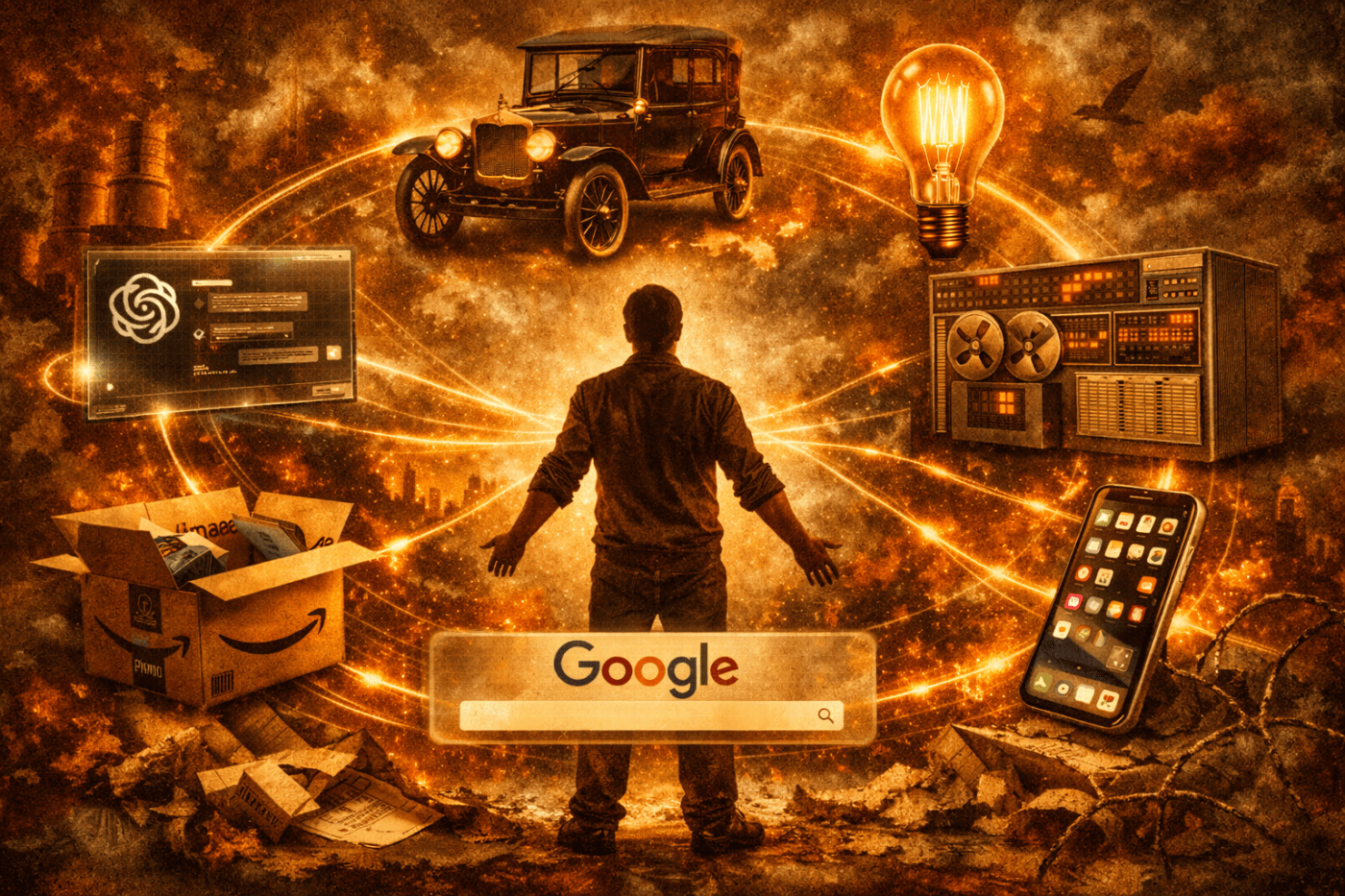
Or: A Meditation on Progress, Tyranny, and Why Canadians Are Too Polite to Change the World
Seven American companies have done more to reshape human existence than all the empires, religions, and revolutions of the previous five thousand years combined.
And here you are, probably reading this on a device made by one of them, having Googled your way here, with an Amazon package arriving tomorrow, annoyed that it’s taking so long.
The cognitive dissonance is delicious, isn’t it?
Ford Motor Company
Founder & Vision
Henry Ford founded his company in 1903 with a radical proposition: “I will build a car for the great multitude… so low in price that no man making a good salary will be unable to own one.” Ford didn’t invent the automobile—he made it inevitable.
What They Created
The assembly line, introduced in 1913, was the most boring innovation in human history. Take skilled craftsmen and replace them with interchangeable humans doing one repetitive task forever. But here’s the trick: Ford paid workers enough to buy the cars they built. The $5 workday wasn’t generosity—it was genius capitalism. Create your own customers.
Ford accidentally invented the American middle class. The weekend exists because he needed rested consumers. Suburbs exist because cars made distance irrelevant. The assembly line became the template for manufacturing everything from refrigerators to bombers.
Controversies
Henry Ford wasn’t just casually anti-Semitic—he was internationally influential in his hatred. His newspaper, The Dearborn Independent, ran “The International Jew: The World’s Problem,” which was so popular with Nazis that Hitler kept Ford’s portrait in his office and cited him in Mein Kampf.
Ford received the Grand Cross of the German Eagle from Hitler in 1938—the highest honor Nazi Germany could bestow. His German subsidiary built military vehicles for the Wehrmacht using slave labor from concentration camps. The assembly line methods Ford pioneered made German rearmament terrifyingly efficient.
Nobody talks about this at Ford dealership openings.
Impact
Try getting anywhere without using systems Ford’s innovation spawned. You can’t. That’s how thoroughly he won. Mass production made the modern world physically possible—along with traffic jams, suburban sprawl, and climate change.
Impact Factor: 7/7
General Electric
Founder & Vision
Thomas Edison founded GE in 1892 with characteristic boldness: “We will make electricity so cheap that only the rich will burn candles.” Edison understood that selling light bulbs without electrical infrastructure was like selling cars without roads.
What They Created
Before GE standardized electrical infrastructure, life ended at sundown. After GE, humans told darkness to go to hell. Factories ran 24/7. Cities glowed. Food stayed fresh. Babies survived in incubators.
GE also invented the corporate research laboratory in 1900—the template for every tech company’s “innovation lab” today. This methodology built atomic reactors, jet engines, and medical imaging.
Impact
None of the other companies on this list could exist without electricity. You can’t run computers or charge smartphones without the grid GE built. Everything else is decoration on their infrastructure.
The cost? 24/7 exhaustion, light pollution that killed the stars, and an energy appetite that requires strip-mining the planet. Progress always costs something.
Impact Factor: 7/7
IBM
Founder & Vision
Charles Ranlett Flint founded IBM in 1911, but Thomas J. Watson Sr. transformed it. Watson’s vision was embodied in one word posted in every office: “THINK”—systematic problem-solving through information management. Watson believed corporate culture was competitive advantage: dark suits, white shirts, professional presentation. IBM sold respectability along with machines.
What They Created
Watson’s son bet the company on the System/360—a $5 billion gamble that nearly bankrupted them but standardized computing. IBM made data manageable when data was punch cards and paper. They built room-sized computers that let corporations think at scale.
When personal computers killed their mainframe business, IBM pivoted to services, becoming the company that helps other companies survive technological disruption.
Controversies
IBM’s German subsidiary, Dehomag, made the Holocaust administratively possible. IBM’s punch card technology allowed Nazis to automate the identification, cataloging, and deportation of Jews with terrifying efficiency. Each person received a Hollerith card: column 34, hole 3 meant Jewish.
These weren’t generic machines repurposed—IBM headquarters in New York maintained direct control, customized systems for Nazi requirements, and provided ongoing service throughout the war. Auschwitz had a Hollerith Department. The numbers tattooed on prisoners’ arms corresponded to IBM’s tracking codes.
Watson received the Grand Cross of the German Eagle in 1937. He returned it after Kristallnacht, but IBM kept servicing the machines. After the war, they recovered German operations and continued business. They’ve never formally apologized.
Six million people didn’t get to move on.
Impact
IBM didn’t make computers sexy—they made them useful. Boring, essential, civilization-enabling.
Impact Factor: 6/7
Apple
Founders & Vision
Steve Jobs, Steve Wozniak, and Ronald Wayne founded Apple in 1976. Wayne sold his 10% stake for $800—history’s most expensive case of cold feet. Jobs’ vision evolved from “A computer for the rest of us” to “People don’t know what they want until you show it to them.”
What They Created
The Macintosh brought graphical interfaces to mortals. The iPod killed CD collections. The iPhone, released in 2007, killed everything else: cameras, maps, alarm clocks, newspapers, and dinner conversation.
Apple made you feel sophisticated for joining the cult. Android users are peasants with green text bubbles. Apple didn’t just sell products—they sold identity.
Controversies
Apple’s devices are assembled in Chinese factories where workers have jumped to their deaths. Foxconn installed suicide nets around buildings. Not better conditions—nets. Workers do 12-hour shifts, six days a week, assembling devices they’ll never afford.
Apple champions privacy while removing VPN apps from China’s App Store at government request and storing Chinese users’ data on state-controlled servers. Privacy principles are negotiable when market access is at stake.
The company fights “right to repair” legislation because they make more money if you can’t fix your own device. Your $1,200 phone is designed to be thrown away. But it’s beautiful when you throw it away.
Impact
The iPhone created the app economy, gig economy, and attention economy. It made everyone a photographer and navigator. It also made eye contact optional. Humans check their phones 96 times per day. We’ve become cyborgs and paid premium prices for it.
Impact Factor: 7/7
Founders & Vision
Larry Page and Sergey Brin founded Google in 1998 with messianic ambition: “To organize the world’s information and make it universally accessible and useful.” Not some information—ALL of it. Universally accessible. Forever.
They actually did it.
What They Created
Google made information instant. We’ve outsourced memory to their servers. Phone numbers, directions, facts—why remember anything when Google remembers everything?
The business model: give away miraculous products free, then sell access to users’ attention. AdWords made advertising scientific. Gmail gave unlimited storage for reading your email. Maps made you navigable. Android democratized smartphones. YouTube made everyone a broadcaster.
Controversies
Google’s entire business model is surveillance capitalism. When Gmail launched, they’d read your email to serve ads. Their defense? Algorithms do it, not humans, so it doesn’t count as privacy invasion.
Google Street View cars secretly collected data from unsecured WiFi networks—emails, passwords, browsing histories. They called it an “accident.” For years.
Google bypassed Safari privacy settings to track users who explicitly opted out. Their fine? $22.5 million—about four hours of revenue.
YouTube recommends conspiracy theories and facilitates radicalization because engagement metrics matter more than human wellbeing. The company’s motto was “Don’t be evil” until 2015 when they quietly changed it to “Do the right thing.” Probably because “evil” got harder to define.
Impact
Google knows where you go, what you search, who you email, what you watch. They’ve normalized this. You carry their tracking device voluntarily and pay for the privilege.
Impact Factor: 6/7
Amazon
Founder & Vision
Jeff Bezos founded Amazon in 1994 with two visions: become “Earth’s most customer-centric company” while maintaining “Day 1” thinking—treating every day like a startup fighting for survival, even at empire scale. The vision was always bigger than books: sell everything to everyone, remove all friction from commerce.
What They Created
Amazon is two companies wearing a trench coat. AWS rents computing power to startups—every app you use probably runs on their servers. The retail side eliminated commerce friction: search, compare, buy, receive. Prime made two-day shipping expected, then one-day, then same-day.
Amazon trained us like Pavlov’s dogs. The brown box means dopamine. Three-day shipping means suffering.
Controversies
Amazon surveils workers with Orwellian thoroughness. Warehouse employees wear devices tracking every movement, measuring productivity per second, auto-generating termination warnings for bathroom breaks. Drivers have AI cameras monitoring their faces for “distraction.” Yawn too much? Warning.
Ring doorbells create a privatized surveillance network law enforcement can access without warrants. You bought a doorbell. You created neighborhood police monitoring.
Amazon crushed unions with tactics that would make robber barons proud. When Staten Island workers unionized in 2022, it was despite Amazon spending $4.3 million on union-busting consultants.
Bezos became the world’s richest man while Amazon paid $0 in federal taxes in 2018. Zero.
Impact
They’ve crushed Main Street and turned workers into metrics. But you still use them because convenience beats principle every time.
Impact Factor: 6/7
OpenAI
Founders & Vision
Sam Altman, Elon Musk, Greg Brockman, Ilya Sutskever, and others founded OpenAI in 2015 with a noble mission: “Ensure artificial general intelligence benefits all of humanity.”
OpenAI started as a non-profit. Musk left. The structure changed to “capped profit.” Microsoft invested $13 billion. The scrappy non-profit became a company worth hundreds of billions. Racing to AGI while trying to make it safe is like building an airplane while falling out of the sky.
What They Created
ChatGPT reached 100 million users faster than any product in history. Suddenly everyone had an AI assistant that could write essays, debug code, explain physics. OpenAI made AI accessible—usable by anyone with internet.
This is doing to cognitive labor what Ford did to physical labor: democratizing it, multiplying it, making people nervous about jobs.
Controversies
OpenAI was founded as a non-profit to ensure AI benefits humanity. That lasted two years before changing to “capped profit”—meaning “actually we’d like money.”
They promised open research. Then GPT-2 was “too dangerous” to release (they eventually did). GPT-3 was API-only. GPT-4’s architecture is completely secret. So much for “Open” AI.
Altman was fired by the board in November 2023 over trust breakdown. He was reinstated five days later after employee threats and Microsoft pressure. What happened? We don’t know. The company building humanity’s future can’t maintain organizational stability.
OpenAI scraped the entire internet—copyrighted books, articles, code, art—without permission or compensation. When creators objected, OpenAI’s response: “We needed it, we didn’t ask, we’re not paying, deal with it.”
Microsoft now owns 49% and has exclusive model access. The company building AGI is controlled by a corporation whose primary obligation is shareholders, not humanity.
Impact
Jobs will vanish. New jobs will emerge. We’ll achieve abundance or dystopia—possibly both. It’s too early for a 7, but trajectory is clear. They’ve forced humanity to confront questions about consciousness and purpose we’ve avoided since Socrates.
Impact Factor: 6/7 (for now)
The American Exception
All seven companies are American. Not British. Not German. Not Japanese. Not Canadian.
This isn’t luck—it’s architecture.
America was founded by people who told King George to pound sand. They built institutions to prevent tyranny: separation of powers, protected speech, property rights, bankruptcy laws that let you fail without dying. They created culture celebrating risk and tolerating failure.
The result? A country producing more world-changing companies than anywhere else, while simultaneously producing medical bankruptcy, mass shootings, and political chaos.
I’m Canadian. We built safety nets instead of rocket ships. We regulate more, risk less, apologize constantly. We’re comfortable, stable, pleasant. We’ve invented insulin, basketball, and poutine.
We haven’t built a single company that fundamentally altered human civilization.
But when you’re reading this under electric lights, on your iPhone, having Googled something, waiting for Amazon to deliver ChatGPT’s upgrade—you’re living in a world built entirely by American companies enabled by American institutions.
A country born from rebellion against empire built the most successful economic empire in history—not through conquest, but through convenience.
The Inconvenient Conclusion
These seven companies built modern life’s infrastructure. They made expensive things cheap, difficult things easy, impossible things commonplace.
They also facilitated genocide, normalized surveillance, crushed labor rights, stole intellectual property, and conditioned us to accept exploitation as convenience’s price.
Both statements are true.
The question isn’t whether these companies changed the world—they did. The question is what we do with the world they built, whether we’ll demand better, and whether the next seven will repeat the pattern or finally build something not requiring us to compromise humanity for convenience.
My money’s on more of the same.
Which, as a Canadian, pains me to admit.
But facts don’t care about national pride.
And corporations don’t care about anything except what we force them to care about.
 Notes Beyond the Map
Leave a comment