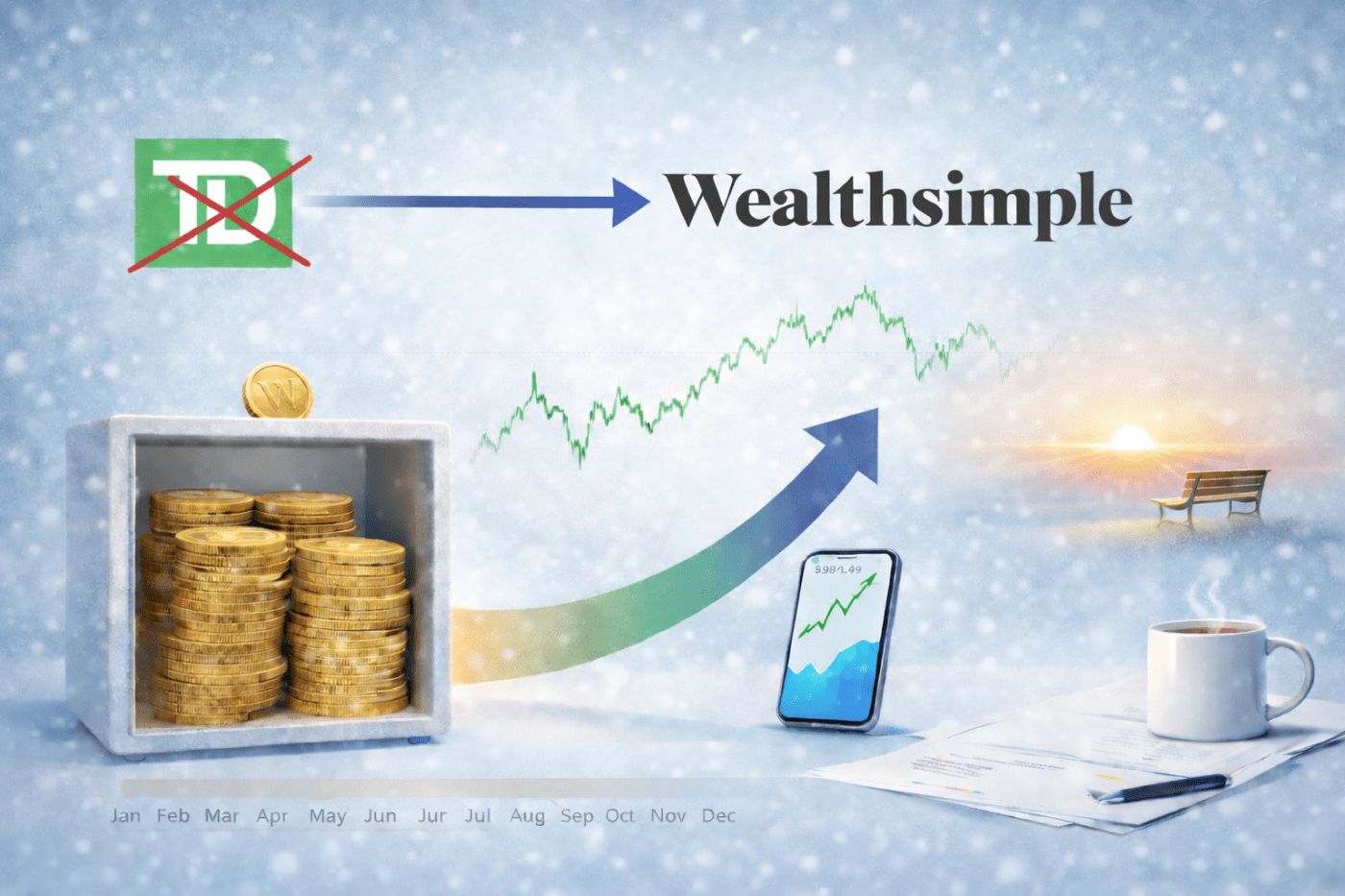
Or: What I Learned After Breaking Up With TD and Never Looking Back
Listen, I’m going to tell you about money, which is almost as uncomfortable as talking about death or why your uncle believes the moon landing was faked. But stick with me here, because this story involves me doing something I swore I’d never do: admitting I was wrong about something for fifteen years.
The Great Migration of 2024
So there I was, a loyal TD customer since I was five years old. Five. That’s nearly 38 years of unwavering loyalty, the kind of relationship that outlasts most marriages and all professional sports careers. I started trading with TD Direct Investing in my late twenties, paying $15.99 every time I wanted to buy or sell a stock—until I finally crossed the $100,000 asset threshold and got “upgraded” to their premium rate of $9.99 per trade. What a privilege that was, like being promoted from getting robbed at gunpoint to merely getting pickpocketed.
I’d been registered with Wealthsimple for five years, sure, but I was that person—you know the type—who keeps both feet in the old way while dipping one cautious toe into the new. I had a few crypto coins with them. A little experimental money. The financial equivalent of keeping your old flip phone “just in case” even though you’ve already bought the smartphone.
Then I realized something: I was tired of being robbed by TD. Not robbed in the dramatic, ski-mask-and-getaway-car sense, but in the slow, methodical, death-by-a-thousand-paper-cuts way that’s somehow legal when banks do it. It was time to move to Wealthsimple.
So last year, I did something that felt as momentous as finally admitting that streaming is better than cable or that your ancient car with 300,000 kilometers probably isn’t going to make it another year: I moved everything. And I mean everything. My assets. My checking account. My savings. My credit card. The whole catastrophe, as they say.
Breaking up with a bank you’ve been with for 38 years isn’t easy. It’s the financial equivalent of leaving your hometown. There’s history there. Comfort. Familiarity. But sometimes familiarity is just another word for “being taken advantage of so gradually you didn’t notice.”
Why did I finally make the leap? Well, partly because Wealthsimple offered me a free MacBook and $2,500 to move my RRSP. I’m not proud, and I’m not going to pretend that wasn’t a factor. But mostly because I’d spent nearly four decades watching TD treat me like a cash machine with legs, and I was tired of it.
The Shopify of Wealth Management
Here’s what Wealthsimple reminds me of: Shopify. And if you know anything about Canadian innovation, you know that’s high praise.
Shopify took e-commerce—something that was clunky, expensive, and accessible only to big corporations—and made it simple, affordable, and available to everyone. They were innovative. They took risks. They built a platform that was not just easy to use but actually addictive to use, the kind of thing that makes you want to log in just to see what’s possible.
Wealthsimple is doing the exact same thing for financial wealth management. They’ve taken something that traditional banks have made deliberately complicated and intimidating, and they’ve turned it into something sleek, intuitive, and dare I say it—enjoyable. When was the last time you enjoyed using your bank’s platform? I’ll wait.
The interface is clean. The tools are modern. The whole experience feels less like doing your taxes and more like, well, actually managing your future. It’s the kind of platform you open up just to check on things, not because you have to, but because you want to.
The Canadian Banking Paradox
Now, I’m Canadian, and I’m proud of it. Our banking system kept us relatively intact during the 2008 financial crisis while American banks were collapsing like houses of cards in a windstorm. We’re careful. We’re regulated. We’re stable. And you know what? Our banks are also boring as hell and about as innovative as a bag of wet sand.
Here’s the uncomfortable truth about Canadian banks: they’re really good at holding your money. They’re also really good at making you pay them for the privilege of holding your money. It’s like paying someone to store your furniture in their garage, except they also charge you every time you want to take something out, and occasionally they just help themselves to a little extra because, well, you’re already there.
Innovation? What’s that? Canadian banks act like the internet is still a novelty, like mobile apps are experimental technology, and like customer service is something you should be grateful to receive rather than something you’re actually paying for. They’ve spent decades building moats around their profits and calling it “stability.”
The Numbers Don’t Lie (Though Banks Sure Try)
Here’s what happened next, and I want you to pay attention because this is the part that sounds like I’m making it up: In one calendar year, I doubled the size of my portfolio.
Doubled it.
Now, before you start thinking I’m some kind of financial wizard or that I’ve discovered the secret to wealth that they don’t want you to know (spoiler: there isn’t one), let me add some context. Was it partly luck? Sure. Was it partly because Trump won the presidency and the market did its thing? Probably. But here’s what I really believe made the difference: I could finally see what I was doing.
With TD’s clunky, outdated tools—which looked like they’d been designed by someone who thought the internet was a passing fad—I was flying blind. With Wealthsimple’s sleek interface and actual, useful analytics, I could measure things. Track things. Understand things. It was like going from reading by candlelight to turning on the sun.
Yes, I’d been in a hole since 2022 when everything dove off a cliff like lemmings with investment portfolios. We all were. But the fact that I could make up all those losses in one year and then add enough extra to actually double my holdings? That wasn’t just luck. That was visibility. That was information. That was having tools built for 2025, not 1995.
The $9.99 Death by a Thousand Cuts (And Some Poor Souls Pay Even More)
Let’s talk about those trading fees for a moment, because this is where traditional banks are quietly picking your pocket while you’re distracted by their marble lobbies and free lollipops.
When I started with TD Direct Investing, I was paying $15.99 per trade. Fifteen ninety-nine! And that was considered normal. Buy a stock? $15.99. Sell it later? Another $15.99. That’s nearly thirty-two dollars round trip. Once I finally accumulated over $100,000 in assets, TD generously “rewarded” my loyalty by dropping my fee to $9.99 per trade. I was supposed to feel grateful for this, like some medieval peasant thankful the lord reduced his tax burden.
Even at the “discounted” rate, I was making 50 to 100 trades a year. Do the math—and I know you don’t want to because it’s depressing—but that’s between $1,000 and $2,000 annually just for the privilege of moving my own money around. At the higher rate I started with? Even worse.
And here’s the kicker: Some customers at other Canadian brokerages are still paying up to $15.99 per trade. In 2025! That’s not a typo from 1995—people are actually paying sixteen dollars to click a button on a website. It’s like paying for air, except at least air is essential.
With Wealthsimple? Zero dollars.
Not “low fees.” Not “reduced costs.” Zero. Nothing. Nada. The same amount of money I have after reading the terms and conditions on literally anything.
Over the course of a year, that’s the difference between paying for a decent vacation and paying TD for doing essentially nothing. Over a decade? Well, that’s a down payment on a house, or a new car, or approximately 200 really good dinners, or one medium-sized yacht if you’re into that sort of thing.
Money That Actually Works For You (What a Concept)
Here’s something that still blows my mind: Over the course of this past year, I’ve made over $300 just from having my money sit in my checking and savings accounts with Wealthsimple.
Read that again. Three hundred dollars. For doing absolutely nothing except keeping my money somewhere that actually respects it.
With TD? I got nothing. Zero. Not a penny. In fact, they charged me monthly fees for the privilege of letting them hold my money so they could lend it out and make themselves money. It’s like paying someone to borrow your car so they can use it as an Uber.
That $300 isn’t life-changing money, I’ll grant you that. But it’s a free dinner for two at a nice restaurant. It’s a new pair of shoes. It’s a weekend getaway. It’s three hundred dollars I wouldn’t have had if I’d stayed with TD, and it required exactly zero effort on my part.
Now multiply that across Wealthsimple’s entire client base. Last year, their customers collectively earned $200 million in interest on their chequing accounts. That’s two hundred million dollars that traditional banks would have simply kept for themselves while giving you nothing in return.
The Credit Card Switcheroo
In August, I did something that felt almost as significant as moving my investment accounts: I enrolled in Wealthsimple’s credit card. Now, this wasn’t a decision I made lightly. I’d enrolled in TD’s Infinite Visa back when I started trading in my late twenties—it had been with me for nearly 17 years. Seventeen years. It had been fantastic for most of that time. I racked up thousands of dollars worth of travel points. Paid for trips for my wife and me. It was a good run, the kind of relationship you don’t end without some genuine consideration.
But here’s the thing about life stages: what makes sense when you’re traveling constantly doesn’t always make sense when your priorities shift. I found myself in a position where I preferred cold, hard cashback over travel points. Two percent might not sound like much—it’s the kind of number that makes you shrug—but it adds up faster than you’d think.
I haven’t even been spending that much this year, and I’ve already received over $350 back. That’s $350 for buying things I was going to buy anyway. For no annual fee. No hoops to jump through. No complicated redemption schemes where you need a PhD to figure out how to actually use your points.
It’s just money. Real money. Back in your account. What a concept.
The Perks (Or: When Your Bank Actually Gives You Things)
Now, here’s where it gets really interesting. Wealthsimple has these tiers—Premium and Generation—and I’ve been enjoying my Generation benefits, which honestly make me wonder what TD was doing with all those fees they collected from me over the years. Certainly not giving anything back.
At the end of each year, I get a free Strava membership. That’s over $100 in value right there, just for doing what I was already doing. I get 10 free airport lounge visits annually through DragonPass, which, if you’ve ever traveled and wanted to escape the chaos of airport terminals, you know is worth its weight in gold. And there’s much, much more.
They also offer a premium advisory service that I haven’t fully explored yet, but the fact that it exists—that they’re actively trying to help people manage their wealth rather than just extract fees from them—tells you everything you need to know about the difference in philosophy.
Taking a Chance on Managed Portfolios (Again)
Here’s something I never thought I’d do: I’ve joined some of Wealthsimple’s managed portfolios. Now, I haven’t touched managed portfolios since mutual funds back in 2009, when I got absolutely burned and made virtually no money. That experience left a bad taste in my mouth that lasted over a decade.
But I’m getting older now. I’m thinking differently about risk, about time, about what I want my money to do for me. So I thought, hey, let’s see what this company can do for me. I’m always a little hesitant with these types of things—once bitten, twice shy, as they say—but Wealthsimple has earned enough of my trust that I’m willing to give them a shot.
So far? So good. The transparency is there. The performance is solid. The fees are reasonable. It’s everything those 2009 mutual funds weren’t, and it’s reminding me that not all managed investments are created equal. Sometimes the problem isn’t the concept—it’s the people running it and the fees they’re charging.
Breaking Free From the Banking Overlords
Here’s what kills me: There are millions of Canadians out there still banking with TD, RBC, Scotiabank, BMO, or CIBC who are getting absolutely fleeced and don’t even realize it. These banks charge you for having a checking account—like you’re renting space in their database. They charge you for transfers. They charge you for breathing too close to their ATMs, probably.
These institutions aren’t helping you build wealth. They’re extracting it from you like vampires with better PR departments and shinier buildings.
When I moved to Wealthsimple, I stopped paying checking account fees. I stopped paying transfer fees. I stopped paying those mysterious “service charges” that show up on your statement like uninvited guests at a party. Instead, I started earning money on my uninvested cash. I made over $300 this year just from my checking and savings accounts. Money that traditional banks would have kept while giving me nothing.
Think about that for a second. The big Canadian banks—the ones with buildings in every city and logos on every hockey rink—could easily pay you interest on your checking account. They just choose not to. Because why would they? You’re already there. You’ve been there for years. Decades, even. Your parents probably banked there. Inertia is their best business strategy, and it’s working.
I was the poster child for that inertia. Thirty-eight years with the same bank. That’s longer than most people keep the same job, the same car, or even the same spouse. And what did TD give me for that loyalty? Higher fees than their competitors and tools that looked like they were designed during the dial-up era.
The Wealthsimple Expansion Project
Once I’d moved my main accounts over, something funny happened: I couldn’t stop. It was like getting one tattoo and then suddenly you’re planning your next three. I opened an FHSA. I invested in various portfolios. I got their credit card when they launched it—which, by the way, was the number one requested product in Wealthsimple’s history, and for good reason.
The company is moving fast, building fast, and actually listening to what people want instead of what some executives in a boardroom think people should want. In 2025 alone, they launched more products than ever before: margin accounts, expanded options strategies, 24/5 trading, self-directed RESPs, mobile cheque deposit, USD savings accounts, international money transfers.
Traditional banks, meanwhile, are still figuring out how to make their apps work without crashing.
This is what innovation looks like. Not just doing the same old thing with a slightly newer coat of paint, but actually building tools that people need, want, and will use. Wealthsimple is a Canadian company, built in Canada, for Canadians. And they’re showing us what’s possible when you prioritize customers over quarterly profit margins.
Like Shopify disrupted e-commerce, Wealthsimple is disrupting wealth management. And just like Shopify, they’re not doing it by playing it safe—they’re doing it by taking risks, moving fast, and actually giving a damn about user experience.
A Letter Worth Reading
A week ago, Michael Katchen, Wealthsimple’s CEO, sent out his annual letter to customers. Now, I’ve received a lot of letters from financial institutions over the years. Most of them are either threatening legal action or trying to sell me something I don’t need. But this one was different.
Katchen talked about how Wealthsimple’s clients built $10 billion in wealth this year. How they saved an estimated $1.3 billion in fees by choosing commission-free trading. How people spent 500 million minutes reading their financial education content. And how the company doubled its assets under administration from $50 billion to over $100 billion, while welcoming 650,000 new clients.
But what struck me most was this story he shared: A client who started investing with Wealthsimple about ten years ago was living in a two-bedroom rental with his parents. After years of disciplined investing, he bought his first home. His parents started investing too, and now they’re in the market to buy their own place. The guy’s planning to get his MBA and start his own business.
That’s the thing about having access to the right tools and not getting nickel-and-dimed to death: You can actually build something. You can actually get somewhere.
Katchen also wrote something that stuck with me: “I believed, then and now, that by making financial tools simpler and more accessible, we could help Canadians build lasting financial freedom for generations to come — and contribute to a stronger, more prosperous Canada.”
That’s what Canadian banks should be doing. Instead, they’re figuring out new ways to charge you monthly fees.
The Uncomfortable Truth About Your Bank
I know what some of you are thinking: “But my bank is safe. It’s established. It’s been around forever.” So have a lot of bad ideas. Bloodletting was established medical practice for centuries, and I don’t see anyone volunteering for that anymore.
The truth is, traditional banks are counting on your inertia. They’re betting that you won’t do the math, won’t compare alternatives, won’t realize that their “relationship” with you is primarily about extracting maximum fees for minimum service. They’ve got nice buildings and friendly tellers and that reassuring feeling of permanence, but underneath all that, they’re quietly bleeding you dry.
Yes, Canadian banks are stable. Yes, they’re secure. But so is a concrete bunker, and I don’t want to live in one of those either. Stability shouldn’t mean stagnation. Security shouldn’t mean you’re paying through the nose for the privilege of basic service.
Wealthsimple isn’t perfect—nothing is—but they’re at least trying to build something that works for you instead of something that works on you. Their whole business model is based on growing with their clients, not off them.
Looking Ahead
Katchen’s letter talked about 2026 plans: expanding spending and investing services, scaling financial advice through both humans and AI, bringing investment opportunities once reserved for the wealthy to more Canadians. The company just raised $750 million in funding and remains profitable, which in the tech world is like finding a unicorn riding another unicorn.
Meanwhile, I’m sitting here looking at my doubled portfolio, my $300 in interest earnings from just parking my money in their accounts, and my $350 in credit card cashback thinking about how many years I wasted paying TD for the privilege of inadequate service. It’s like that Mark Twain quote about how it ain’t what you don’t know that gets you into trouble—it’s what you know for sure that just ain’t so.
I was sure that traditional banks were the safe choice. I was sure that my 38-year relationship with TD meant something, that loyalty would be rewarded. I was sure that paying trading fees was just the cost of doing business. I was sure that switching would be complicated and risky and probably not worth the hassle.
I was wrong.
The Bottom Line (Or: Why I’m Telling You All This)
Look, I’m not getting paid to write this. Wealthsimple didn’t ask me to. I’m just a guy who spent 38 years with a traditional bank—longer than some of you have been alive—got fed up, made a change, and watched his financial life transform as a result.
If you’re still with TD or RBC or any of the other old guard, paying fees for everything from trades to transfers to the privilege of having a checking account, I’m telling you: there’s a better way. Not a perfect way—nothing involving money and humans ever is—but a better way.
The tools are better. The costs are lower (or nonexistent). The service is more responsive. The company is actually innovating instead of just maintaining the status quo. And yeah, you might even get a free MacBook out of it.
It’s 2025, and we’re still acting like we have to do banking the way our grandparents did, which makes about as much sense as using a rotary phone or believing that computers will never catch on. The world has changed. The technology has changed. The possibilities have changed.
I’m proud to be Canadian. I’m proud of what Canadian companies can build when they actually try. Wealthsimple is proof that we don’t have to settle for the boring, extractive banking model that’s dominated for decades. We can have innovation. We can have risk-taking. We can have platforms that are actually built for the people using them.
Thirty-eight years is a long time to be wrong about something. But better late than never.
The only question is: when will you be?
Ready to make the switch? Join Wealthsimple here: wealthsimple.com/invite/2C6NMQ
So it goes.
 Notes Beyond the Map
Leave a comment