Or, How I Learned to Stop Worrying and Love the Coker
The Hook: The Price Tag of a Nation
So it goes.
Here’s what $100 billion buys you in 2026: the world’s largest oil reserves, a compliant government, and exclusive access to the exact grade of heavy crude that American Gulf Coast refineries were designed to devour. Venezuela wasn’t conquered for freedom or democracy—it was purchased for API gravity and coking capacity, which is to say it was bought for the most American reason possible: because the math worked out.
The country with reserves larger than Saudi Arabia spent the last decade watching its people lose an average of 9 kilograms each—not from trendy intermittent fasting but from actual starvation. Hyperinflation reached 53,798,500% by 2019, the kind of number that sounds made up until you meet someone whose life savings became worthless between breakfast and lunch.
But here’s the thing about Venezuela’s oil: it’s heavy. Not metaphorically heavy, like a Dostoevsky novel or your uncle’s political opinions at Thanksgiving. Actually heavy—thick, sulfurous crude that flows like cold molasses and requires billions in specialized refining equipment to turn into anything useful. And the United States, in its infinite wisdom and finite refinery configuration, has built its Gulf Coast into a machine that desperately wants this exact type of oil.
This is not a story about building roads, despite what the press releases say. This is a story about cokers and hydrocrackers and the machinery of empire, which sounds boring until you realize these are the gears that make nations bend.
Dance: The Push and Pull of Empire
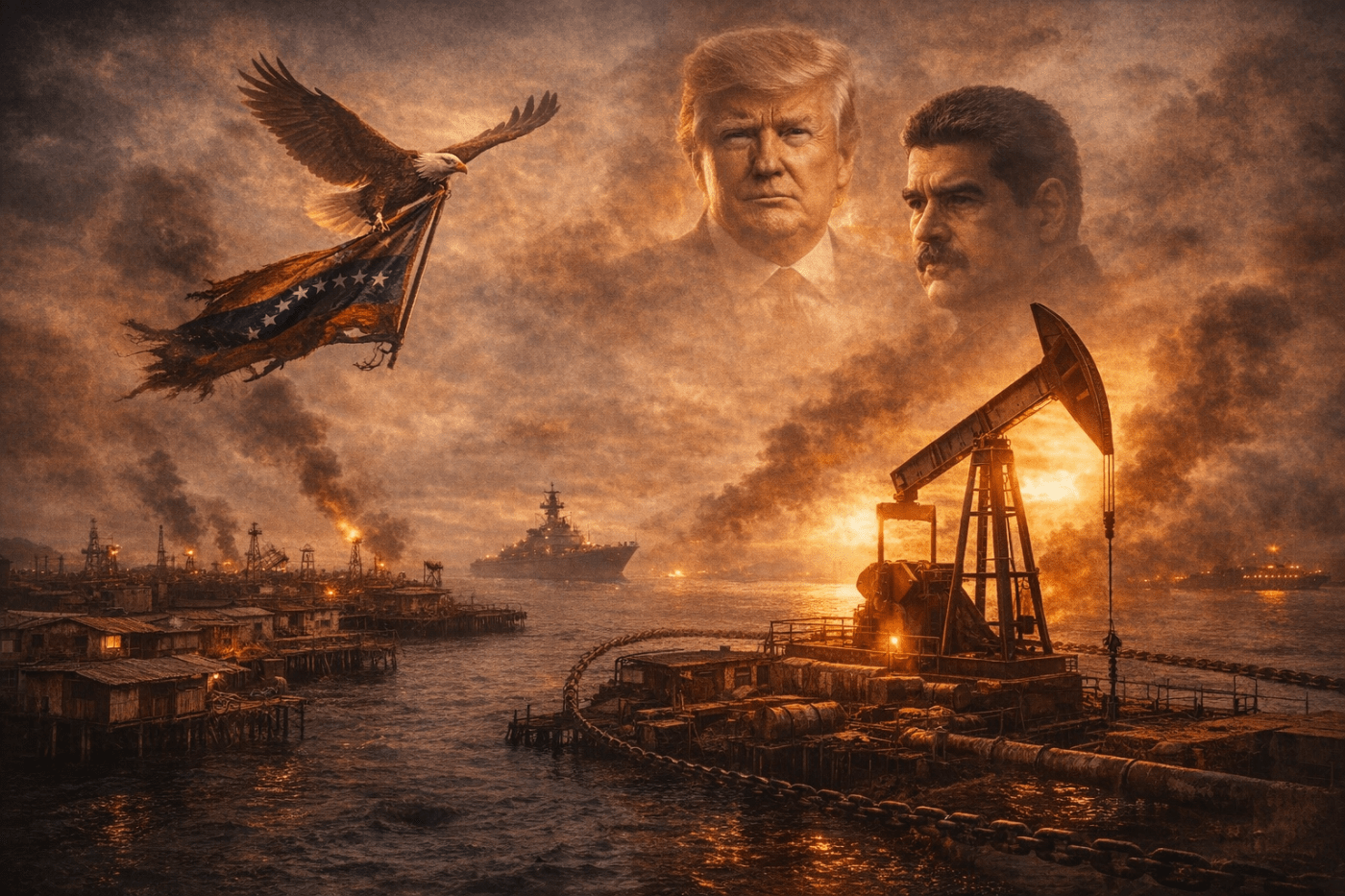
The American military moved into Venezuela in early 2026 with what the President called “tremendous” force, which in translation means the kind of force that makes other countries nervous. The stated goal was humanitarian intervention and restoration of democracy. The actual goal, as laid bare in presidential remarks, was to rebuild Venezuela’s crude industry and “take a tremendous amount of wealth out of the ground.”
But here’s where the tension lives: this is not 1954 Guatemala or 1973 Chile. The world has cameras now, and memory, and Twitter, which is like memory except louder and less accurate.
Then again, the world also has a Gulf Coast refining complex that represents tens of billions in sunk capital, all of it optimized for heavy crude. Venezuela used to supply 500,000 barrels per day to these refineries. American shale oil is light and sweet, excellent for making gasoline, but it doesn’t maximize diesel and fuel oil production the way heavy crude does. The refineries sit there like expensive, hungry machines built for a specific meal.
The U.S. is taking a reputational risk for discount barrels. This is the international relations equivalent of shopping at an outlet mall in a bad neighborhood because the deals are just too good.
Rhythm: The Symphony of Sucrose and Suffering
Let’s go back. Back to when Venezuela was beautiful and rich and everyone wanted an invitation.
In the 1920s and 1930s, American companies found oil around Lake Maracaibo. Lots of oil. Exxon and Gulf Oil set up shop like they owned the place, which in a very real sense they did. Production exploded from 1 million barrels annually to 137 million by 1929. By 1950, Venezuela was the world’s second-largest oil producer.
The money flowed in. Caracas became a destination for American and European elites, all marble and ambition and that particular kind of wealth that makes people forget to ask where it came from. The country helped supply the Allies during World War II, secured post-war quotas for American refineries, built infrastructure, renewed trade with Europe and Asia.
But—and here’s the rhythm change—in 1976, Venezuela nationalized its oil industry. The seeds of future conflict, planted. What looks like sovereignty to one side looks like expropriation to the other. Both sides are right. Both sides are wrong. History doesn’t care about your feelings.
Fast forward through decades of mismanagement, corruption, socialism, authoritarianism, sanctions, and what you get is a GDP contraction of 75%. You get 91% of the population in poverty. You get people losing weight not from Ozempic but from not eating. You get a currency so worthless that by 2019, Venezuelans just started using dollars instead, which is the kind of informal dollarization that happens when your government has destroyed all faith in money itself.
By 2026, the bolivar was a punchline. The intervention made the dollar official, which at least had the virtue of honesty.

Tone: Breaking Down the Barrier Between Then and Now
Let me level with you.
I don’t know if this intervention will work. Nobody does. The history of American interventions in Latin America reads like a greatest hits album of good intentions and catastrophic outcomes. Guatemala, Chile, Nicaragua—places where the U.S. installed friendly governments and protected economic interests while inadvertently (or not so inadvertently) entrenching oligarchies, increasing repression, and delaying the kind of economic diversification that actually builds stable societies.
A recent study found that CIA-backed regime changes cause, on average, a 10% per-capita income loss five years after intervention. Think about that. The cure is worse than the disease, at least in the short run, at least for the people who live there.
But El Salvador changed. Under Nayib Bukele, the country went from the highest crime rate in the region to something approaching normalcy. Not through American intervention but through a local leader with popular support and, admittedly, some deeply concerning authoritarian tendencies. The point is: change is possible. Transformation happens. Countries don’t have to stay broken forever.
The question is whether Venezuela in 2030 will be a success story or another chapter in the long history of well-meaning empire.
Direction: Three Futures, One Destination
By January 2030, Venezuela will not be Norway in the tropics. Let’s be clear about that from the start. But there are several plausible paths, each with its own internal logic and historical precedent.
Scenario One: The Managed Protectorate
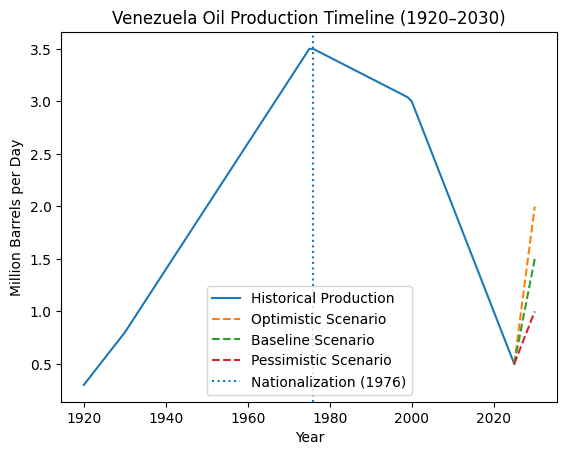
In this future, American oil companies invest the $100 billion needed to rebuild pipelines, upgraders, and oilfields. Production climbs to 2 million barrels per day by the early 2030s. U.S. Gulf Coast refineries run at capacity on discounted heavy crude. The Venezuelan government—led by a vice president who “doesn’t really have a choice” about following American guidance—collects royalties, taxes, and some local employment.
Real per-capita income rises from its current catastrophic levels. Not to pre-crisis heights, but enough to stabilize the currency (now officially the dollar), reopen access to IMF and World Bank funding, and restructure the defaulted debt. The country re-enters global capital markets, securitizing future oil exports.
Urban elites and the middle class align with the new order. Infrastructure improves in Caracas and major cities. Elections happen, but under rules and media structures that heavily favor pro-U.S. factions. Intelligence cooperation is extensive. The security state becomes entrenched.
But: the interior and border regions simmer. Poorer, more nationalist segments feel excluded from the recovery. Criminal-political hybrid groups form, mixing ideology with narco-trafficking. The system’s legitimacy rests entirely on delivering visible economic improvements, which means any oil price downturn or U.S. recession translates immediately into unrest.
It’s stable until it isn’t. The problem with building a house on oil is that oil prices move.
Scenario Two: The Resource Curse Redux
In this darker timeline, production recovers but institutions hollow out. Oil flows to American refineries, but the Venezuelan government becomes primarily answerable to foreign creditors and security partners rather than citizens.
Inequality deepens despite higher oil revenues because the value chain is foreign-controlled. Local contractors get crumbs while American majors take the bulk of profits through production-sharing agreements. Regulatory enforcement weakens under pressure to maximize output, causing environmental damage in the Orinoco Belt and Lake Maracaibo.
Nationalist insurgency gains strength. What starts as scattered resistance becomes a prolonged conflict as armed groups frame the intervention as occupation and resource theft. The death toll rises. The government responds with repression, justified by security concerns but ultimately eroding any remaining legitimacy.
By 2030, Venezuela is technically wealthier on paper—GDP is higher, oil production is up—but structurally weaker. Institutions are corrupt. Courts are not independent. The non-oil economy remains stunted. Political violence is routine.
It’s Iraq with better weather and worse consequences for U.S. energy policy.
Scenario Three: The Norwegian Dream (Adapted)
This is the optimistic scenario, and it requires decisions that go against both American short-term interests and historical precedent, which should tell you something about its probability.
In this future, the new Venezuelan government—with significant pressure from multilateral institutions and perhaps even elements within the U.S. State Department who remember that soft power exists—establishes a sovereign wealth fund modeled loosely on Norway’s system. Part of oil revenues flow into this fund, which is invested globally and used to finance education, healthcare, infrastructure, and non-oil sector development.
The fund is legally shielded from political raids, managed by an independent board with international oversight. Elections are monitored by multilateral observers, not just American intelligence. Security forces are gradually professionalized with an emphasis on rule of law rather than regime protection.
U.S. oil companies get their production agreements and their heavy crude, but within a framework that also builds Venezuelan capacity. Training programs. Technology transfer. Local content requirements that actually mean something.
The country diversifies. Agriculture recovers. Manufacturing grows. By 2030, oil is still dominant but no longer the only game. Inequality decreases. Political violence declines. Regional relations normalize.
It’s possible. Anything is possible. But hope is not a strategy, and history suggests that empires rarely volunteer to give up control once they have it.
Story Lenses: The View from Different Angles
From Washington: This is about energy security, refinery economics, and geopolitical leverage. Controlling Venezuelan heavy crude means protecting Gulf Coast margins, reducing dependence on other heavy crude suppliers, and projecting power in the Western Hemisphere. The intervention is a calculated risk, but one with clear strategic benefits if managed correctly.
From Caracas: This is about survival, sovereignty, and the bitter taste of foreign control. Even those who hated Maduro and cheered his ouster are beginning to ask whether independence under dictatorship was preferable to stability under external management. The daily humiliation of being a protectorate wears on people in ways that statistics don’t capture.
From Houston: This is business. Pure, simple, profitable business. The refineries need heavy crude, Venezuela has heavy crude, and the political arrangements are someone else’s problem. The contracts are favorable, the risk premium is built into the pricing, and the quarterly earnings look excellent.
From the Venezuelan countryside: This is just the latest chapter in a long story of people far away deciding what happens here. The oil money never reached the villages before the intervention, and it doesn’t reach them now. The only difference is which flag flies over the checkpoints.
Emotional Resonance: The Weight of 9 Kilograms
Here’s what 53,798,500% inflation means in human terms: It means watching your savings vanish. It means a month’s salary that won’t buy a week’s groceries. It means your grandmother’s pension becoming literally worthless between breakfast and lunch.
It means 74% of Venezuelans losing an average of 9 kilograms—about 20 pounds—not from choice but from necessity. Picture that. Picture a entire nation getting thinner because there’s no food. Picture parents skipping meals so their children can eat. Picture lines at empty stores. Picture pharmacies without medicine. Picture a modern country sliding backwards into a kind of poverty that feels medieval.
That’s the emotional weight behind the statistics. That’s why some Venezuelans welcomed American intervention despite knowing the historical record. When you’re drowning, you grab whatever rope appears, even if you know it might be attached to an anchor.
The question—the real, human, consequential question—is whether the people who supported intervention out of desperation will look back in 2030 and feel it was worth it, or whether they’ll have traded one kind of suffering for another.
The Machinery of Change: What Actually Has to Happen
Let’s talk specifics, because hope requires blueprints.
Education: Venezuela’s education system has collapsed. Teachers fled the country. Universities closed. Schools lack basic supplies. By 2030, a generation of children will have missed years of schooling.
Recovery means not just rebuilding school buildings but rebuilding the teaching profession. Competitive salaries. Training programs. Curriculum reform that prepares students for a diversified economy, not just oil extraction. Digital infrastructure for remote regions. Scholarships for higher education that don’t require political loyalty.
It means university systems that conduct independent research, train professionals, and serve as engines of social mobility rather than regime legitimation machines.
Institutions: The rule of law is not optional. It’s not a luxury that poor countries can skip. It’s the foundation of everything else.
By 2030, Venezuela needs courts that rule based on law rather than political pressure. Anti-corruption agencies with real enforcement power. A central bank that manages monetary policy independent of presidential whim. Regulatory bodies that can tell oil companies no when environmental or safety standards are violated.
This is harder than it sounds because institutions require trust, and trust requires time, and time is what nobody wants to give because oil revenues are flowing now and shareholders want returns now and next quarter’s GDP number needs to be higher now.
But without institutions, the whole structure is sand. One political crisis, one oil price shock, one determined populist, and it all falls apart.
Livelihood: Real economic diversification means creating opportunities outside the oil sector.
Agriculture: Venezuela used to feed itself. It can again. This requires land reform, access to credit for small farmers, agricultural extension services, and market access that doesn’t require bribing fifteen officials.
Manufacturing: Start small. Food processing. Light manufacturing. Import substitution for basic consumer goods. Build industrial parks near border regions to capture trade flows. Provide stable power and water, which sounds basic but hasn’t been reliable in years.
Services: Tourism can return. Venezuela has beaches, mountains, Angel Falls. It has a climate and geography that could support a significant tourism sector if basic safety and infrastructure exist. This requires more than military security; it requires a society where travelers feel welcome rather than like marks.
Small business development: The informal economy already employs most Venezuelans. Formalize it gradually. Business registration that takes days not months. Microfinance. Technical assistance. Legal protections.
None of this is revolutionary. It’s basic development economics. The question is whether the political will exists to do it, or whether the easier path—just pump oil and let foreign companies handle the complicated parts—wins out.
The Historical Mirror: Why We Should Be Worried
Let’s look at the scorecard.
Guatemala, 1954: CIA-backed coup against Jacobo Árbenz. Installed a series of military governments. Result by the 1980s: civil war, genocide, 200,000 dead. Democracy eventually returned, but the country never fully recovered economically or institutionally.
Chile, 1973: U.S. support for Pinochet’s coup against Allende. Thousands killed and disappeared. Economic restructuring that created growth but also massive inequality. Democracy returned in 1990, but the social divisions remain.
Nicaragua, 1980s: Contra war backed by the U.S. against the Sandinistas. Tens of thousands dead. Economy devastated. The Sandinistas eventually returned to power through elections, now running an authoritarian regime that looks disturbingly like what the U.S. was trying to prevent.
The pattern is consistent: short-term strategic gains for Washington, long-term institutional damage for the target country, and eventual political backlash that sometimes circles back to something resembling the original problem.
A quantitative study found that CIA-backed regime changes cause an average 10% per-capita income loss five years post-intervention compared to control groups. The economic damage persists. Civil and political institutions weaken.
Why should Venezuela be different?
The honest answer is: it might not be. History is not destiny, but it is a pretty reliable guide when the same playbook keeps getting run.
The El Salvador Exception: What We Can Learn
But—and this is important—El Salvador shows that rapid transformation is possible.
Nayib Bukele took office in 2019 facing the highest murder rate in the hemisphere. By 2024, through a combination of mass incarceration, gang crackdowns, and genuine public works, El Salvador became one of the safer countries in Central America.
The methods are controversial. Civil liberties groups document serious human rights concerns. Due process has been suspended. Thousands sit in prison without trial.
But murder is down. Investment is up. Salvadorans, by large margins, support Bukele because they can walk their streets again.
The lesson is not that authoritarianism works—it often doesn’t, and the long-term costs may be severe. The lesson is that visible, rapid improvement in daily life builds legitimacy faster than any democratic procedure or economic statistic.
If Venezuela’s new government can deliver basic security, stable currency, available food, and functioning utilities, a lot of Venezuelans will overlook questions about who’s really in charge. This is how consent is manufactured, how protectorates become accepted, how intervention gets normalized.
It’s also why the first two years matter so much. If conditions visibly improve, the new order solidifies. If they don’t, or if they improve only for elites while the majority still struggles, the window for nationalist backlash stays open.
The Price of Heavy Crude: What It All Comes Down To
Here’s the mechanical reality: U.S. Gulf Coast refineries have over 2.5 million barrels per day of coking capacity designed for heavy, sour crude. That capacity represents tens of billions in sunk capital. It’s optimized for Venezuelan, Mexican, and Canadian heavy grades, not for light, sweet shale.
When these refineries run on discounted heavy crude, margins are excellent. When they’re forced to substitute lighter grades or import expensive heavy crude from elsewhere, margins compress. This is not about patriotism or democracy promotion. This is about return on invested capital.
Venezuela has the world’s largest oil reserves, predominantly heavy and extra-heavy crude from the Orinoco Belt. It’s costly and technically demanding to produce—requires heated pipelines, specialized upgraders, high energy input. But when you have the infrastructure for it and can buy it at a discount because of political risk or sanctions, it’s very profitable.
The U.S. intervention is, at its core, about locking in access to this discounted heavy crude. The humanitarian justification, the democracy restoration, the rhetoric about freedom—it’s all real, in the sense that people believe it. But the structural driver is refinery economics and energy security.
By 2030, if the intervention succeeds on its own terms, Venezuelan heavy crude will be flowing steadily to Gulf Coast refineries at favorable prices through long-term contracts with U.S. majors. Those companies will have spent something approaching $100 billion to rebuild production. They will want returns for decades.
This creates a dependency that runs both directions. Venezuela needs the investment and the market. The U.S. needs the heavy crude. Breaking that mutual dependency becomes harder every year the system runs.
Whether this arrangement benefits ordinary Venezuelans depends entirely on what the Venezuelan government does with its share of the revenues and whether it has enough autonomy to make independent choices. History suggests the autonomy will be limited and the revenue sharing will favor external stakeholders.
But history also suggests that nothing is permanent, that empires overextend, that populations eventually demand sovereignty regardless of cost, and that oil prices don’t stay high forever.

Looking Forward: The Honest Assessment
By 2030, Venezuela will likely be:
- Producing 1.5 to 2 million barrels of oil per day
- Using the U.S. dollar as official currency
- Under significant American political and military influence
- Modestly wealthier than 2026 but poorer than 2010
- Still heavily dependent on oil exports
- Governed by a formally democratic but practically constrained political system
- Home to ongoing low-level political violence and social tension
- Environmentally degraded in key oil-producing regions
- Divided between those who benefited from the intervention and those who didn’t
- Struggling with the basic development questions it failed to answer in decades prior
The best-case scenario sees institutions strengthening, revenues being partially channeled into education and infrastructure, and gradual diversification beginning to show results. The worst-case sees institutions hollowing out, revenues concentrating in foreign hands, and nationalist insurgency becoming entrenched.
The most likely scenario sits somewhere between: partial recovery, persistent inequality, visible improvement for urban elites, continued struggle for rural and poor populations, and a political system that functions but lacks full legitimacy.
It will not be Norway. But it might not be Iraq either. Something in between. Something distinctly Venezuelan. Something that works well enough for enough people that it persists, but not so well that anyone mistakes it for success.
The tragedy—if we’re being honest about tragedy—is that Venezuela had the resources to become genuinely prosperous. It still does. What it lacks, and has always lacked, is the political settlement and institutional framework to translate natural wealth into broad-based development.
American intervention might provide the stability for that framework to develop. Or it might simply create a new version of the same extractive system with different beneficiaries.
We won’t know until we know. That’s not satisfying, but it’s true.
So it goes.
Sources
[1] “Trump says U.S. is taking control of Venezuela’s oil reserves: Here’s what it means.” CTV News. https://www.ctvnews.ca/world/article/trump-says-us-is-taking-control-of-venezuelas-oil-reserves-heres-what-it-means/
[2] Marques, José. “Trump says US is taking control of Venezuela’s oil reserves.” CNN Business. https://www.cnn.com/2026/01/03/business/oil-gas-venezuela-maduro
[3] Meyer, Zlati. “Trump says Venezuelan regime change is largely about oil.” Fortune. https://fortune.com/2026/01/03/trump-venezuelan-regime-change-nicolas-maduro-oil-us-energy-companies-investment/
[4] “Will the US Oil Majors Really Come Running to Venezuela?” Geopolitics Unplugged. https://geopoliticsunplugged.substack.com/p/will-the-us-oil-majors-really-come
[5] “What the U.S. Attack on Venezuela Could Mean for Oil and Canadian Crude Exports: The Economic Impact.” Economy.com.pk. https://economy.com.pk/what-the-u-s-attack-on-venezuela-could-mean-for-oil-and-canadian-crude-exports-the-economic-impact/
[6] Siegel, Rachel. “U.S. will look to tap Venezuelan oil reserves, Trump says.” NBC News. https://www.nbcnews.com/business/energy/us-will-look-tap-venezuelan-oil-reserves-trump-says-rcna252054
[7] Mahapatra, Lisa and Marr, Garry. “What the U.S. attack on Venezuela could mean for oil and Canadian crude exports.” The Globe and Mail. https://www.theglobeandmail.com/business/article-us-attack-venezuela-energy-sector-crude-oil-nicolas-maduro-markets/
[8] Arbatli, Ekim and Gomez, Diego A. “The consequences of CIA-sponsored regime change in Latin America.” Science Direct. https://www.sciencedirect.com/science/article/abs/pii/S0176268023000964
[9] “United States involvement in regime change in Latin America.” Wikipedia. https://en.wikipedia.org/wiki/United_States_involvement_in_regime_change_in_Latin_America
[10] Wilkie, Christina and Gardner, Timothy. “Trump admin sends tough private message to oil companies about Venezuela.” Politico. https://www.politico.com/news/2026/01/03/trump-venezuela-oil-us-companies-return-00709782
[11] Öztürk, Arda E. and van Rijckeghem, Caroline. “Venezuela’s hyperinflation.” Bruegel. https://www.bruegel.org/blog-post/venezuelas-hyperinflation
[12] “History of U.S. involvement in Venezuela’s petroleum industry.” Wikipedia. https://en.wikipedia.org/wiki/History_of_U.S._involvement_in_Venezuela’s_petroleum_industry
[13] Liow, David. “Anatomy of an economic suicide: Venezuela under Maduro.” Asia Times. https://asiatimes.com/2026/01/anatomy-of-an-economic-suicide-venezuela-under-maduro/
[14] “Hyperinflation in Venezuela.” Wikipedia. https://en.wikipedia.org/wiki/Hyperinflation_in_Venezuela
[15] Sesin, Carmen. “Why oil has been a longstanding source of tension between Venezuela and the United States.” El País English. https://english.elpais.com/international/2026-01-04/why-oil-has-been-a-longstanding-source-of-tension-between-venezuela-and-the-united-states.html
[16] Fernández, Valentina and Smith, Ethan. “Venezuela Lets Bolivar Depreciate to Near 43 Per Dollar.” Bloomberg. https://www.bloomberg.com/news/articles/2024-11-04/ves-usd-venezuela-lets-bolivar-depreciate-to-near-43-per-dollar
[17] “Venezuela Inflation Rate.” Trading Economics. https://tradingeconomics.com/venezuela/inflation-cpi
[18] “History of the Venezuelan oil industry.” Wikipedia. https://en.wikipedia.org/wiki/History_of_the_Venezuelan_oil_industry
 Notes Beyond the Map
Leave a comment