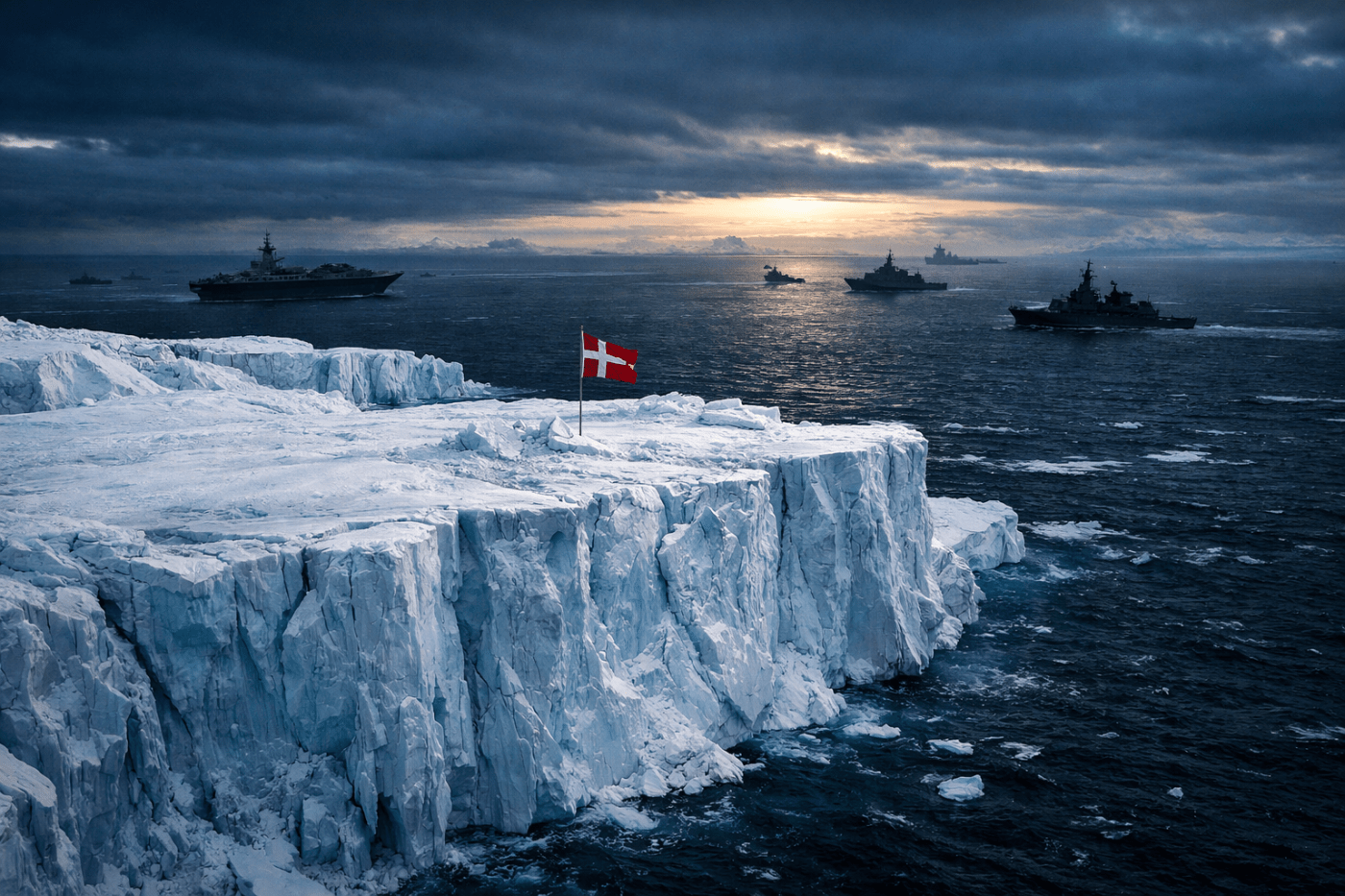
Or: How a Nation of Six Million Europeans Came to Control America’s Arctic Future
So it goes.
In 1721, Denmark began what polite historians call “recolonization” of Greenland. A missionary named Hans Egede sailed north with the Lord’s word in one hand and a trading monopoly in the other, ready to save the souls of the Inuit people whether they wanted saving or not. The Norse settlements had vanished centuries before, leaving behind only ruins and questions. But Denmark wasn’t interested in archaeology. They were interested in control.
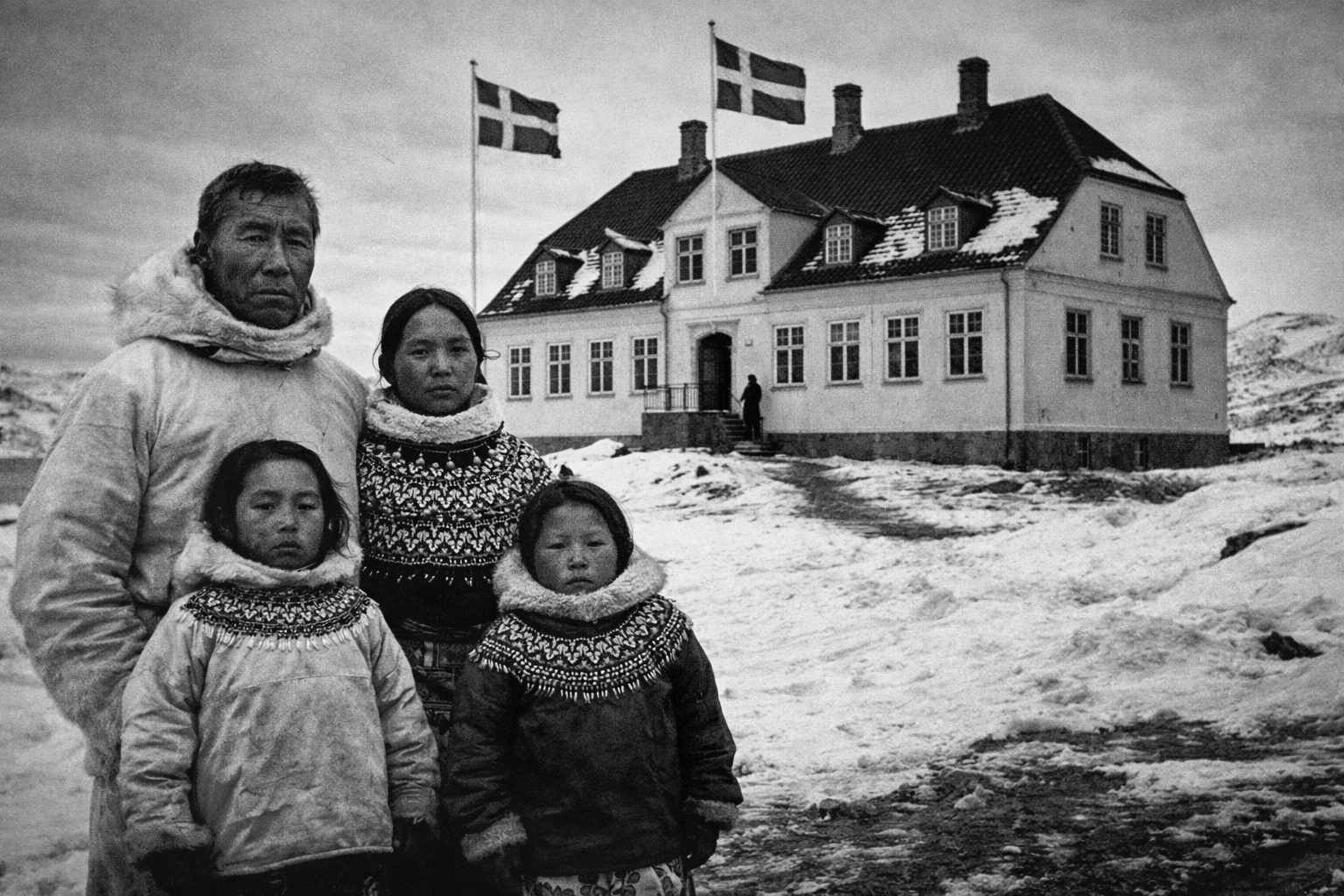
What followed reads like a fever dream written on ice. Forced relocations. Language bans. Children torn from families in the name of “civilization.” The 1951 “Little Danes” experiment saw 22 Inuit children shipped to Denmark for “assimilation,” severed from their families like so many inconvenient weeds.[1] Women are fitted with IUDs without consent. Wage discrimination that would make a robber baron blush. Cultural genocide dressed up in the Sunday clothes of European enlightenment.
Denmark maintained this colonial stranglehold until 1953, when Greenland’s formal status as a “colony” quietly disappeared from the paperwork, replaced with the more respectable title of “Danish county.”[2] The abuses didn’t stop; they just got better PR. It wasn’t until 2009 that Greenland received genuine self-government, and even now, Copenhagen controls foreign affairs and defence while cutting checks for about $650 million annually, roughly half of Greenland’s public budget.[3]
The Audacity of Smallness
Denmark is a nation of six million souls squeezed into a country smaller than the Netherlands. To put this in perspective: there are more people in Greater London than in all of Denmark. Yet this nation presumes to control 2.16 million square kilometres of Arctic territory—an island roughly the size of France, Germany, and Spain combined—defended by 25 warships.[4]
Twenty-five.
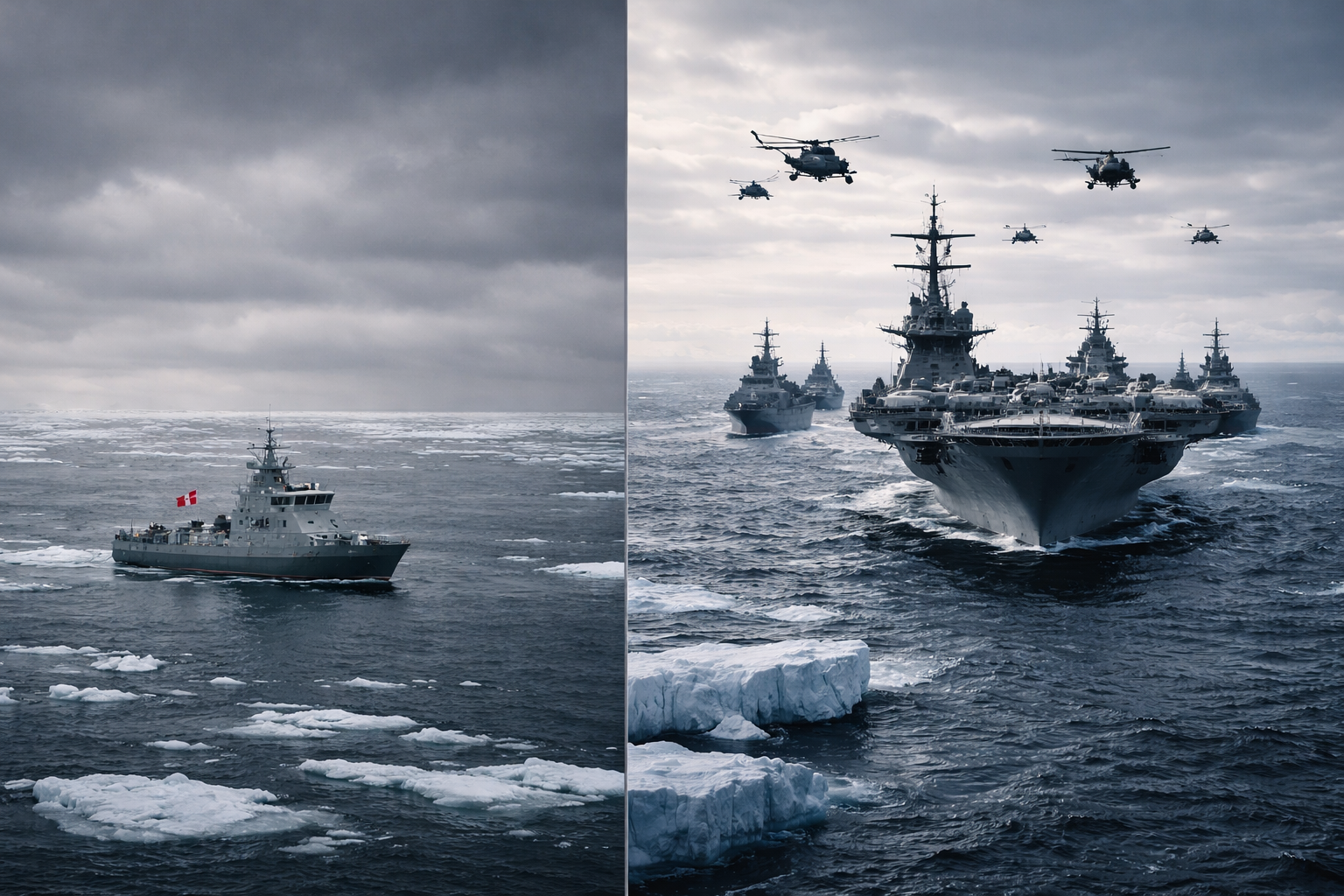
The United States Navy operates over 300 warships. China and Russia are circling the Arctic like sharks who’ve caught the scent of rare earth elements, oil, natural gas, and control over emerging Arctic shipping lanes worth trillions. And Denmark’s response? A couple of dozen ships and firm reliance on American protection through NATO.
Let me be crystal clear: Denmark cannot protect Greenland without American intervention. They know it. The Americans know it. The Russians and Chinese certainly know it.[5] Denmark’s defence budget wouldn’t cover a long weekend for the Pentagon. When it comes to securing 44,000 kilometres of Arctic coastline against hostile powers who view international law as a polite suggestion, Denmark is bringing a bicycle to a tank fight.
The Free World vs. The Autocracies
Here’s what the comfortable critics won’t acknowledge: America runs the free world. Whether you like it or not, that’s the reality. When was the last time China held a free election? Never. When was the last time Russia had an election that wasn’t tampered with, rigged, or predetermined? You’d have to go back further than most people can remember.
The United States isn’t looking to secure colonial interests overseas. If it were, the conversation would be very different, and the methods would be far less diplomatic. America is looking to secure the Northern Hemisphere, which, for the last 200 years, it has believed—correctly—falls well within its rights under the Monroe Doctrine.[6]
The difference between American control and Chinese or Russian control isn’t subtle. It’s the difference between a territory that gets a referendum, constitutional protections, and optional citizenship versus a territory that becomes a resource extraction zone with no voice, no vote, and no rights. Ask the Uyghurs in Xinjiang how Chinese “development” works. Ask the Chechens about Russian “protection.”
When Americans talk about securing Greenland, they’re talking about offering compensation, guaranteed autonomy, profit-sharing, and a democratic vote requiring supermajority approval. When China talks about Arctic access, they’re talking about debt-trap infrastructure loans and mining contracts that strip resources while leaving locals with contaminated water and subsistence wages. When Russia talks about the Arctic, they’re talking about military bases, closed zones, and zero consultation with indigenous populations.
The moral difference isn’t propaganda. It’s measurable in elections held, rights protected, and wealth shared.
What’s Really at Stake
Critics want to frame this as Donald Trump’s real estate fantasy, another gaudy addition to a portfolio of properties with his name slapped on them in gold letters. Others dismiss it as legacy-hunting, an elderly president desperate to be remembered for something grander than tabloid headlines and Twitter feuds. That’s lazy thinking that mistakes the messenger for the message and feels smug about it.
Here’s what Greenland actually represents:
Critical minerals. Rare earth elements exist in Greenland in some of the world’s largest deposits. The Kvanefjeld and Tanbreez sites hold approximately 1.5 million tons of rare earth reserves, including heavy rare earths like dysprosium and neodymium, essential for electric vehicles and defense systems.[8] China controls roughly 70% of global rare earth production and 90% of processing. They’ve already weaponized this monopoly. Greenland represents a way to break that chokehold.
Energy resources. Offshore surveys indicate tens of billions of barrels of oil equivalent in Greenland’s waters.[9] Add the hydropower potential of roughly 20,000 gigawatt-hours annually from untapped rivers, enough to power energy-intensive industries or produce green hydrogen for export.[10]
Arctic shipping routes. As the ice melts, new sea lanes are opening that cut shipping times between Asia and Europe by thousands of miles. Control those routes, and you control commerce. Lose them to autocracies, and you’ve handed global trade leverage to regimes that don’t believe in free navigation or international law.
Space access. Greenland hosts Pituffik Space Base, providing early warning systems for missile defence and serving as the second-most important space surveillance site after Svalbard.[11] But isolated airbases like Pituffik are defensible only with the permission and cooperation of the controlling power. They’re chokepoints easily overrun in serious conflict. For comprehensive Arctic access, space operations, defence infrastructure, and resource extraction, full territorial control is the only viable long-term security posture. When China or Russia comes calling, “sufficient access” becomes a death trap.
Data centers. The digital economy runs on server farms requiring massive cooling. Greenland offers ambient Arctic temperatures and surplus hydroelectric power, a combination that tech companies would pay billions for.[13]
The kicker? Denmark can’t develop any of this. They lack the capital, expertise, and political will. Greenland’s 2021 moratorium on oil licensing shows that local politics actively prevent resource development even as subsidies from Copenhagen create permanent dependency.[14]
The Arithmetic of Sovereignty
Informal discussions have floated the idea of $100,000 per Greenlandic resident as potential compensation. At roughly 57,000 residents, that totals approximately $5.7 billion. But let’s be honest: $100,000 is insulting in today’s economy. It’s a used car and maybe a down payment on a house. It’s not generational wealth. It’s not life-changing money for families living in one of the harshest climates on Earth with limited economic opportunities.
Show me the money, as Jerry Maguire would say. And if Washington is serious about securing consent rather than imposing control, they need to show substantially more.
If the United States wants Greenland badly enough to risk diplomatic fallout with Europe, the offer needs to be compelling. Consider what $250,000 per person would mean: a family of four receives $1 million. Total cost? Approximately $14.25 billion. Suddenly, the choice between perpetual Danish dependency (subsidized by Copenhagen’s annual $650 million that keeps Greenlanders economically captive) and American partnership looks radically different when you’re holding wealth that guarantees your children’s education and economic security, your ancestors never imagined.
Compare either figure to the Golden Dome missile defence system, estimated at $175 billion. Securing Greenland, an island nearly 836,000 square miles rich in minerals and ideally positioned for Arctic shipping, space tracking, and data centers, for even $14.25 billion would be remarkably cheap. The United States spends approximately $850 billion annually on defence. Even at the higher figure, Greenland would cost less than 2% of one year’s Pentagon budget.
The Louisiana Purchase cost $15 million in 1803, equivalent to roughly $400 billion today. That purchase doubled the size of the United States and opened the pathway to continental dominance. Greenland would be a fraction of that cost for arguably greater strategic value in the 21st century.
And what of concerns about healthcare and education? If a deal can guarantee cultural autonomy and resource profit-sharing (50% of extraction revenues flowing to Greenlandic communities), then accommodating comprehensive healthcare and education programs is trivial. The United States spends over $4 trillion annually on healthcare. Extending coverage to 57,000 people in a strategic territory is a rounding error.
The real offer should include: substantial per-resident payments paid into individual sovereign wealth accounts generating perpetual dividends like Alaska’s Permanent Fund. Guaranteed autonomy for Greenlandic culture and language. Pathways to statehood or independence after 30 years. Infrastructure investment of $20-50 billion. Comprehensive healthcare and education matching or exceeding Danish standards. Profit-sharing from resource extraction. And critically: a referendum requiring 60% supermajority approval, ensuring genuine democratic consent.[16]
But that offer needs to be compelling enough to actually change the conversation. $100,000 per person isn’t it. $250,000 or more? That’s a different discussion entirely.
This isn’t imperialism. It’s mathematics with a moral framework.
The Colonialism Canard
Denmark actually colonized Greenland through cultural genocide. That’s a documented fact acknowledged by Denmark’s own reconciliation commission.[15] The United States would be proposing a purchase, a voluntary transaction with compensation, making Greenland’s 57,000 residents among the wealthiest people per capita on Earth.
The uncomfortable truth is that Greenland’s 57,000 people, 85% living in a handful of southwest coastal towns, cannot viably govern 2.16 million square kilometres alone.[17] They lack the population, economic base, and military capacity. Their choices are:
- Permanent dependency on Danish subsidies while Denmark depends on American protection
- Independence that collapses into chaos, inviting intervention from China or Russia
- Partnership with the United States offering security, investment, and genuine prosperity
Option three isn’t colonialism. It’s geopolitics for grown-ups.
The Realpolitik Reality
Every nation acts in its self-interest. Denmark holds Greenland because it elevates their status and provides future resource claims, not because they’re uniquely suited to govern it. They accept American military protection while lecturing America about aggression. That’s not principle; that’s hypocrisy with a Scandinavian accent.
Canada, my own country, manages 65,000 Inuit across Nunavut and other territories without annexation threats or economic collapse, providing transfers of CAD 1.8 billion annually.[18] If Canada can do it, why can’t Greenland? Canada has 38 million people, vast resources, and G7 economies of scale. Greenland has fewer people than Lyon, France.
The Falkland Islands, home to 3,500 people, remain British because 99.8% voted to reject Argentine claims, backed by British military power that Argentina can’t match.[19] French Polynesia’s 280,000 residents have voted multiple times to stay French because eurozone stability beats independence poverty. These territories survive through partnerships with powers that can protect them.
The Arctic Cold War Is Here
While Europeans debate migration quotas, Russia and China are carving up the Arctic. Russia has reopened Soviet-era military bases and claims vast swaths of the continental shelf. China, despite being nowhere near the Arctic Circle, declared itself a “near-Arctic state” and is investing billions in Greenland mining projects.[21]
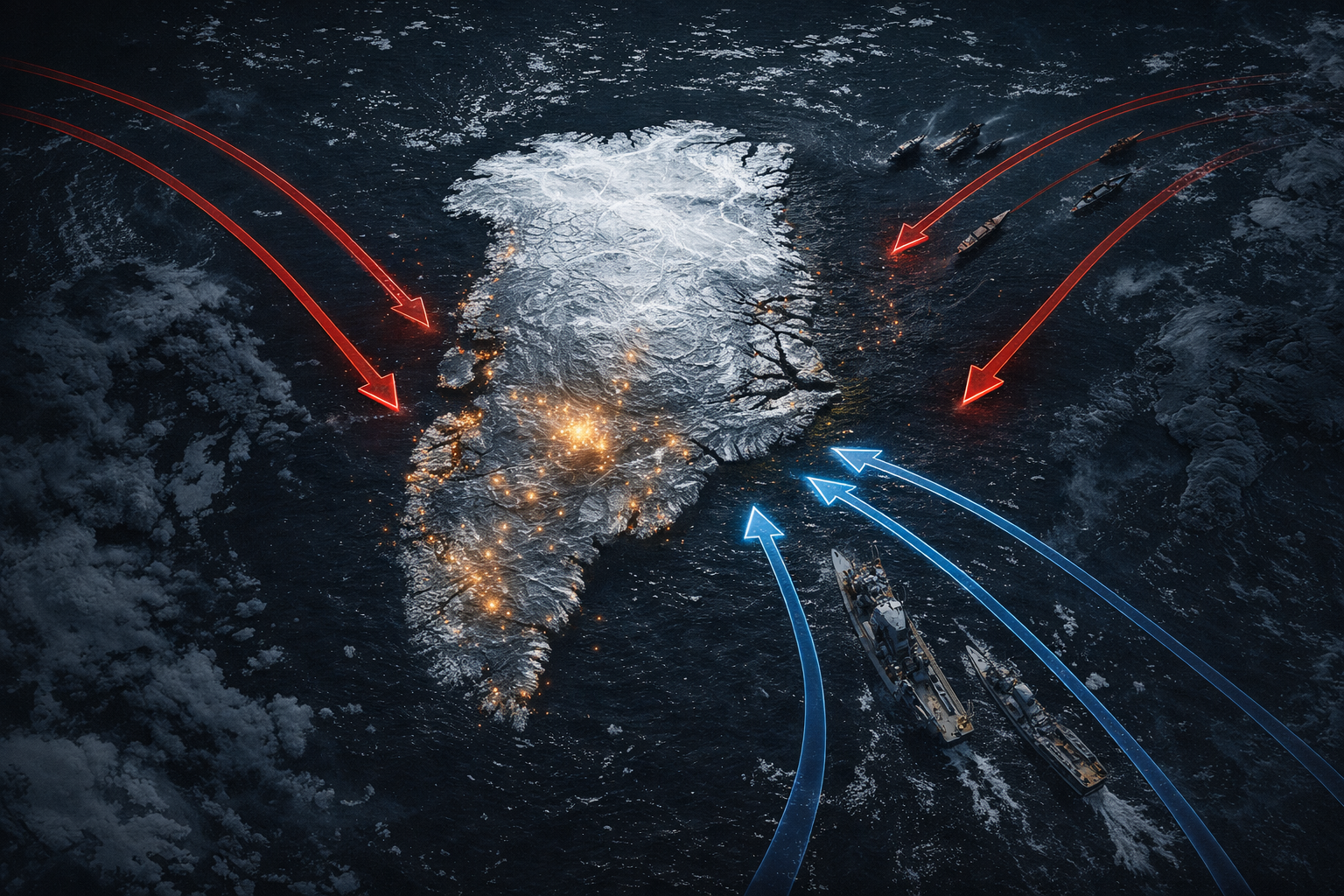
Denmark’s 25-ship navy cannot stop a Chinese mining consortium backed by Beijing’s chequebook diplomacy. They cannot stop Russian submarines prowling the GIUK Gap, the strategic chokepoint that Russian missiles would traverse en route to European and North American cities.[22]
And here’s the delicious irony: when push comes to shove, when Chinese warships appear in Greenlandic waters or Russian bombers test Danish air defences, does anyone seriously believe NATO members will rush to Denmark’s aid in a shooting war with China and Russia? France will send a strongly worded letter. Germany will convene a committee. Sweden will express deep concern.
But actual defense? That falls to the Americans. It always has.
International law only operates when the sun is shining, and great powers agree to pretend it matters. The moment real interests collide, when China wants rare earths, or Russia wants Arctic sea lanes, international law becomes about as relevant as a bicycle in that tank fight.
The Case for America
Greenland cannot defend itself. Its 57,000 people and zero military capacity make it indefensible. Denmark’s 25 warships cannot protect 44,000 kilometres of coastline. NATO allies won’t rush to anyone’s rescue when China and Russia come calling.[24]
Denmark cannot afford Greenland long-term. The $650 million annual subsidy represents a permanent drain with no strategic upside beyond status. Denmark’s own central bank warns Greenland’s finances are worsening.[25]
Resource control matters for American security. Breaking China’s rare earth monopoly, accessing Arctic oil and gas, and securing space surveillance are strategic necessities.[26]
The price should be strategically compelling. While $100,000 per person has been floated informally, that’s insufficient to change minds. A serious offer would need to be substantially higher—perhaps $250,000 or more per person—to transform lives and create genuine wealth. Even at the higher figure, less than 2% of annual U.S. defence spending, this represents perhaps the most cost-effective strategic acquisition possible.
Full territorial control beats scattered bases. Isolated installations are indefensible chokepoints. For comprehensive Arctic access, full territorial control is the only viable security posture.
The Arctic is opening now. Melting ice is creating shipping lanes and resource access, defining 21st-century power dynamics. Missing this window means ceding control to adversaries who won’t offer Greenlanders referendums or constitutional rights.
Historical precedent supports the purchase. America bought Alaska from Russia (1867) and the Louisiana Territory from France (1803). Territorial acquisition through negotiation is as American as apple pie.[27]
Greenlanders deserve compelling options. An American partnership offering substantial compensation, optional citizenship, guaranteed healthcare and education, cultural autonomy, and resource profit-sharing creates a genuine third option beyond Danish dependency or impossible independence.
The Northern Hemisphere is America’s to secure. For 200 years, the Monroe Doctrine has established that the Americas fall within the U.S. sphere of influence. This isn’t imperialism; it’s hemispheric security against autocracies that don’t believe in elections, free speech, or human rights.[28]
International law is a fair-weather friend. When storms come, legal niceties evaporate. What remains is power and the willingness to use it. Denmark has neither.
The Lesson History Teaches
This isn’t about Trump’s ego or legacy-building. It’s about who can best secure Greenland’s future in a world where China and Russia are expanding while European powers manage decline.
Denmark is lovely. But lovely countries with six million people and two dozen warships do not get to control strategic territories they cannot defend, especially when demanding that the country providing their defence stay out.
History teaches that great powers do not ask permission; they create facts on the ground. The question is whether those facts are created through negotiation or force, through mutual benefit or conquest. The United States is offering the former. Denmark, by refusing even to discuss terms, may be inviting the latter from powers far less scrupulous than America.
The United States should purchase Greenland. Do not seize it. Don’t colonize it. Purchase it, with compensation, making current residents wealthier than they ever imagined.
Put it to a vote. Offer real terms: substantial per-person payments well above the informal $100,000 figure, optional American citizenship, comprehensive healthcare and education, cultural autonomy, infrastructure investment, and resource profit-sharing. Let Greenlanders choose between Danish dependency, impossible independence, or American partnership with ironclad guarantees.
The ice is melting. The great powers are circling. And Denmark is standing in the middle of the Arctic with a bicycle helmet, a strongly worded letter to the UN, and the naive belief that NATO allies will sacrifice their economies and sons for Copenhagen’s colonial legacy when Beijing and Moscow decide they want what Denmark cannot defend.
For a fraction of what America spends on defence annually, Washington could secure its Arctic future, break China’s mineral monopoly, and offer 57,000 people the kind of prosperity that makes freedom meaningful rather than theoretical.
That’s not imperialism. That’s the bargain of the century.
So it goes.
Sources
[1] Denmark’s experiment on Inuit children: a painful legacy of forced assimilation, Humanium. https://www.humanium.org/en/denmarks-experiment-on-inuit-children-a-painful-legacy-of-forced-assimilation/
[2] Greenland Fantasies, Origins OSU. https://origins.osu.edu/read/greenland-sovereignty-denmark
[3] Greenland has only limited impact of the Danish economy, FXStreet. https://www.fxstreet.com/analysis/denmark-greenland-has-only-limited-impact-of-the-danish-economy-202601071414
[4] Add wouldn’t it make sense for a reasonable protector against the threat of China and Russia? Perplexity. https://www.perplexity.ai/search/069ff264-cc04-414a-b44c-6d97bf6dcb76
[5] Why most Greenlanders favor a future without Trump, CNBC. https://www.cnbc.com/2026/01/12/greenland-independence-denmark-trump-military-operation.html
[6] Trump & Greenland: Is There Logic in the Chaos? The Arctic Institute. https://www.thearcticinstitute.org/trump-greenland-logic-chaos/
[7] Proposed United States acquisition of Greenland, Wikipedia. https://en.wikipedia.org/wiki/Proposed_United_States_acquisition_of_Greenland
[8] Greenland, Rare Earths, and Arctic Security, CSIS. https://www.csis.org/analysis/greenland-rare-earths-and-arctic-security
[9] The Greenland Gold Rush: Promise and Pitfalls of Greenland’s Energy and Mineral Resources, Brookings. https://www.brookings.edu/articles/the-greenland-gold-rush-promise-and-pitfalls-of-greenlands-energy-and-mineral-resources/
[10] Greenland Hydropower Potentials, Hydropower.gl. https://hydropower.gl/emner/greenland-hydropower-potentials?sc_lang=en
[11] Greenland, Rare Earths, and Arctic Security, CSIS. https://www.csis.org/analysis/greenland-rare-earths-and-arctic-security
[12] Does the US need to ‘own’ Greenland to build Trump’s Golden Dome? Yahoo News. https://ca.news.yahoo.com/does-trump-own-greenland-build-060616106.html
[13] Our Projects, Nunagreen. https://nunagreen.com/our-projects/
[14] Why Greenland’s vast natural resources won’t necessarily translate into huge profits, The Conversation. https://theconversation.com/why-greenlands-vast-natural-resources-wont-necessarily-translate-into-huge-profits-273137
[15] Greenland Reconciliation Commission finds colonization did ‘a lot of damage,’ CBC. https://www.cbc.ca/news/canada/north/greenland-reconciliation-commission-report-1.4471695
[16] Proposed United States acquisition of Greenland, Wikipedia. https://en.wikipedia.org/wiki/Proposed_United_States_acquisition_of_Greenland
[17] Where People Live in Greenland: Towns & Settlements, Brilliant Maps. https://brilliantmaps.com/where-people-live-in-greenland/
[18] Hungry Days in Nunavut: The Façade of Inuit Self-Determination, Yellowhead Institute. https://yellowheadinstitute.org/2022/hungry-days-in-nunavut-the-facade-of-inuit-self-determination/
[19] Greenland is caught in a love triangle between the U.S., Denmark and independence, CNBC. https://www.cnbc.com/2025/03/11/greenland-caught-between-the-us-denmark-and-independence-in-election.html
[20] Greenlanders overwhelmingly oppose becoming part of the US, Reuters. https://www.reuters.com/world/poll-shows-85-greenlanders-do-not-want-be-part-us-2025-01-29/
[21] Trump & Greenland: Is There Logic in the Chaos? The Arctic Institute. https://www.thearcticinstitute.org/trump-greenland-logic-chaos/
[22] Add wouldn’t it make sense for a reasonable protector against the threat of China and Russia? Perplexity. https://www.perplexity.ai/search/069ff264-cc04-414a-b44c-6d97bf6dcb76
[23] Trump hits 8 European countries with 10% tariff, Washington Times. https://www.washingtontimes.com/news/2026/jan/17/trump-hits-8-european-countries-10-tariff-backing-us-acquisition/
[24] Add wouldn’t it make sense for a reasonable protector against the threat of China and Russia? Perplexity. https://www.perplexity.ai/search/069ff264-cc04-414a-b44c-6d97bf6dcb76
[25] Greenland Finances Are Suddenly Worse, Bloomberg. https://www.bloomberg.com/news/articles/2026-01-06/greenland-finances-are-suddenly-worse-danish-central-bank-warns
[26] Greenland, Rare Earths, and Arctic Security, CSIS. https://www.csis.org/analysis/greenland-rare-earths-and-arctic-security
[27] Proposed United States acquisition of Greenland, Wikipedia. https://en.wikipedia.org/wiki/Proposed_United_States_acquisition_of_Greenland
[28] Trump & Greenland: Is There Logic in the Chaos? The Arctic Institute. https://www.thearcticinstitute.org/trump-greenland-logic-chaos/
 Notes Beyond the Map
Leave a comment