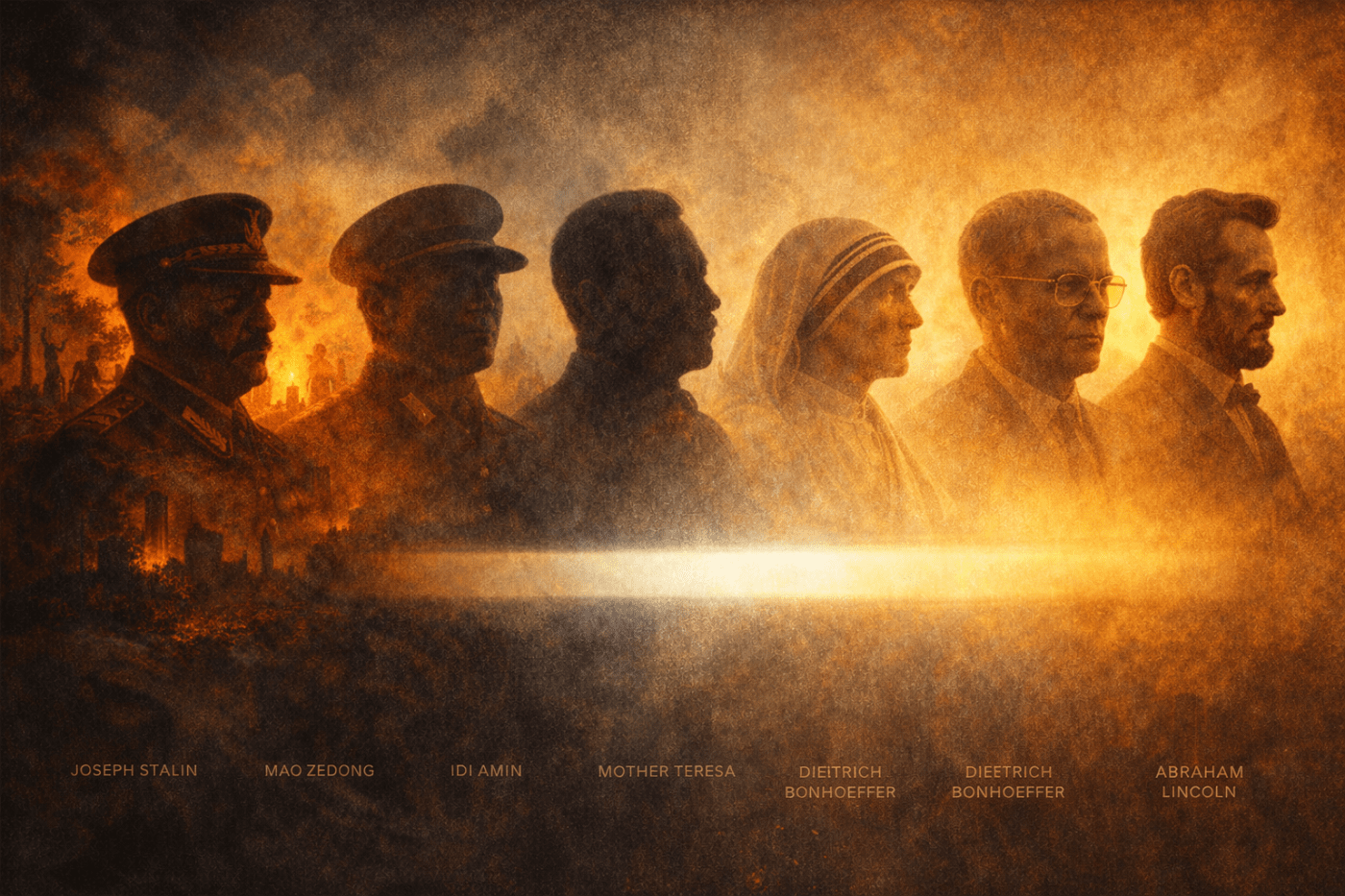
An examination of moral complexity and the dangerous myth of absolutes
In the great ledger of human history, we are forever tempted to sort our fellow beings into two columns: saints and monsters, saviours and destroyers. This impulse, though understandable, betrays a fundamental misunderstanding of human nature itself. For within each soul lies the capacity for both transcendent goodness and terrible darkness—a truth as old as civilization and as contemporary as this morning’s news.
The question that haunts every historian, every philosopher, every person of conscience is not whether humans are good or evil, but rather: what circumstances, choices, and accidents of fate push us toward one pole or the other?
A necessary caveat: What follows is an admittedly imperfect exercise in moral assessment. Labeling individuals as “most good” or “most evil” is inherently subjective, culturally contingent, and methodologically fraught. No rigorous, objective system exists for assigning numeric scores to human souls. These tables reflect historical consensus, documented actions, and lasting impact—but they remain interpretations, not absolute truths. They are offered not as final judgments but as provocations for deeper reflection on our shared humanity.
The Spectrum Illustrated
Ten Among the Most Morally Admirable
| Name | Rating | Notable Good Actions | Notable Bad Actions |
|---|---|---|---|
| Nelson Mandela | 9.5 | Led peaceful transition from apartheid; championed reconciliation over revenge; established Truth and Reconciliation Commission; promoted education and human rights | Early advocacy of armed resistance; some argue his ANC’s methods in the 1960s caused civilian casualties; post-presidency, faced criticism for not acting faster on AIDS crisis |
| Malala Yousafzai | 9.5 | Fearless advocacy for girls’ education under Taliban threat; youngest Nobel laureate; established Malala Fund; continues global activism for education rights | Limited due to youth; some criticize her Western platform as not representative of all Muslim women’s experiences |
| Mother Teresa | 9.0 | Dedicated life to serving the poorest; established Missionaries of Charity; provided care to millions of dying and destitute | Hospitals criticized for inadequate pain management; accepted donations from questionable sources; opposition to contraception and abortion even in dire circumstances |
| Mahatma Gandhi | 8.5 | Led nonviolent independence movement; inspired global civil rights leaders; promoted interfaith harmony; championed the oppressed | Documented racism toward Black Africans in early life; controversial views on sexuality; treatment of his wife; problematic statements about Jewish people during Holocaust |
| Martin Luther King Jr. | 9.0 | Led nonviolent Civil Rights Movement; “I Have a Dream” speech; Nobel Peace Prize; expanded economic justice advocacy | Extramarital affairs; FBI documented personal moral failings; some militant activists felt his methods too passive |
| Desmond Tutu | 9.0 | Led Truth and Reconciliation Commission; championed anti-apartheid movement; advocated for LGBTQ+ rights; promoted forgiveness and healing | Faced criticism from some for being too forgiving of apartheid perpetrators; views on Israel-Palestine controversial to some |
| Jimmy Carter | 8.5 | Post-presidency humanitarian work; Habitat for Humanity; Carter Center disease eradication; election monitoring; Nobel Peace Prize | Presidency marked by economic struggles; Iran hostage crisis; some foreign policy decisions criticized; Camp David Accords implementation challenges |
| Fred Rogers | 9.5 | Revolutionary children’s programming promoting emotional intelligence; testified to Congress to save PBS; advocated for children’s mental health; lived his values consistently | Minimal documented failings; perhaps overly idealistic approach criticized by some as not preparing children for harsh realities |
| Harriet Tubman | 9.0 | Freed approximately 70 enslaved people via Underground Railroad; Civil War spy and nurse; women’s suffrage activist; never lost a “passenger” | Used violence when necessary to prevent escapees from returning; carried a gun and threatened to use it on those who wavered |
| Wangari Maathai | 9.0 | Founded Green Belt Movement (planted 51 million trees); first African woman Nobel Peace laureate; environmental and women’s rights activist | Faced criticism for some controversial statements linking AIDS to biological warfare; political stances alienated some allies |
Ten Among the Most Morally Troubling
| Name | Rating | Notable Good Actions | Notable Bad Actions |
|---|---|---|---|
| Adolf Hitler | 1.0 | Early advocacy for workers’ rights; animal welfare laws; anti-smoking campaigns; infrastructure development (autobahn) | Holocaust (6 million Jews murdered); WWII (60+ million deaths); genocide of Roma, disabled, LGBTQ+; totalitarian dictatorship; crimes against humanity |
| Joseph Stalin | 1.5 | Industrialized Soviet Union; defeated Nazi Germany; improved literacy rates; modernized agriculture (initially) | Great Purge (750,000+ executed); Holodomor famine (3.5-5 million deaths); Gulag system; political repression; estimated 20+ million deaths attributable to policies |
| Pol Pot | 1.0 | Initially sought agrarian equality; anti-colonial resistance | Cambodian genocide (1.5-2 million deaths); forced labor camps; targeting of intellectuals; Killing Fields; complete societal destruction |
| Osama bin Laden | 1.5 | Fought Soviet occupation of Afghanistan; built infrastructure in Sudan; religious devotion | 9/11 attacks (3,000 deaths); other terrorist attacks globally; founding Al-Qaeda; promotion of religious extremism and violence |
| Idi Amin | 2.0 | Initially popular populist reforms; expelled Asians to give Ugandans economic opportunities; infrastructure projects | 300,000-500,000 deaths during regime; ethnic persecution; economic destruction of Uganda; torture; cannibalism allegations; political murders |
| Saddam Hussein | 2.5 | Modernized Iraq infrastructure; improved literacy and women’s rights initially; nationalized oil for Iraqi benefit; healthcare improvements | Anfal genocide of Kurds (100,000+ deaths); chemical weapons on civilians; Iran-Iraq War (500,000+ deaths); invasion of Kuwait; totalitarian brutality |
| Kim Jong-il | 2.0 | Maintained North Korean sovereignty; some cultural initiatives; film enthusiast who promoted arts | Perpetuated totalitarian dictatorship; responsible for famine deaths (600,000-1 million); gulags; nuclear weapons development; cult of personality |
| Mao Zedong | 3.0 | Unified China; improved women’s rights; increased literacy; eliminated opium addiction; land reform benefited some peasants | Great Leap Forward (15-55 million deaths from famine); Cultural Revolution (1.5 million deaths); totalitarian control; political persecution; destroyed cultural heritage |
| Augusto Pinochet | 3.5 | Economic reforms created growth; modernized Chilean infrastructure; fought perceived communist threat | Military coup; 3,000+ political murders; 40,000 tortured; disappeared thousands; human rights atrocities; dictatorship from 1973-1990 |
| Slobodan Milošević | 2.5 | Initially promoted Serbian nationalism as unity; early career showed competence in economics | Bosnian genocide; ethnic cleansing; war crimes; 100,000+ deaths in Yugoslav wars; systematic rape as weapon; crimes against humanity |
The Myth of Moral Purity
Let us dispense immediately with a comforting fiction: that some among us are purely good, while others are irredeemably evil. History offers no such luxury. Gandhi, who led millions toward freedom through nonviolence, harbored documented racism and treated his wife with contempt. Martin Luther King Jr., whose dream inspired a nation, was unfaithful to his marriage vows. Mother Teresa, who devoted her life to the dying poor, ran facilities criticized for glorifying suffering rather than alleviating it.
These revelations do not diminish their extraordinary contributions to human dignity. Rather, they remind us that moral greatness emerges not from perfection, but from imperfect beings choosing, again and again, to serve something larger than themselves. The saint is not one without shadow, but one who walks toward the light despite it.
Conversely, even history’s most destructive figures possessed capacities for ordinary kindness. Hitler loved his dog and wept at opera. Stalin wrote poetry in his youth. These facts do not redeem their monstrous acts—the Holocaust’s six million murdered Jews, Stalin’s twenty million dead from purge and famine—but they do complicate our understanding. Monsters are made, not born; they emerge from the same human clay as heroes.
The Crucible of Childhood
Here we encounter one of history’s most disturbing patterns: many who inflicted unimaginable suffering were themselves victims of childhood brutality. Hitler’s father beat him regularly; Stalin endured a violent, alcoholic father in crushing poverty. The thread connecting abused child to genocidal dictator is neither direct nor deterministic, yet it appears too often to ignore.
This observation carries profound implications for how we treat the vulnerable among us. Every child denied love, every young soul subjected to violence, every neglected mind—these are not merely private tragedies but potential catastrophes in waiting. We cannot predict which wounded child will heal and which will metastasize into something monstrous, but we can know this: cruelty begets cruelty, and violence seeds violence across generations.
Yet the pattern is not absolute. Mao Zedong, whose Great Leap Forward and Cultural Revolution killed tens of millions, came from a relatively prosperous farming family. His radicalism emerged not from childhood trauma but from ideological certainty—the dangerous conviction that he alone understood how humanity should be remade. Pol Pot, architect of Cambodia’s killing fields, was educated in Paris. Their evil sprang not from deprivation but from the intoxication of absolute power married to utopian vision.
This teaches us that while compassion toward children is essential, it is not sufficient. We must also guard against the arrogance of ideology, the seduction of power, and the human tendency to sacrifice real people on the altar of abstract principles.
The Common Thread
What unites history’s great destroyers, whether traumatized or privileged in origin? A telling pattern emerges: the abandonment of empathy for those deemed “other.” Whether Jews to Hitler, kulaks to Stalin, intellectuals to Pol Pot, or Kurds to Saddam Hussein, genocide begins when we cease to see the humanity in those we’ve categorized as enemies.
This dehumanization represents evil’s essential mechanism. It transforms murder from unthinkable act to administrative necessity, from moral crisis to logistical challenge. The bureaucrat stamping deportation orders, the soldier herding villagers into churches before setting them ablaze, the ideologue justifying starvation as historical necessity—all have first performed the fundamental evil of denying their victims’ full humanity.
Against this darkness stands a simple, radical counter-principle: the recognition of inherent dignity in every human being. This is not sentiment but survival wisdom, encoded in every major moral tradition. “Love thy neighbor as thyself,” Christ commanded—not as metaphor but as practical instruction for building societies that don’t consume themselves. The Golden Rule appears in Confucius, in Hillel, in the Buddha, because our ancestors learned through bitter experience that civilization requires reciprocal recognition of our common humanity.
The Choice Before Us
We are all somewhere on the spectrum between saint and monster, and we move along it daily through choices both grand and mundane. The executive who ignores worker safety for profit, the parent who strikes a child in anger, the citizen who looks away from injustice—these are not the acts of monsters but of ordinary people making choices that, accumulated, shift the moral center of gravity.
Similarly, the neighbor who checks on the elderly, the stranger who intervenes when witnessing abuse, the professional who sacrifices advancement to maintain integrity—these are not saints but ordinary people choosing, in that moment, to honor the dignity of others.
History’s lesson is neither optimistic nor pessimistic but realistic: we are capable of extraordinary good and terrible evil, sometimes in the same lifetime, sometimes in the same day. What determines which capacity we manifest? The answer lies not in our nature—which contains both—but in our choices, our circumstances, and crucially, in how we were ourselves treated during our formation.
The Only Certainty
In the end, perhaps only one moral certainty exists: that we must treat each other with kindness, not because we are certain of goodness but because we know our capacity for evil. We must love not because it is easy or natural, but because the alternative—a world where might makes right and cruelty goes unchecked—is unthinkable.
The spectrum of human morality is not a distant abstraction but a daily reality. We are all authors of our portion of history, contributing our verses to the eternal human story. Whether those verses speak of compassion or cruelty, whether they build or destroy, depends not on our nature but on our choices.
And that, paradoxically, is both the most humbling and most hopeful truth we possess.
 Notes Beyond the Map
Leave a comment