
Canada sold its soul — one tonne at a time. It wasn’t alone.
There is a metal that has outlasted every empire that ever touched it.
The Sumerians buried it with their dead around 3000 BCE — not because it was useful, but because they understood, at a cellular level, that it was permanent. The Aztecs called it teocuitlatl: excrement of the gods. The Spanish murdered an entire civilization to get their hands on it. The Portuguese built the Atlantic trade on it. The Dutch hoarded it. The British Empire ran on it. And the Americans — well, they wrote it into law, then quietly walked away from it in 1971, and are now, fifty years later, quietly walking back.
Gold has watched every fiat currency in human history go to zero.
Every. Single. One.
And yet, in 2016, Canada — a G7 nation, a country of serious people making serious decisions — sold its last gold bar and called it a day. The balance: zero tonnes. The reasoning: modern portfolio theory. The outcome: $125 billion in unrealized losses and counting.
So it goes.
An Asset That Predates Civilization As We Know It
Before we talk about Canada’s spectacular miscalculation, we need to understand what gold actually is — beyond the jewelry, beyond the aesthetics, beyond the gleam.
Gold is one of 118 elements on the periodic table. Of those, roughly 72 are metals. But only gold — for reasons both chemical and psychological — became the universal store of value across cultures that had zero contact with one another. The Egyptians, the Chinese, the Mesopotamians, the Mesoamerican civilizations: all of them, independently, landed on the same conclusion.
Why?
Gold doesn’t corrode. It doesn’t oxidize. It doesn’t react with air, water, or most acids. A gold coin buried in the ground for three thousand years emerges looking exactly as it did the day it was minted. No other metal behaves this way at scale. Silver tarnishes. Iron rusts. Copper corrodes. Gold simply… endures.
It is also extraordinarily rare. All the gold ever mined in human history — every bar, every coin, every necklace, every tooth filling — would fit inside roughly 3.5 Olympic swimming pools. The entire global supply. Six thousand years of digging.
But the third reason is the one economists undervalue: gold’s rarity is predictable. You can’t print it. You can’t hack it. You can’t issue a decree and conjure more of it into existence. A government can devalue its currency overnight. It cannot devalue gold. This is not a feature — it is the whole point.
The Aztecs didn’t build their cosmology around gold because it sparkled. They built it around gold because it embodied something they understood intuitively: permanence in a world of change. When Hernán Cortés arrived in 1519 and saw the Aztec treasury, he didn’t see jewelry. He saw a threat to Spanish monetary supremacy. He melted almost all of it down. The message was clear: whoever controls the gold controls the story.
The Spanish Empire ran on gold. So did the Portuguese, who financed their entire Age of Exploration on the promise of gold from Brazil and West Africa. The Dutch East India Company — the most valuable corporation in human history in inflation-adjusted terms — settled accounts in gold. The British Empire, at its peak, ran the global reserve currency on a gold standard, and when that standard broke under the strain of two world wars, the American dollar stepped in — backed, initially, by the largest gold hoard the world had ever seen: 8,133 tonnes still sitting in Fort Knox, West Point, and the Federal Reserve Bank of New York.
Here’s the pattern: every empire that dominated the global financial order understood gold not as an investment, but as legitimacy. As proof of permanence. As collateral for trust.
And then came the economists with their spreadsheets. And a few countries decided they were smarter than six thousand years of human history.
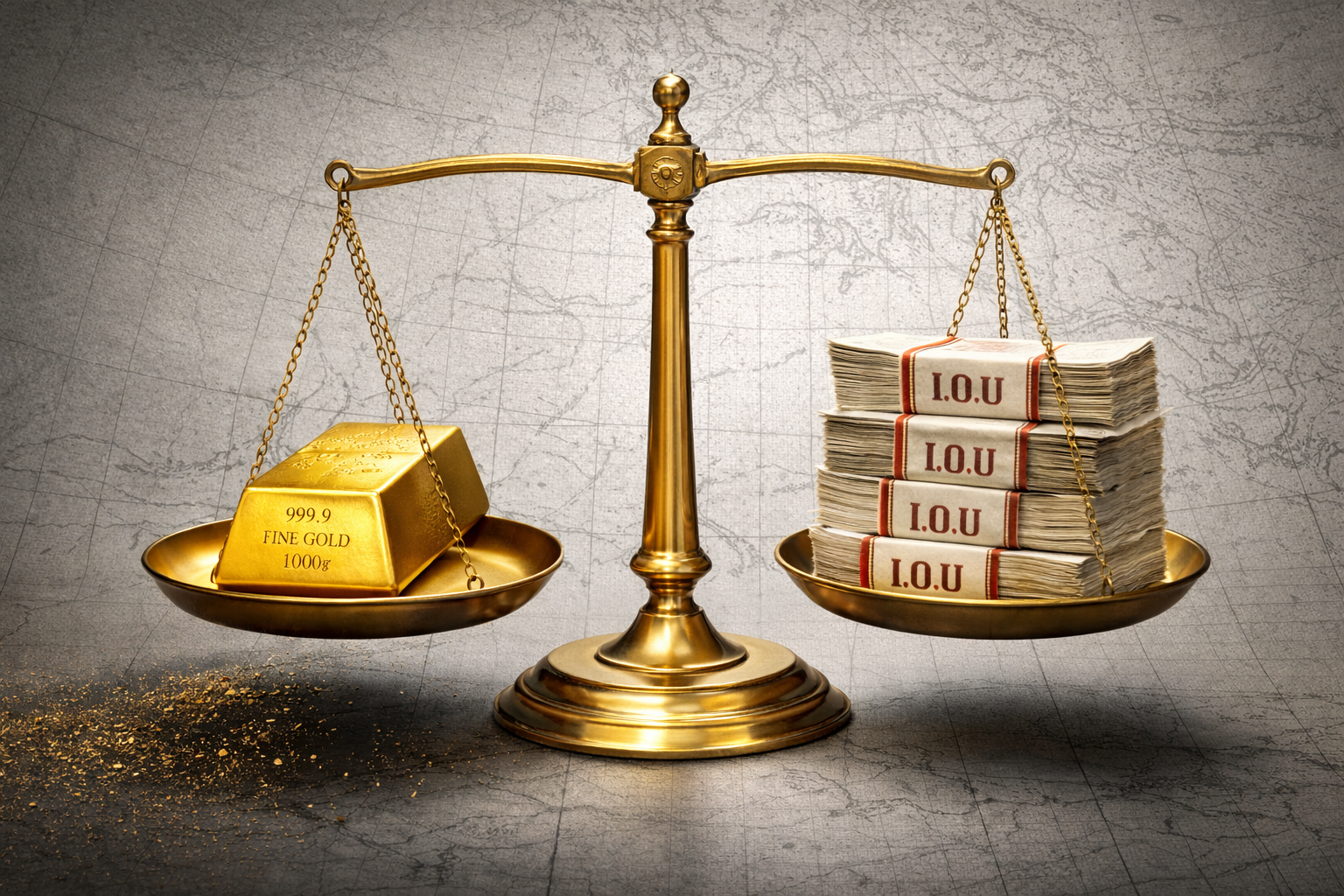
The Smarter-Than-History Club
Canada is the marquee member. But it has company.
Norway liquidated its reserves in 2004, keeping seven ceremonial bars on display in its central bank — a museum piece, a fossil of an outdated idea. Canada went further, selling its final holdings in 2016 and achieving the rare distinction of being the only G7 nation on earth with zero gold on its balance sheet.
The rationale, repeated in government reports with the confidence of people who have never been wrong before: gold doesn’t pay interest. Dollar-denominated assets do. A 2004 Canadian government report claimed the strategy of selling gold and rotating into foreign currency assets had generated billions more in returns than holding bullion.
And for a while, they were right.
Then gold did what gold does. It waited.
Consider the arithmetic. In 1965, Canada held 1,023 tonnes of gold, worth approximately $1.13 billion USD at the fixed Bretton Woods price of $35 per troy ounce. Today, those same 1,023 tonnes would be worth roughly $125.67 billion USD. That is not a rounding error. That is the GDP of a small country. That is the difference between a nation that enters a global financial crisis with ammunition and one that enters it holding someone else’s promises.
One tonne of gold, worth $1.1 million in 1965, is worth $159 million today.
Canada sold its seat at the table and bought a very nice chair.
Bitcoin Was Supposed to Fix This
For a glorious few years in the late 2010s and early 2020s, the narrative shifted. Gold was old. Gold was your grandfather’s asset. Bitcoin was digital gold — scarce by design, decentralized, uncensorable, and infinitely more exciting.
The argument had merit, in theory. Bitcoin’s supply is capped at 21 million coins, coded in mathematics rather than geology. It can be transferred across borders in minutes. You don’t need Fort Knox to hold it. And between 2020 and late 2021, it seemed like the thesis was working: Bitcoin surged to nearly $69,000, and the magazine covers declared the dawn of a new monetary era.
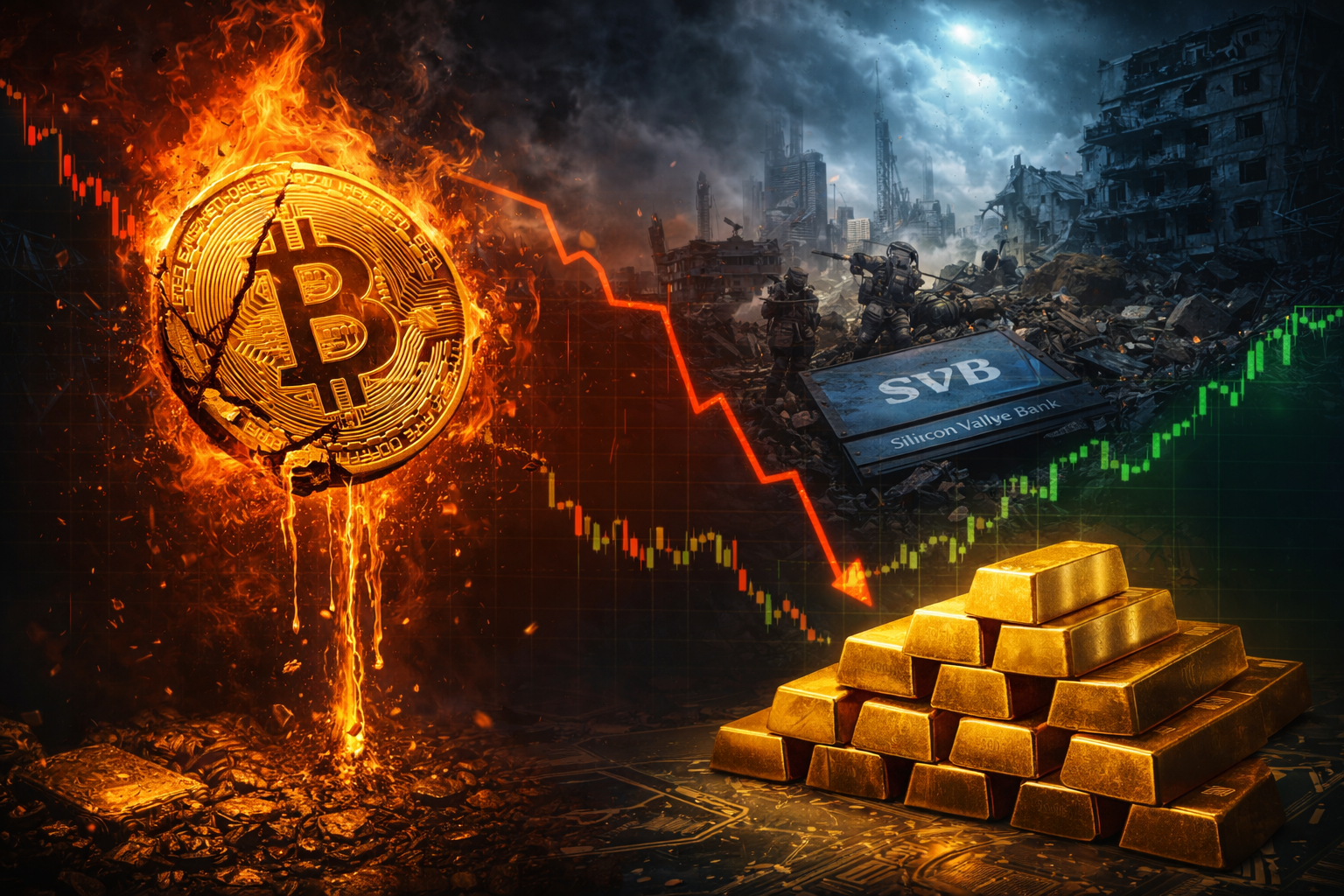
But here’s the thing: when the world actually broke — when inflation surged, when Russia invaded Ukraine, when Silicon Valley Bank collapsed, when tariffs reignited and trade wars accelerated — Bitcoin did not behave like gold.
It behaved like a tech stock.
In 2022, as inflation peaked and uncertainty spiked — precisely the conditions under which gold should underperform and a “digital gold” should shine — Bitcoin lost over 60% of its value. Gold fell modestly and recovered. The divergence was clarifying. Bitcoin has made fortunes for the early, the bold, and the well-timed. But it has not demonstrated the one property that makes gold irreplaceable to central banks: counter-cyclical stability. When institutions need a safe haven in a crisis, they don’t wire Bitcoin to their counterparties. They move gold.
The world’s reserve managers know this. The retail investor is still catching up.
Gold Is Not What You Think It Is Anymore
Here is where the story takes a turn most people miss entirely.
When people argue against gold, they picture it the way their grandmother wore it — a necklace, a ring, an heirloom gathering dust in a safety deposit box. Something sentimental. Something pre-modern. Something that belongs in a museum alongside the Sumerians who loved it first.
That picture is about fifty years out of date.
Gold is now one of the most strategically critical industrial materials on earth, and the industries consuming it are precisely the ones the entire global economy is betting its future on.
Start with space. Every serious spacecraft launched in the last three decades — from the Hubble Space Telescope to the James Webb Space Telescope to the Mars rovers — is coated in gold. Not for aesthetics. Because gold reflects infrared radiation better than any other material, it protects sensitive instruments from the temperature extremes of deep space. The James Webb’s iconic golden mirrors? 18 hexagonal beryllium segments, each coated in 48.25 grams of pure gold, vapour-deposited to a thickness of 100 nanometers — thinner than a wavelength of light. Gold is, quite literally, how humanity sees the early universe.
Then there’s semiconductors. Every advanced chip — the kind that powers the device you’re reading this on — uses gold bonding wires to connect the silicon die to its packaging. Gold doesn’t corrode, doesn’t oxidize, and maintains conductivity under conditions that would degrade any other metal. As chips get smaller and more complex, gold’s role becomes more, not less, critical.
Quantum computing may be the frontier that changes everything. Quantum processors operate at temperatures approaching absolute zero — colder than outer space — and require materials that maintain near-perfect conductivity without introducing thermal noise. Gold is the connector of choice. Companies racing to build quantum supremacy — IBM, Google, IonQ — are building their systems with gold at the junctions where it matters most.
Medical technology. Gold nanoparticles are now used in cancer diagnostics and targeted drug delivery, binding to tumour cells with a precision that conventional therapies can’t match. Gold electrodes are used in cochlear implants and neural interfaces — the kind being developed by companies like Neuralink to bridge the gap between human cognition and machine computation. The human brain, it turns out, responds well to gold.
AI infrastructure. The data centres powering the large language models, the recommendation engines, and the autonomous systems reshaping every industry? They run on servers loaded with gold-containing connectors, contacts, and circuit boards. Every time you run a query through an AI system, somewhere upstream, gold is doing its job.
This is the detail that makes Canada’s decision not just financially painful, but strategically disorienting. The twenty-first century is being built on semiconductors, space technology, quantum systems, and biomedical innovation — and gold sits quietly at the foundation of all of it. The countries that hold gold aren’t just holding a monetary relic. They’re holding a strategic material for the industries that will define the next century.
Canada has zero.
The Shift Nobody’s Talking About Loudly Enough
David Einhorn, founder of Greenlight Capital and the man who publicly called Lehman Brothers’ collapse before it happened, is not given to hyperbole. His fund has compounded at nearly 12.9% annually since 1996, against the S&P 500’s ~10%. When he speaks, the numbers behind the words deserve attention.
What he’s saying now is this: gold is no longer competing with oil or equities for reserve allocation. It is competing with U.S. Treasuries.
That is a tectonic statement.
Central banks bought 863 tonnes of gold in 2025. In 2022, they bought 1,082 tonnes — the highest single-year accumulation on record. In 2023, 1,037 tonnes — the second highest. Three consecutive years of structurally elevated demand from the institutions that know most about the cost of getting monetary policy wrong.
China has reduced its U.S. Treasury holdings to $683 billion, down sharply from peak levels, and has been a consistent net seller. Meanwhile, a World Gold Council survey found that 76% of global reserve managers believe gold will constitute a significantly higher share of reserves within five years.
Wall Street has noticed. JPMorgan is targeting $6,300 per ounce by end-2026. UBS: $6,200. Deutsche Bank: $6,000. Goldman Sachs: $5,400. As of this writing, gold is trading near $4,969.
These are not fringe numbers from gold bug newsletters. These are the most systemically important financial institutions on earth.
The question Einhorn is really asking — and it’s the right question — is whether the U.S. deficit trajectory, the weaponization of dollar-denominated sanctions, and the restructuring of global trade alliances have permanently altered the trust calculus that makes Treasuries the world’s default reserve asset. If even 10% of global reserves rotate from Treasuries into gold over the next decade, the implications for gold prices are staggering.
And for countries with no gold? The implications are quieter, but no less severe.
What Happens When You Arrive Empty-Handed
Imagine a scenario — not far-fetched, increasingly consensus — where the U.S. dollar weakens materially, either through deliberate devaluation, runaway deficit spending, or a structural loss of confidence in American institutional credibility.
Countries with gold reserves face that scenario with options. They can revalue their reserves upward. They can use gold to settle trade bilaterally, bypassing dollar-clearing systems. They can signal fiscal credibility in a world where fiat credibility is contested.
Countries with no gold face it with dollar-denominated assets that are, in this scenario, declining in real value. They face it with the full exposure of having trusted the system and held no insurance against the system’s failure.
Canada holds approximately $106 billion in foreign exchange reserves, predominantly in U.S. dollars and euros. In a dollar crisis, those reserves don’t disappear — but they become the problem, not the solution. There is no counter-weight. No floor. No yellow metal sitting in a vault somewhere reminding the market that this country’s balance sheet is not purely a function of someone else’s promises.
The Germans understand this. They repatriated 300 tonnes of gold from New York and Paris between 2013 and 2017 — a quiet, deliberate, expensive operation that attracted little fanfare and significant logistical complexity. They did it anyway. When a country that rebuilt an entire civilization from the rubble of two world wars decides to bring its gold home, it’s worth asking why.
The answer is not irrational sentiment. It is institutional memory of what happens when the music stops and you don’t have a chair.
The Fool’s Bargain
Here is the uncomfortable truth at the center of this story.
Canada’s decision to sell its gold wasn’t stupid at the time. It was the product of a coherent worldview — a world where American financial dominance was permanent, where the dollar was as good as gold (literally, by treaty, until 1971, and by inertia ever since), and where financial assets would reliably outperform inert metals over any reasonable time horizon.
For decades, that worldview was mostly right.
But “mostly right for decades” is a dangerous credential when the scenario you’re wrong about is an existential one.
Gold is not an investment in the traditional sense. It does not pay dividends. It does not grow earnings. It does not compound. What it does is refuse to go to zero. In a world where every other asset is someone’s liability — a stock is a claim on corporate future earnings, a bond is a claim on government solvency, a currency is a claim on institutional trust — gold is simply a thing. It exists independent of the promises of any institution.
And in a world where those promises are being quietly, systematically questioned by the very central banks entrusted to uphold them, that property is worth more every year.
Canada had 1,023 tonnes of that property in 1965. It is worth $125 billion today. Instead, Canada has zero.
Every civilization in human history that has understood power has understood gold. The Sumerians. The Aztecs. The Spanish. The British. The Americans — who, it should be noted, still hold 8,133 tonnes. Not because they forgot. Because they didn’t.
Canada forgot.
Or perhaps more precisely: Canada trusted the system so completely that it saw no need for insurance against the system’s failure.
The question worth sitting with — and it has no clean answer — is whether that trust was wisdom or naivety. Whether the spreadsheets that justified selling 1,023 tonnes at $35 an ounce capture everything that matters about a nation’s financial resilience.
Gold has been around for six thousand years. The modern portfolio theory is about seventy.
So it goes.
The views in this article are intended to provoke thought, not constitute financial advice. For reserve management decisions affecting the GDP of entire nations, consult someone with more than a blog.
 Notes Beyond the Map
Leave a comment