
They built the most prosperous society in human history. Then they locked the door from the inside.
I grew up in Victoria, British Columbia — a city so beautiful it almost feels dishonest. Ocean to the west, mountains to the north, old-money neighbourhoods lined with cherry trees and Tudor homes that now sell for well over a million dollars on a quiet Tuesday. I had a good upbringing. A real one. Post-secondary education, a family that cared, and enough curiosity to push me out into the world — through continents, cultures, and experiences that most people encounter only in documentaries.
I’m 43. I’ve lived more lives than I probably deserved.
I say that not to boast, but to establish what I’m about to say with the full weight of hard-won perspective: Canada is being held hostage by a generation that cannot let go. And the worst part? They built the cage with the best of intentions.
They Came Home from the War and Built a World
Let’s be honest about what Baby Boomers actually accomplished. This is not a hit piece on a generation I despise — I love many of them, including the ones who raised me.
These were the children of veterans. Raised in the long exhale after World War II, conditioned by the sight of rubble and rationing to believe that stability was the highest human achievement. They were right, for a while. They built public infrastructure. They raised living standards. They avoided a catastrophic war. They looked at the brutal 20th century and said: Not again.
And mostly, they delivered.
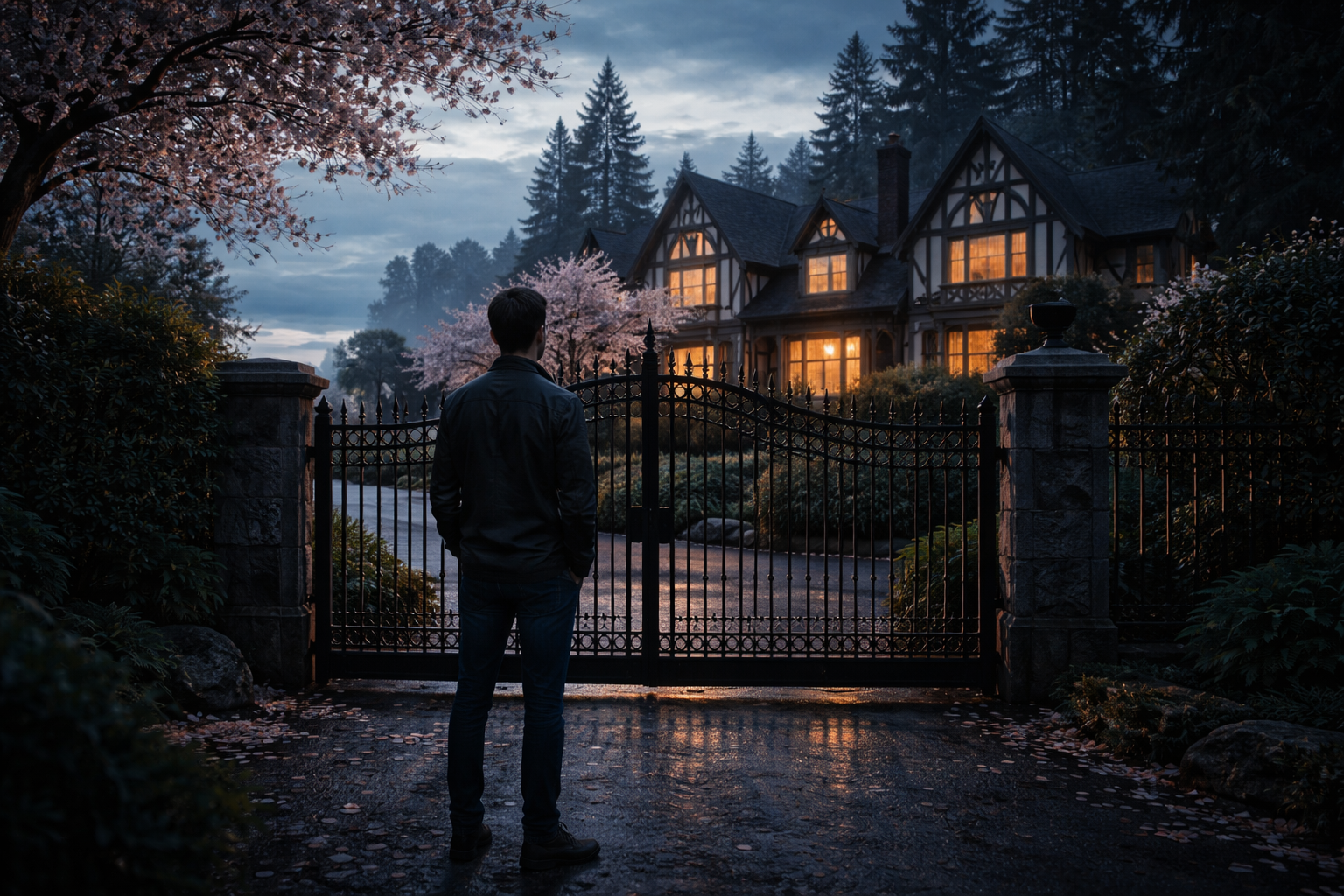
But here’s the thing about building a fortress: eventually, you have to open the gates. A fortress that never opens isn’t protection. It’s a prison.
Canada’s Boomers — born roughly between 1946 and 1964 — now control an estimated 40% of this country’s total household wealth. They own the homes. They hold the senior positions. They sit on the boards, run the unions, lead the parties, and vote in numbers that dwarf every other demographic combined. In the 2021 federal election, voter turnout among Canadians 65 and older was nearly double that of voters under 35.
Politicians notice these things. Politicians respond to these things. So when housing policy calcifies, when zoning reform moves like a glacier, when our political vocabulary still orbits around protecting existing asset values rather than creating new ones — this is the gravity pulling it there. The most powerful voting bloc in the country is largely sitting on the very asset they’re being asked to make more accessible.
It’s not malice. It’s physics.
Then, Quietly, They Changed the Locks
Let me give you a number. Not for shock value — for orientation.
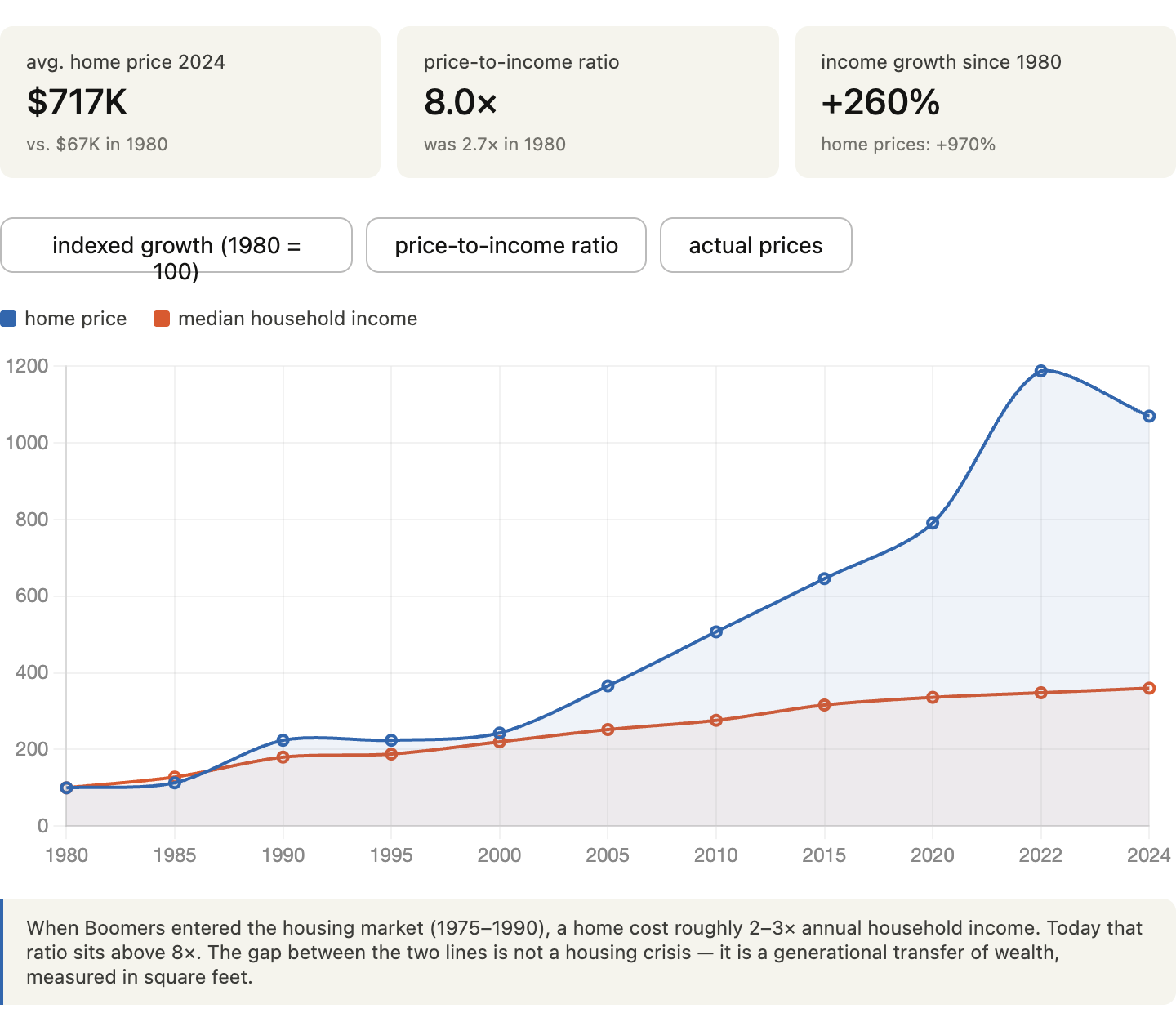
In Vancouver and Toronto, the average detached home now crosses $1.1 to $1.3 million. A first-time buyer who manages to scrape together a 20% down payment — an almost heroic act of savings discipline in today’s economy — still walks away carrying $850,000 to nearly a million dollars in mortgage debt. That is not the cost of luxury. That is the entry fee for ordinary.
A starter home. A beginning. Something to hang a coat on.
Think of it this way: that buyer has just signed up for a financial obligation roughly equivalent to funding a small business — except the business is a bungalow, it doesn’t generate revenue, and the bank owns most of it for the next 25 years. Meanwhile, the person who bought that same bungalow in 1987 for $140,000 is sitting on a paid-off asset worth ten times what they paid, watching the news and wondering why young people can’t seem to get ahead.
The ladder didn’t disappear. Someone just pulled it up behind them.
And Canadian households, as a whole, are now carrying the highest debt-to-income ratio in the G7 — above 180%. We are not a little stretched. We are structurally fragile. One significant shock — a sustained interest rate spike, a global recession, a crisis that arrives wearing a different mask — and entire cohorts of Canadians who did everything right could find themselves underwater, with no floor beneath them.
An Economist Mapped What Happens Next
The investor and economic theorist Ray Dalio has spent decades mapping what he calls the long-term debt cycle — a roughly 75-year arc in which economies expand on the back of increasing debt, until debt levels outgrow the economy’s ability to service them, and the whole system is forced into a painful, disorderly deleveraging.
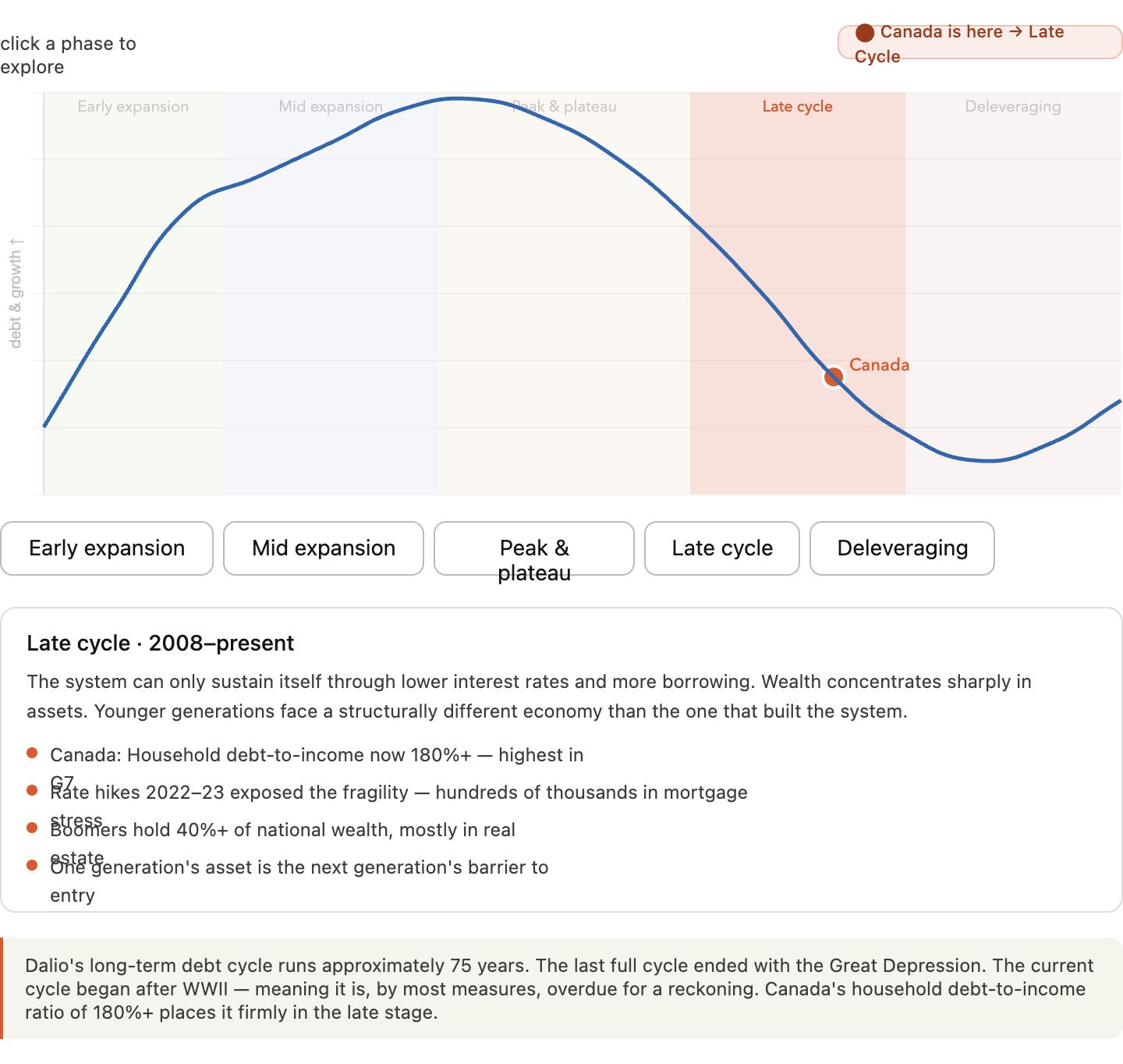
The late stage of this cycle has a particular texture. Growth slows. Wealth concentrates. The gap between asset owners and everyone else widens into a canyon. The mechanisms that once created broad prosperity — rising wages, accessible credit, affordable housing, upward mobility — begin to work in reverse. And the political and institutional leaders who benefited most from the cycle’s earlier chapters are, by then, thoroughly invested in preserving it.
Canada is late in that cycle. The numbers are not subtle.
When Dalio describes the final chapter of long-term debt accumulation, he talks about societies that feel poorer than they should, given their objective wealth. That description is not abstract to anyone trying to rent a one-bedroom apartment in Ottawa on a professional salary, or watching their grocery bill climb 30% in three years while their wage grew 4%.
We are a rich country that is making its own people feel poor. That is not an accident. That is a stage.
Meanwhile, Your Dollar Works Harder Everywhere But Here
Here is the part that truly unsettles me, and I say this from direct experience.
A Canadian professional earning $75,000 in Toronto or Vancouver lives carefully. Modestly. They watch what they spend, skip the vacations, and calculate the groceries. Life is managed, not lived. But take that same person — same education, same ambition, same skills — and put them in Ho Chi Minh City, in Chengdu, in Medellín, in Lisbon. Suddenly, money moves. It expands. It creates options and experiences and breathing room that simply don’t exist at home.
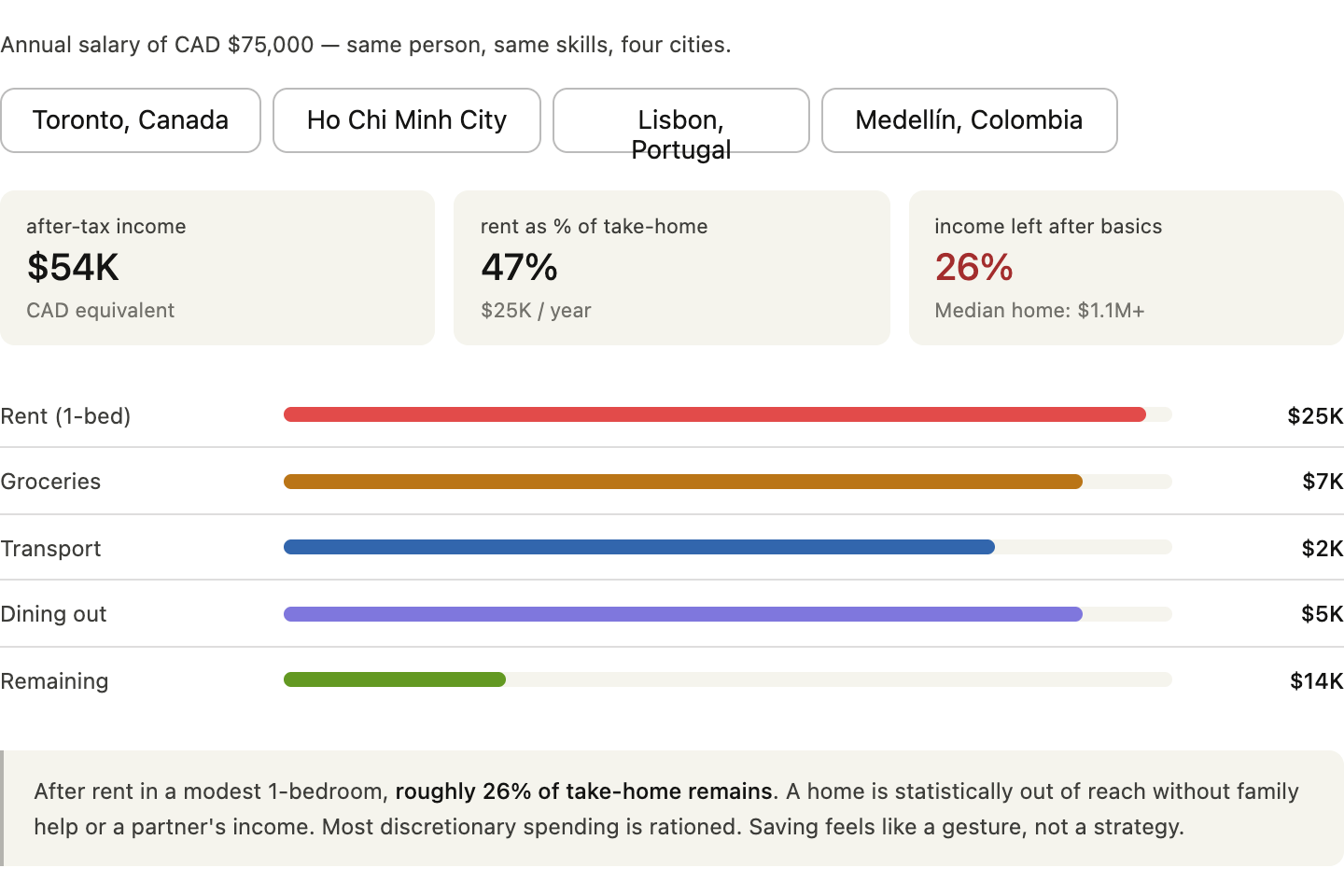
This is the late-stage capitalism paradox that nobody in Canadian politics wants to say out loud: our money no longer works for us the way it once did. In a developing economy, capital is still in formation. Supply is growing, demand is accelerating, and the energy of a rising middle class electrifies everything it touches. In a mature, asset-inflated economy like Canada’s, that same dollar is absorbed almost immediately by the cost of existing rent, debt service, taxes, and utilities. You run hard just to stay in place.
Vietnam isn’t wealthier than Canada. But a Vietnamese family earning the equivalent of a modest Canadian income, in their own economy, can build something. A home. A business. A future. That feeling — of money as possibility rather than money as survival — is something a generation of young Canadians has never experienced in their own country.
And that is a slow emergency we seem determined to ignore.
Nobody Meant for This to Happen
I want to slow down here, because the easy narrative — greedy old people — is not the complete one, and it isn’t fair.
Boomers are living longer. That is not a character flaw; it is a triumph of medicine, nutrition, and public health. A healthy 68-year-old today is physiologically closer to a 55-year-old of their parents’ generation. Why would someone retire when they have 25 active years ahead of them, a healthcare system that will eventually cost them more than they’ve budgeted for, and pension structures that were designed for shorter lifespans?
Many Boomers who look like they’re hoarding are simply afraid. Nearly 60% report delaying retirement because they fear outliving their savings. That fear is real. That fear is rational. The system was never built for this kind of longevity.
Neither were the institutions.
In politics, in corporations, in universities, in newsrooms — the same individuals have occupied senior seats for decades. Not because they’re uniquely villainous, but because the structures around them were never built with adequate succession pipelines, and longevity kept pushing back the natural transition. The result is what political scientists are beginning to call gerontocracy — governance by the old, for the old, optimized for the past.
Canada has not had a Prime Minister under 50 in over 30 years.
So it goes.
But Good Intentions Don’t Open Doors
There is a metaphor I keep returning to, and it bothers me precisely because it’s accurate.
The helicopter parent. The one who loves their child completely — so completely that they cannot stop managing, correcting, hovering — even as that child grows into an adult who simply needs room to fail, adapt, and find their own way. The damage is never from cruelty. The damage comes from love that never learned to become trust.
That is Canada, in too many rooms and too many sectors, right now. A generation that built something real, earned genuine authority, holds the keys — and cannot quite bring itself to hand them over.
But consider another image: an old-growth tree in a dense forest whose canopy has spread so wide that no light reaches the floor. The saplings below are not weak. They are simply starved of the light they need to grow. The forest looks healthy from above. From below, it is a slow suffocation. And when the old tree eventually falls — as all trees do — the floor beneath it is barren.
You cannot inherit a future that was never allowed to take root.
Young Canadians are not asking to tear down the institutions. They are asking to be trusted inside them. They are asking for housing that doesn’t require a near-million-dollar mortgage just to start a life. They are asking for leadership that understands the world they actually inhabit — one shaped by algorithmic anxiety, climate disruption, and global instability, not the long post-war expansion that made real estate a guaranteed return.
The bootstrap logic that built the Boomer generation worked inside the context it was born into. That context is gone. Pounding the pavement for a job is nostalgia, not strategy. Buying a house on a year’s savings is mythology, not a plan.
And Closed Doors Have a Price
When a society prevents its most productive generation from accessing leadership, equity, and capital, it doesn’t just harm those individuals. It slows everything. Innovation stalls when senior positions are permanently occupied. Entrepreneurship withers when access to capital requires either a wealthy family or near-crippling debt. Culture calcifies when the people shaping it stopped being shaped by the present world a decade ago.
Canada is not on the verge of becoming the next great economic story. We could be. The talent is here. The education is here. The culture of collaboration and civic intelligence is a genuine comparative advantage. But we are burning it quietly, incrementally, politely — which is perhaps the most Canadian way to do it — by failing to transition power before the window closes.
An estimated $1 trillion in wealth is set to transfer in Canada over the next decade. But transfer to whom, at what age, under what conditions? If the average Canadian Millennial receives their inheritance at 60, it does not solve a housing crisis. It funds a retirement. The moment for that capital to reshape lives, seed companies, and reinvent communities will have already passed.
Somebody Has to Go First
I don’t have a clean solution. Only a question — the one Canada needs to put on the table in every boardroom, constituency office, and dinner table conversation, willing to go there:
At what point does protecting what we’ve built become the very thing that destroys it?
The long-term debt cycle ends. Dalio is clear about that. The deleveraging comes, one way or another — managed or chaotic, chosen or forced. The generation that holds the wealth and the power has an extraordinary opportunity right now: to be the ones who opened the door before the fire reached it, rather than the ones who were still arguing about the lock while the house burned.
The greatest generation’s gift to their children was possibility. The Boomers’ gift was stability. Both were extraordinary. Both were necessary.
But the gift this moment demands — the one that would honour everything built before it — is trust.
The door is still locked. The keys are still in the same pockets.
The smoke is already visible from the second floor.
The question is not whether the transition happens. The question is whether it happens in time to mean something.
 Notes Beyond the Map
Leave a comment