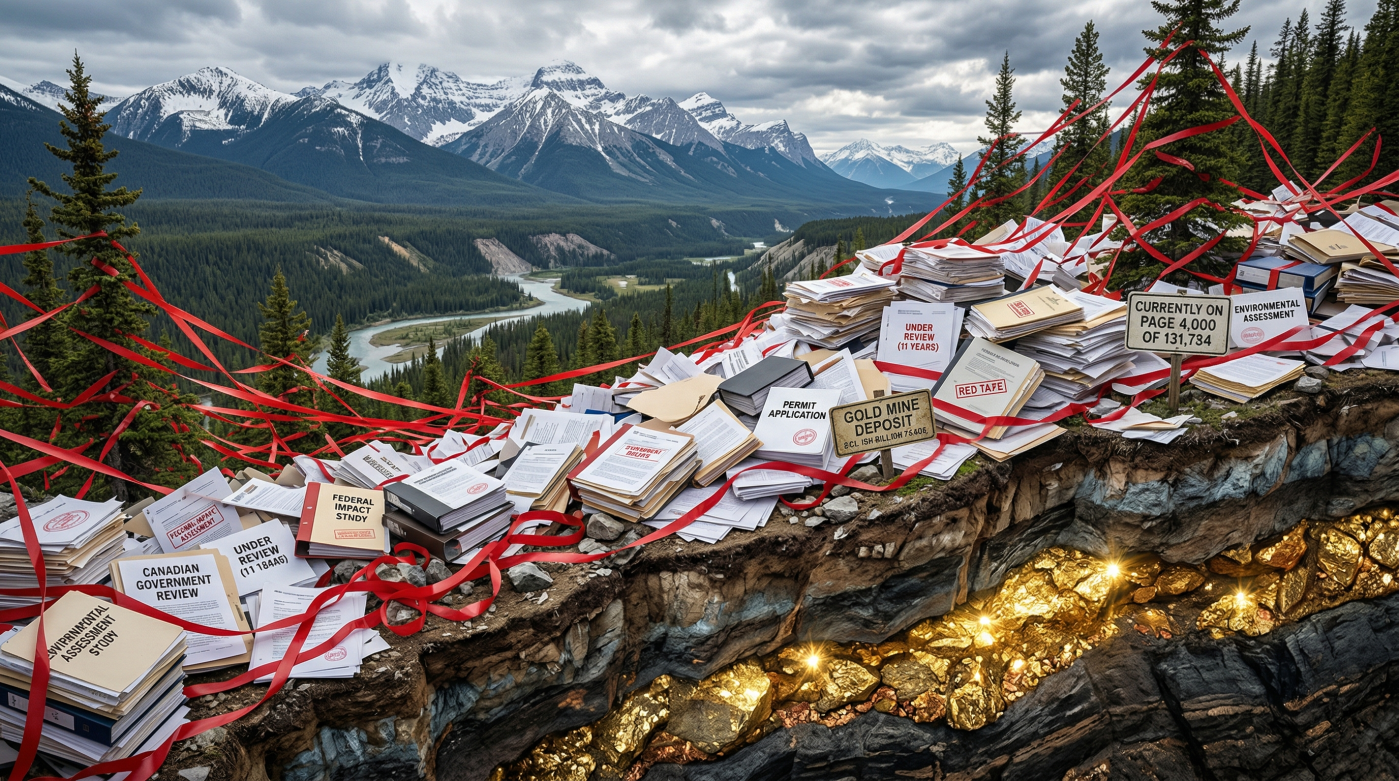
Canada has everything a country needs to be wealthy beyond reason. It also has the paperwork.
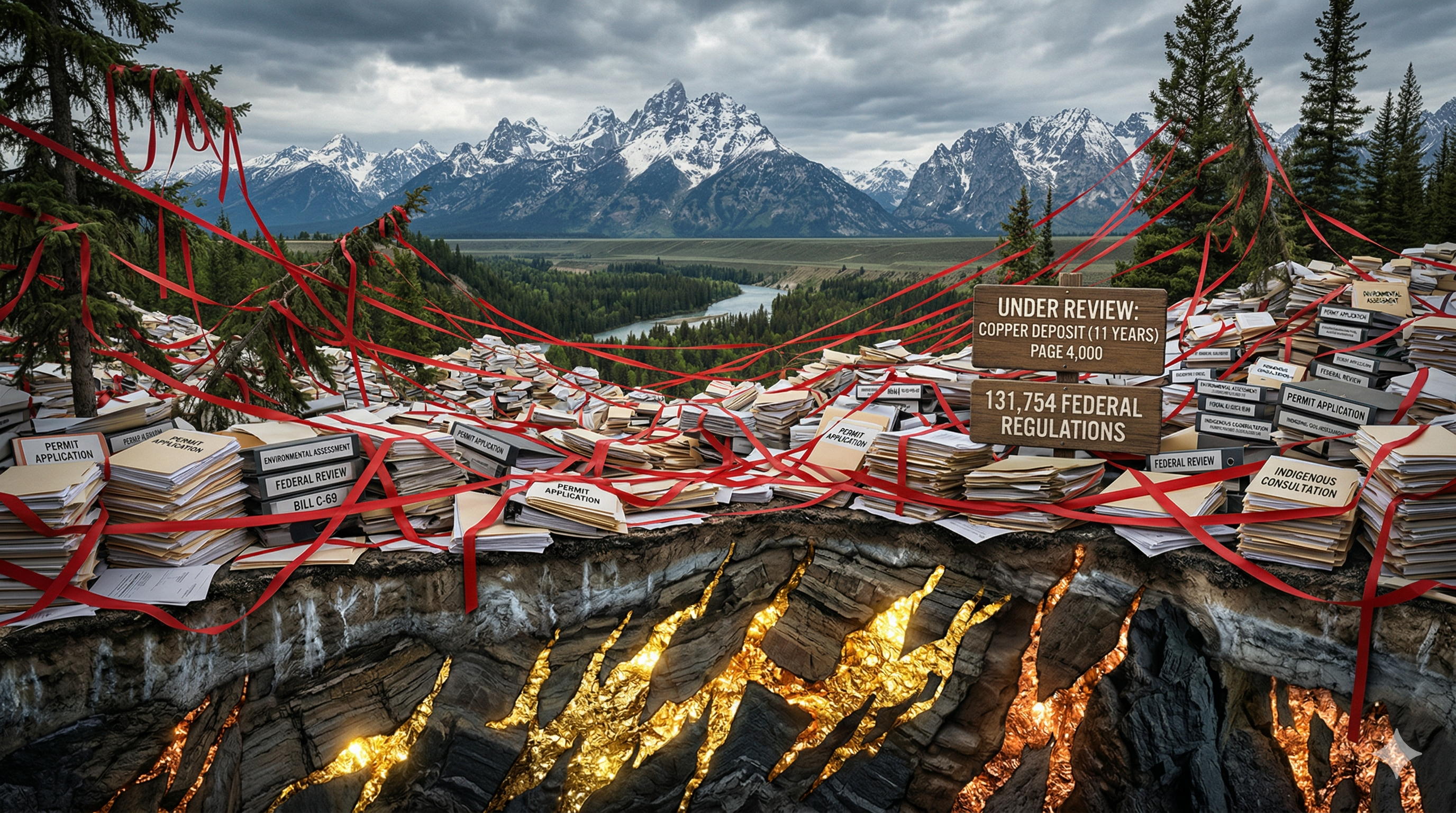
There is a copper deposit in Northern British Columbia that has been under review for eleven years.
Eleven years. The Soviet Union collapsed in less time. The entire Second World War was fought and won in less time. A child born the day that project entered its first environmental assessment is now in middle school, probably learning about natural resources in a social studies class, completely unaware that the natural resource underneath their future is currently on page 4,000 of a federal impact assessment that will eventually be challenged in court by three separate levels of government and then referred back to committee.
So it goes.
Canada is the third-richest country on earth by natural resources, trailing only China and Saudi Arabia, sitting on top of the lithium, uranium, rare earths, fresh water, and timber that the 21st century is going to need more desperately than it needs almost anything else. We have the most educated workforce in the world. We have political stability, rule of law, and a trading relationship with the largest consumer market in human history that is so close it practically requires couples’ counselling. We have every ingredient a serious country needs to be outrageously prosperous.
What we’ve done with those ingredients is commission a report about the ingredients. Then held public consultations about the report. Then referred the consultations to a review panel. Then watched the review panel get struck down by the Supreme Court for overstepping federal jurisdiction. Then started over.
The Rulebook That Rewrites Itself
Here’s a board game analogy, because this situation practically demands one.
Imagine you sit down to play a game. The rules are explained. You make your opening moves. Then, mid-game, someone adds three new rules, not because anything went wrong, but because a different player at a different table thinks the original rules weren’t quite right. Then a referee arrives and rules that two of the original rules were unconstitutional. Then someone calls a timeout to consult with observers who weren’t playing but feel they should have been asked before anyone rolled the dice.
You don’t finish the game. Nobody finishes the game. The game has never, in fact, been finished. But everyone involved can tell you exactly which rule was violated on which turn and who is to blame.
This is Canadian resource development. Not an exaggeration. A documentary.
In 2019, the federal government introduced Bill C-69, the Impact Assessment Act, with the stated goal of rebuilding public trust in major resource projects. Noble intention. The implementation required projects to assess not just environmental impacts but social impacts, health impacts, and gender impacts. Then in 2023, the Supreme Court of Canada ruled significant portions of it unconstitutional, citing federal overreach into provincial jurisdiction over natural resources. The law meant to fix the process was itself illegal. The rulebook was rewritten while the game was being played. Projects that had spent years navigating the new rules had to recalibrate mid-process.
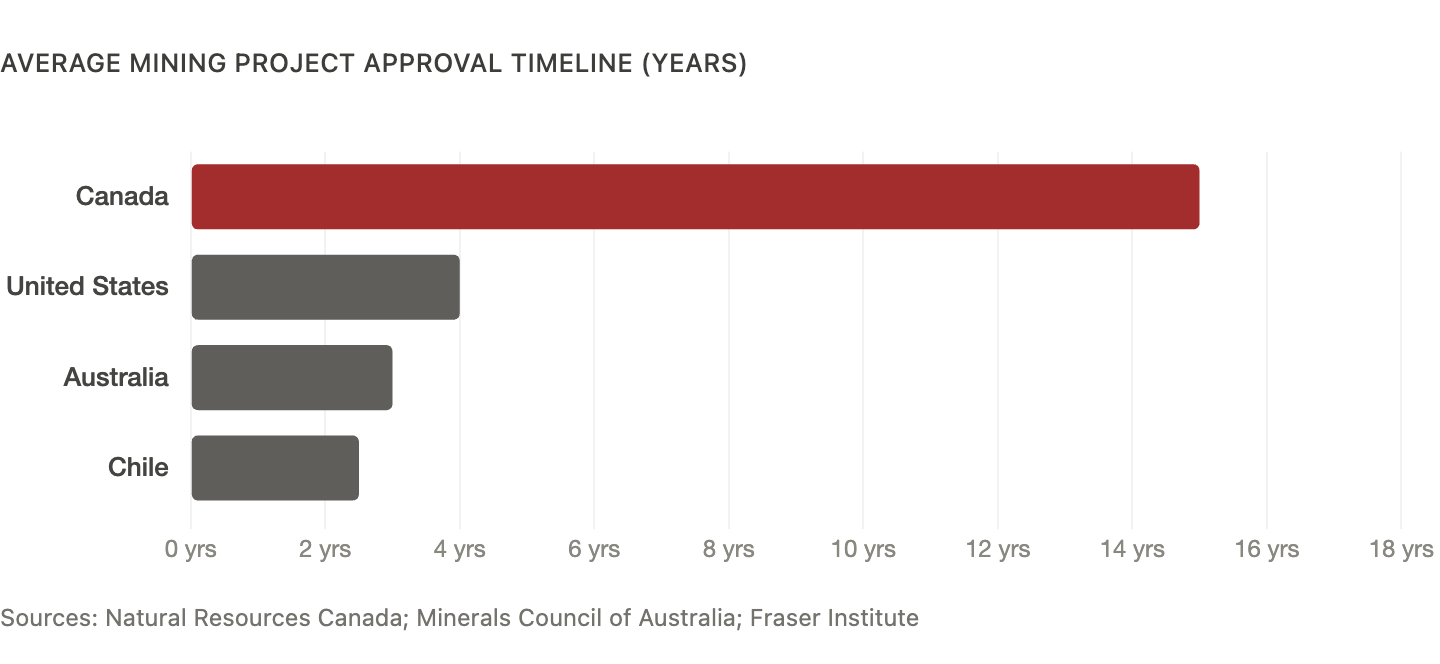
Somewhere in Calgary, an investment analyst quietly updated a spreadsheet and moved $2 billion toward a copper mine in Chile. Chile’s approval process takes four years. Canada’s takes fifteen.
131,754 Ways to Say No
There is a number that deserves to be read slowly: one hundred and thirty-one thousand, seven hundred and fifty-four.
That is the count of distinct federal regulatory requirements imposing administrative burdens on Canadian businesses, as of 2015. That number hasn’t shrunk. It does not include provincial regulations. It does not include municipal bylaws. It is purely the federal layer of a regulatory parfait that no sane investor orders twice.
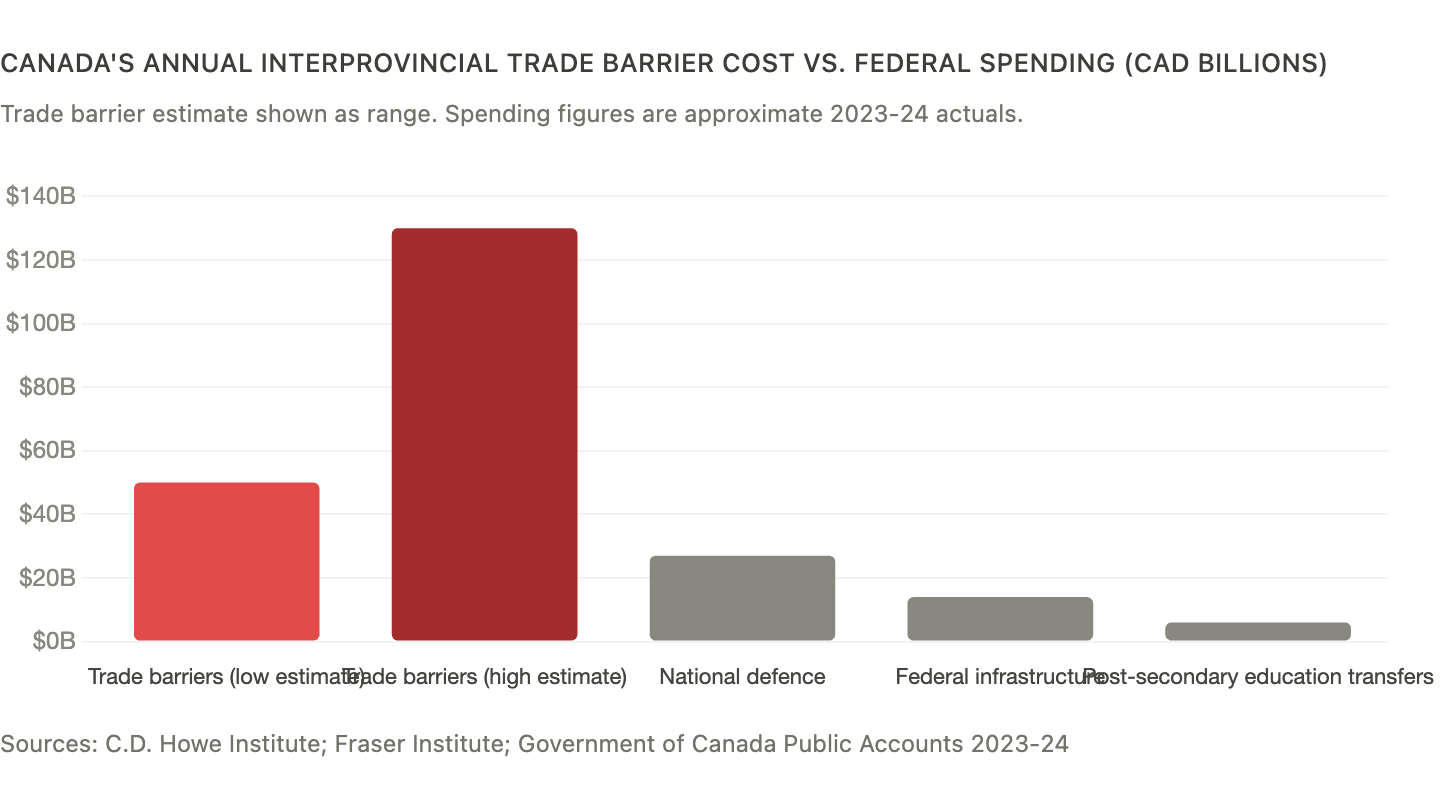
Canada’s interprovincial trade barriers, the fact that different provinces maintain slightly different versions of the same rules, cost the economy somewhere between $50 billion and $130 billion every single year. Not because the rules are necessarily wrong. Because they’re different. Because nobody ever sat down and said: we are one country, we will have one rulebook, and we will stop performing sovereignty through paperwork.
Business leaders, in survey after survey, name inefficient government bureaucracy as the single most problematic factor for doing business in Canada. Not taxes. Not labour costs. Not geography. Bureaucracy. The self-inflicted wound. The own goal, scored with great deliberateness and then studied by a committee to understand how the goal got scored, which will report back in eighteen months.
Meanwhile, Norway, a country of five million people on the edge of the Arctic, has a sovereign wealth fund worth over a trillion dollars built largely on oil revenue. They did this by setting clear rules, running a transparent process, and then actually developing the resource. Radical concept.
The Consultation That Never Ends
Now we arrive at the part of the article where things get genuinely complicated, because they are genuinely complicated, and anyone who tells you otherwise is selling something.
The relationship between Canada’s federal government, provincial governments, and Indigenous nations is not a simple villain-and-victim story. It is something messier and older and more painful than that. The reserve system was colonial architecture designed for control. The treaty process was systematically broken before the ink dried. The damage is real, the distrust is earned, and reconciliation is not optional. It is the only path to a country that actually works.
But here’s the thing nobody wants to say out loud: the current implementation of reconciliation has created a legal framework so fragmented, so undefined, and so prone to litigation that it has effectively given the courts, not communities, not governments, not negotiators, the final word on whether anything gets built anywhere in Canada. That is not good for Indigenous communities. It is not good for Canada. It is very good for lawyers.
The Northern Gateway Pipeline was cancelled after a court found the government’s consultation with First Nations inadequate. The Energy East Pipeline was cancelled after years of regulatory uncertainty. Trans Mountain was approved, challenged, re-approved, challenged again, and eventually built at a cost that had tripled. These are not stories of consultation working. They are stories of consultation as a mechanism for delay so sophisticated it’s practically artisanal.
The Nordic countries figured this out decades ago with the Sami people. Not perfectly, the Sami have their own criticisms of the process, but functionally. The Sami have parliamentary representation. Their voice is unified and consultative. Economic integration was chosen over territorial separatism. The welfare state invested heavily in Sami communities as a foundational principle, not as a negotiating tactic. The rules were set. They weren’t revised after every project application.
Canada, by contrast, has 634 recognized First Nations, each with distinct treaty rights, distinct consultation protocols, and distinct legal standing. The federal government consults each one separately. Provincial governments maintain parallel consultation processes. The legal standard for adequate consultation is adjudicated in court, case by case, project by project, year after year. The result is not reconciliation. It is a permanent state of procedural limbo dressed up in the language of rights.
Real reconciliation, the kind that actually produces better outcomes for Indigenous communities, requires two things Canada has so far been unable to provide simultaneously: genuine power-sharing, and a consistent legal framework that makes the exercise of that power predictable. You cannot have a game where some players don’t know the rules, other players keep changing the rules, and the referee is a court that only rules after the game is already over.
The Talent Is Watching
Here is a quieter tragedy, running underneath all of this.
Canada produces exceptional engineers, geologists, project managers, financiers. World-class. And then, with remarkable regularity, those people move to Houston, or Perth, or London, because those cities have projects that get built. The capital follows. The expertise follows. Canada keeps the degrees on the wall and watches the careers happen somewhere else.
This is what’s called a cottage economy problem. Canada is extraordinary at starting companies and growing them to a certain size. Then, because the domestic market is fragmented and the regulatory environment punishes scale, those companies get acquired by American or international buyers before they can become global champions. We are a country that grows the seeds and sells them before the harvest.
The talent knows this. The capital knows this. The only people who seem surprised by this are the people writing the regulations.
A Country Worth the Fight
I am proud of this place. That’s not a disclaimer. It’s the whole point.
I’ve been to countries with vast natural wealth and broken institutions. I know what that looks like. It looks like concentration of power, poverty at the margins, and an elite that extracts the resource while the people watch. Canada is not that. Canada has the educated population, the stable institutions, the global relationships, and the ethical framework to do this right, to develop its resources in a way that is environmentally defensible, economically transformative, and genuinely beneficial to Indigenous communities who have been cut out of the prosperity sitting beneath their land for a century.
The question isn’t whether Canada can afford to fix the regulatory framework.
It isn’t whether reconciliation is possible. It has to be, because the alternative is permanent gridlock dressed up as principle.
The question is simpler and harder than both of those.
It’s whether the people who design the systems are willing to make the systems work. Whether Ottawa can set rules that don’t change every election cycle. Whether provinces can accept a unified national market. Whether reconciliation can be built on economic partnership rather than litigation. Whether Canada can stop being a country that consults its way to paralysis and start being a country that decides something and then does it.
The deposit is still there, under the permafrost. It has been there for a hundred million years.
It is not particularly impressed by the committee.
 Notes Beyond the Map
Leave a comment