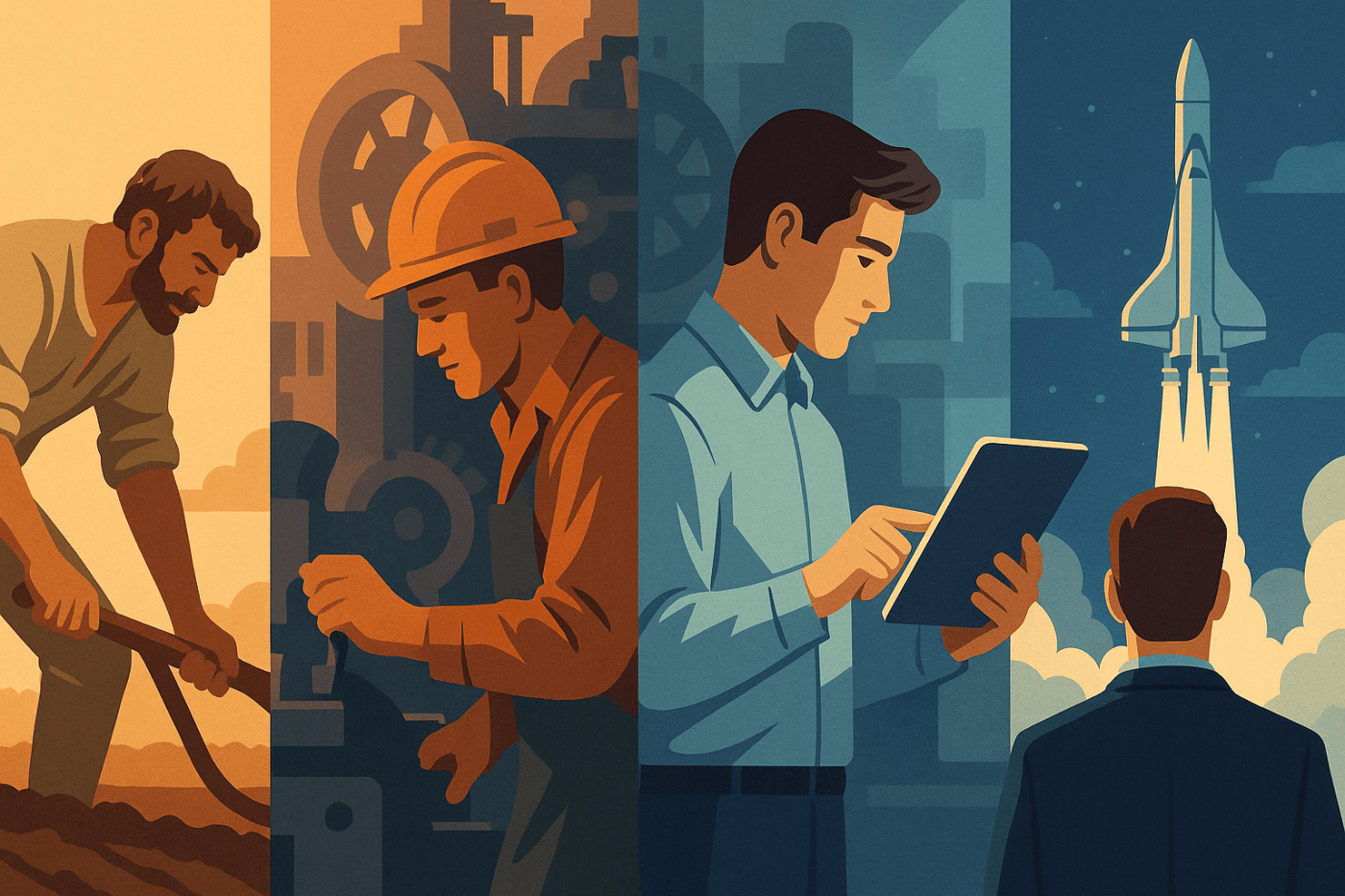
Let’s be honest: people have been predicting the end of work since we first tied a rope and lifted a rock. Every era has its apocalypse fantasy—fire, famine, robots stealing your job. And now, with AI charging in like a caffeine-fueled intern who never sleeps, we’re hearing it again: this time, the jobs are really gone for good.
But flip through the pages of history, and you’ll notice something familiar. This fear? It’s not new. And what followed wasn’t collapse—it was reinvention. The transformation of the obsolete into opportunity.
I was recently inspired by Sam Altman’s post The Gentle Singularity, which reminded me: we may be entering uncharted territory, but we’ve rewritten the rules of work before. And we might just do it again.
When the Plow Killed the Hunter
Thousands of years ago, you weren’t employable unless you could kill a wild boar or dig roots out of the ground. Then along came agriculture. Farming was, at first, a death sentence for the hunter. Why roam forests when you could grow wheat and sit still?
But this shift didn’t lead to mass unemployment—it led to cities, trades, writing, religion, and ultimately the birth of civilizations. Entire job classes were invented: scribes, bakers, traders, and soldiers. The hunter didn’t vanish. He became a soldier or a herder or, occasionally, a drunk poet in Athens.
The Industrial Revolution: Machines Will Take Everything!
Jump to the 18th century, and machines once again threatened humanity’s purpose. The Luddites, skilled weavers, literally smashed the machines that replaced them. It was understandable. Power looms cut labour demand, and artisans were left out in the cold.
But what happened next? Jobs exploded, not in weaving, but in spinning, dying, shipping, retail, railways, oil, coal, steel, electricity, finance, insurance, and advertising. Within a hundred years, the global population ballooned from around 800 million to over 2 billion, and somehow, we kept finding ways to keep people working.
And let’s be clear: many of those jobs seemed ridiculous at first. “Insurance underwriter”? Try explaining that to a blacksmith.
The Assembly Line Giveth and Taketh Away
When Henry Ford introduced the assembly line in the early 1900s, it slashed the time to build a car from 12 hours to just over one. Factory jobs changed overnight. Skilled labour was devalued. But rather than spell doom, the assembly line made cars affordable to the masses. That meant more drivers, roads, motels, mechanics, gas stations, traffic cops, and yes—car insurance underwriters.
Every job-ending innovation has unlocked hundreds of job-creating side quests.
The Internet Ate Typing Pools and Gave Us Influencers
In the late 20th century, personal computers and the Internet swept through like a digital tsunami. Typists, travel agents, film processors, and switchboard operators—gone or severely diminished. But the Internet also gave us content creators, UX designers, cybersecurity analysts, app developers, YouTubers, social media marketers, podcasters, and… OnlyFans stars.
Did we lose old jobs? Of course. But we invented whole new economies. Global employment didn’t shrink. It grew. By the time smartphones arrived, we weren’t just connected—we were addicted. And that addiction created work. Lots of it.
The Singularity: From Obsolete to Amplified
So what about now? What about AI and the so-called Singularity?
Let’s keep it simple: the Singularity is the moment when machines become smarter than humans, and then start improving themselves without us. It’s when the student surpasses the master and then redesigns the school, the curriculum, and the teacher. Some say it’s near. Others say it’s hype. But in a way, it’s already happening—slowly, steadily, and without much drama.
Tools like ChatGPT, Claude, and Copilot are already transforming the workplace. They write, code, summarize, translate, design, and—if we’re honest—perform better than most interns. But instead of fearing the takeover, we should remember this: a tool is not a destiny.
We’ve been here before.
AI will eliminate tasks. It will streamline workflows. It will replace some jobs. But more importantly, it will unlock entire new industries. Just as the printing press made scribes obsolete but launched publishing, journalism, and public education, AI will redefine the future of value creation.
Why This Time Is Not Different (And Why That’s Good)
Yes, the speed is new. AI moves fast. But so does humanity when pushed. We went from horse carts to moon landings in less than a century. We adapted to railroads, cars, phones, computers, and smartphones. Why would this be the one time we don’t adapt?
The global population has surged from a few hundred million in the 1700s to over 8 billion today—and yet, somehow, most people still find work. We’ve created fake-sounding jobs like data analyst, brand strategist, and “community manager” for a Discord server of cat GIFs.
And what do these jobs prove? That work evolves with our imagination. Our economy is not built on necessity alone. It’s built on human curiosity, desire, creativity, and connection. That’s something AI can assist—but not replace.
The Real Hope: Abundance, Not Dependence
What if AI doesn’t lead to mass unemployment and reliance on UBI checks?
What if it leads to the opposite?
What if abundance becomes so extreme—energy, intelligence, production—that we can actually choose work based on meaning, not necessity? What if AI handles the soul-draining tasks so humans can spend more time building, healing, teaching, creating, mentoring, and exploring?
That’s not a utopia. That’s the historical trend line.
The better our tools, the more we ask of ourselves and each other. We invent new jobs, new skills, new challenges. AI may be the greatest tool we’ve ever created. That doesn’t mean it replaces us. It means it amplifies us.
In Conclusion: Let’s Not Forget the Pattern
Every great transformation in history looked, at first, like the end of the world for someone. But it always turned out to be the beginning of a new one. The end of the hunter gave us the city. The end of the artisan gave us the factory. The end of the typewriter gave us the internet.
And now, as AI rewrites the rules of productivity, we’re faced with the same choice: resist and fear—or adapt and invent.
The Singularity isn’t the end of jobs. It’s the end of boring jobs. The future is not a world run by machines—it’s a world co-written with them.
And if history is any guide, every ending is just the start of something better. From obsolete to opportunity—again and again.


Leave a Reply