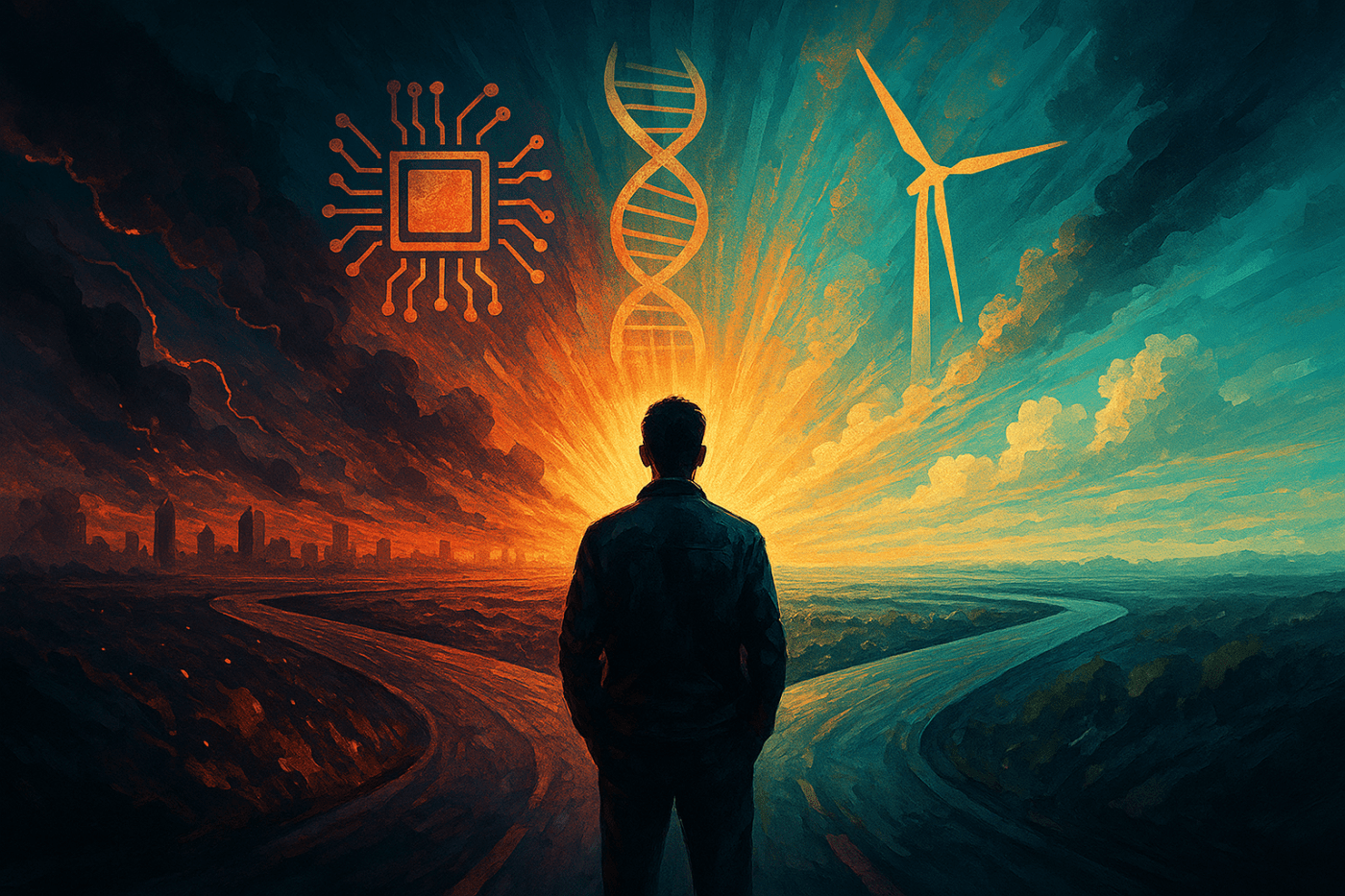
AI, Energy, Biology, and the Reboot of Civilization
2025 is not just another year. It will be a threshold. Everything we rely on in how we govern, power our economies, treat illness, and define leadership is about to change. This isn’t speculation. It’s a visible convergence of three powerful technologies—artificial intelligence, clean energy, and bioengineering—that are rapidly transforming into civilization-shaping forces.
This article offers more than insight—it’s a call to awareness. The last three centuries have taught us that every 80 years, the world resets its core systems. 2025 will mark the beginning of that next reset, a 25-year window of reinvention that will define the next 250. If you lead, build, teach, or invest, this is the map you need now.
The 80-Year Pattern: Why Civilizations Reset
Every 80 years or so, the world enters a crisis it cannot solve using old tools. What follows is a societal reconfiguration so sweeping that everything, from how we create wealth to how we define citizenship, gets rewritten. Peter Leyden, former Wired editor and futurist, defines three that have already reshaped the modern world since the American empire was established.
The Founding Era (1787–1812) gave us nation-states, mechanical engines, and representative democracy. The Gilded Age (1865–1890) emerged from the Civil War ashes to deliver industrial capitalism and mass infrastructure. The Post-War Boom (1945–1970) built the world we recognize today: global institutions, electrified homes, consumer technology, and suburban life. Each followed the same cycle—chaos, then clarity. Now, in 2025, that cycle begins again.
The Three Forces Rewriting Civilization
1. Artificial Intelligence: From Automation to Autonomy
We’ve moved past narrow AI. The next era belongs to agentic AI systems that reason, act, and learn autonomously. These systems aren’t just answering questions or completing sentences. They are managing supply chains, discovering molecules, drafting legislation, building products, and even suggesting new business models.
As intelligence becomes an infrastructure layer—like electricity or the internet—it redefines the boundaries of labour, decision-making, and even leadership. Companies will not just adopt AI—they will organize around it. The shift is not additive. It is architectural. Just as the internal combustion engine transformed cities, agentic AI will reshape the foundations of value creation.
Within five years, organizations without AI-led operations will struggle to remain competitive. Decision-making will increasingly be distributed to intelligent agents embedded into every layer of the enterprise.
2. Clean Energy: From Scarcity to Abundance
Clean energy is not just a moral imperative. It’s a technological inevitability. Unlike fossil fuels, clean energy scales with usage. Solar, wind, solid-state batteries, and fusion follow cost curves, not commodity pricing. Breakthroughs in gene-editing therapies, cell regeneration, and programmable immunity will require governments and global institutions to develop entirely new ethical and legal frameworks—urgently and collaboratively—before the decade ends.
In a post-scarcity world, energy-intensive industries, agriculture, desalination, logistics, and AI computing can operate at a fraction of today’s cost. This transformation will reduce geopolitical tensions, decentralize power grids, and fundamentally shift economic strategy. The most valuable nations and businesses will be those that master energy abundance, not resource control.
By the late 2020s, energy costs will drop so significantly that business models based on energy scarcity will collapse, giving rise to entirely new value chains in infrastructure, manufacturing, and logistics.
3. Bioengineering: Life Becomes Editable
CRISPR’s discovery in 2016 introduced genetic precision. Now, synthetic biology is unlocking the programmability of life. We are on the edge of designing immunity, customizing therapeutics, printing organs, and growing meat, without animals. Biology is becoming the next frontier of engineering.
This doesn’t just alter healthcare. It changes agriculture, climate mitigation, nutrition, and even how we think about aging and disease. The human body is no longer a fixed object. It’s a system, open to redefinition. In the coming years, organizations that understand biology as a programmable platform will gain a profound advantage across sectors.
Breakthroughs in gene-editing therapies, cell regeneration, and programmable immunity will require governments and global institutions to develop entirely new ethical and legal frameworks—urgently and collaboratively—before the decade ends.
What Happens When Old Systems Can’t Adapt?
The most profound disruptions won’t be technological. They will be institutional. Representative democracy is struggling to keep pace with decentralized information. Capitalism is increasingly optimized for short-term profit in a world demanding long-term resilience. Global governance structures designed after WWII are buckling under 21st-century complexity.
When over 80% of citizens in advanced economies believe their systems no longer work for them, it signals more than dysfunction. It signals the need for reinvention. We are heading toward planetary coordination, digital-first democracy, and economies that prioritize regenerative abundance. These aren’t speculative concepts. They are the logical adaptations of a world in flux.
Conclusion: 2025 Isn’t Just a Turning Point—It’s a Test
This article exists to name what’s unfolding: 2025 will be a year historians mark as the beginning of the most significant shift since the mid-20th century. The convergence of AI, clean energy, and bioengineering will not merely optimize the systems we know—it will render many of them obsolete. We are not in an era of improvement. We are in an era of reinvention. And those who lead with vision will define what comes next.
The question isn’t whether things will change—they already are. The real question is: Who will shape the systems that replace them? If we wait, we will inherit a future built by others. But if we engage now—as leaders, founders, educators, investors—we can architect a future that is more adaptive, humane, and intelligent. The prediction is simple: everything will change. The opportunity is this: be among those who shape what that change becomes—for yourself, your industry, and the world.
 Notes Beyond the Map
Leave a comment