
As I write this, a maternity ward in a hospital somewhere in Seoul sits half-empty. The nurses outnumber the babies. The cribs, sterile and waiting, will remain that way.
In Berlin, an actuary pulls up a spreadsheet. The numbers don’t lie, but they’re so absurd she checks them twice. Then three times. The pension fund she manages will collapse in thirty years. Not because of a market crash or a policy failure, but because there simply won’t be enough young people paying in to support the old people drawing out.
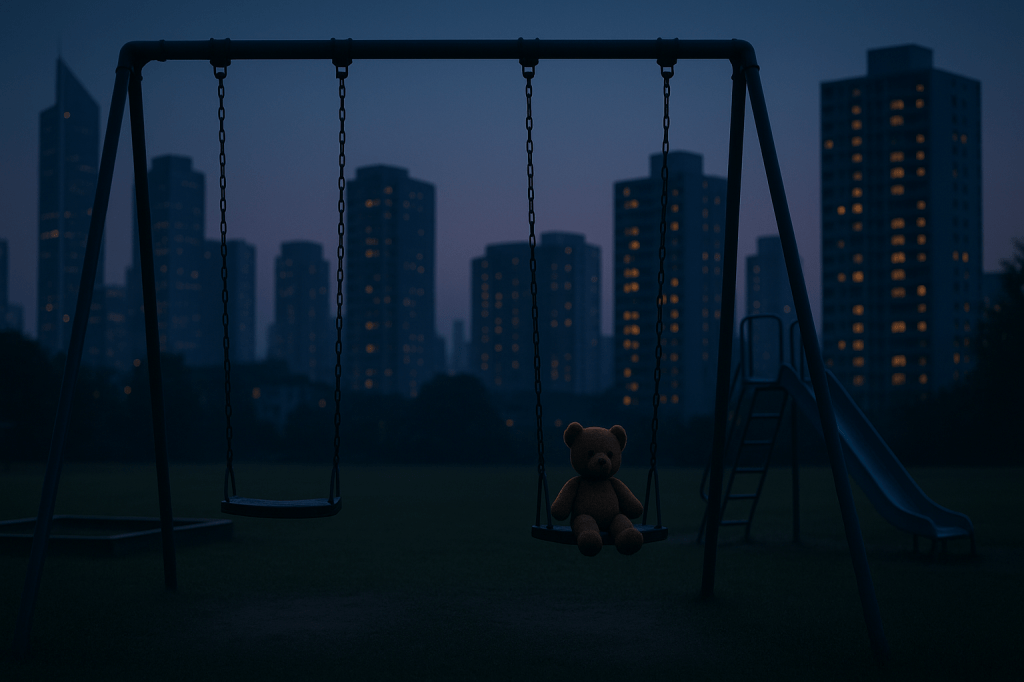
And in Tokyo, a woman named Yuki waters the plants in her apartment. She’s seventy-three. She had one child, who had none. The apartment is immaculate, filled with a lifetime of carefully chosen things. In twenty years, it will sit empty. In forty, demolished. The neighbourhood she grew up in—the one that once echoed with children’s laughter—now echoes with nothing at all.
We’re running out of people.
But here’s what’s strange: Nobody seems particularly alarmed about it. Not in the way you’d expect when discovering your entire civilization has decided, quite rationally, to stop reproducing. We’re choosing extinction, one Excel spreadsheet at a time. And we’re doing it so quietly, so politely, that most people haven’t even noticed.
The Arithmetic of Extinction
Here’s the math that matters: You need roughly 2.1 children per woman to keep a population steady. We call this “replacement rate,” which is a bloodless term for the biological minimum required to prevent your country from becoming a museum.
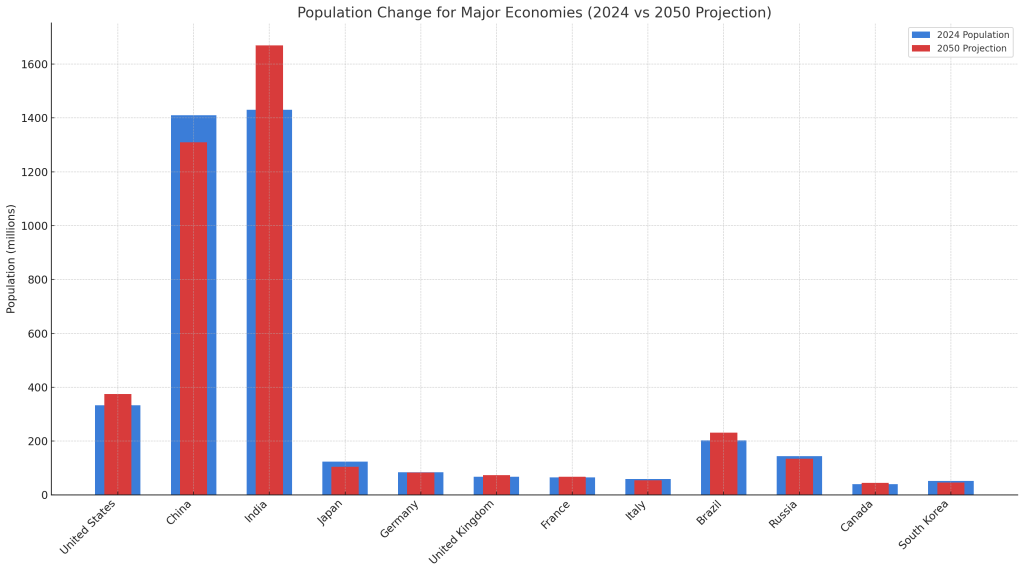
Total population masks the crisis: most countries stay numerically stable only because aging and shrinkage haven’t fully hit yet.
South Korea clocks in at 0.72. Canada—my homeland, vast and mostly empty—manages 1.33. Even China, after decades of forcing people not to have babies, is now somewhere around 1.09 and begging them to reconsider.
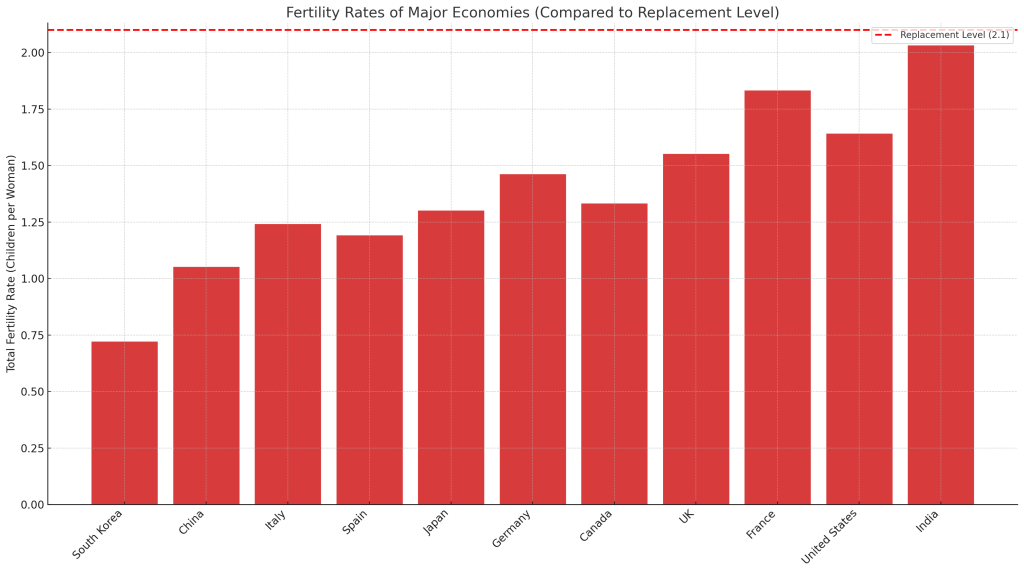
Every major economy except India is now below the fertility level required to sustain its own population.
Are the countries still above replacement? Mostly in Africa. Everywhere else has decided that children are negotiable.
What Happens When the Music Stops
That’s pension systems when there aren’t enough young workers. That’s hospitals without nurses. That’s innovation without innovators. You can’t Zoom your way out of needing actual people to exist.
We’re not talking about overpopulation anymore. We’re talking about Japan’s rural villages where the only sound is the wind through abandoned houses. We’re talking about European towns converting elementary schools into retirement homes because that’s the only demographic left.
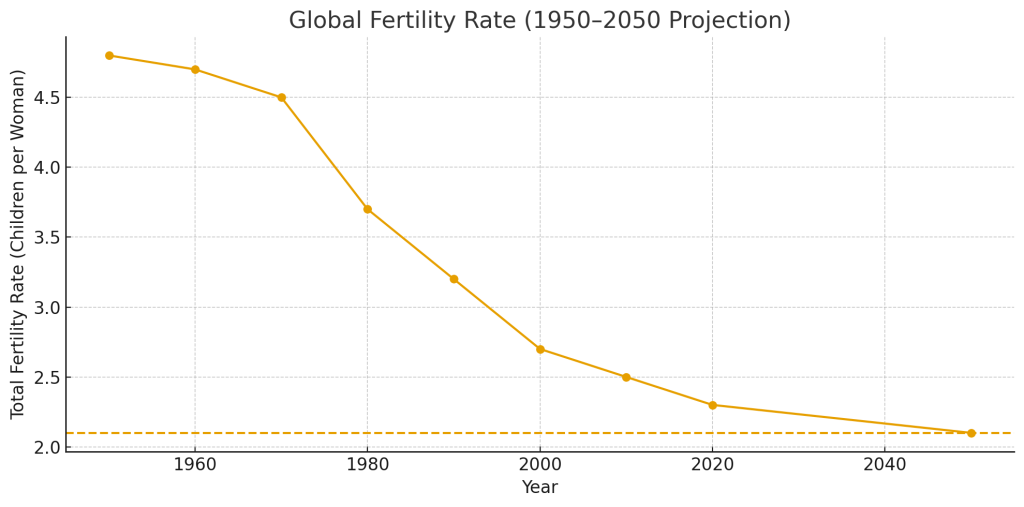
In just seventy years, the world’s fertility rate has collapsed from five children per woman to near extinction levels.
The Real Reason Nobody’s Having Kids
People aren’t stupid. They’ve done the math.
A child costs roughly $300,000 to raise to age 18 in most developed countries—and that’s before college, which might add another mortgage. Career advancement, that golden ticket to security, demands the exact same years you’d spend raising small humans who require constant attention and have terrible timing. Housing prices have detached from reality entirely.

Major economies are aging into extinction, with several nations surpassing a median age of 50 by 2050.
So people choose. And increasingly, they’re choosing the option that doesn’t bankrupt them or derail their lives.
The tragedy isn’t that people don’t want children. Most do. The tragedy is we’ve built a civilization where wanting them isn’t enough.
The Universal Basic Income Paradox
Countries worldwide are experimenting with Universal Basic Income—paying people money for simply existing. The premise? Automation will eliminate jobs, so we’ll need to support people regardless of employment.
Let that sink in. We’re discussing paying people to do nothing while refusing to pay caregivers creating the future of humanity.
If we can contemplate funding idleness in the face of robot labour, why can’t we fund the most essential labour of all—raising the next generation? Children bring joy, hope, and a future for everyone. Without them, what exactly are we working for? What’s the point of building wealth, infrastructure, or a legacy if there’s nobody to inherit it? Once we’re gone, what’s left?

A society willing to fund existence but not creation has fundamentally confused its priorities.
The “Thoughts and Prayers” Approach
Governments have tried the gentle nudge: small tax credits that might buy a week’s worth of diapers. Modest parental leave policies that expire before the sleep deprivation does. Public awareness campaigns featuring happy stock-photo families that bear no resemblance to the exhausted reality.
Results? Negligible. Turns out, you can’t incentivize people to reshape their entire existence with what amounts to a Starbucks gift card.
A Modest Proposal
Here’s the uncomfortable truth: If you want people to do something costly and difficult, you have to make it worth their while. Substantially.
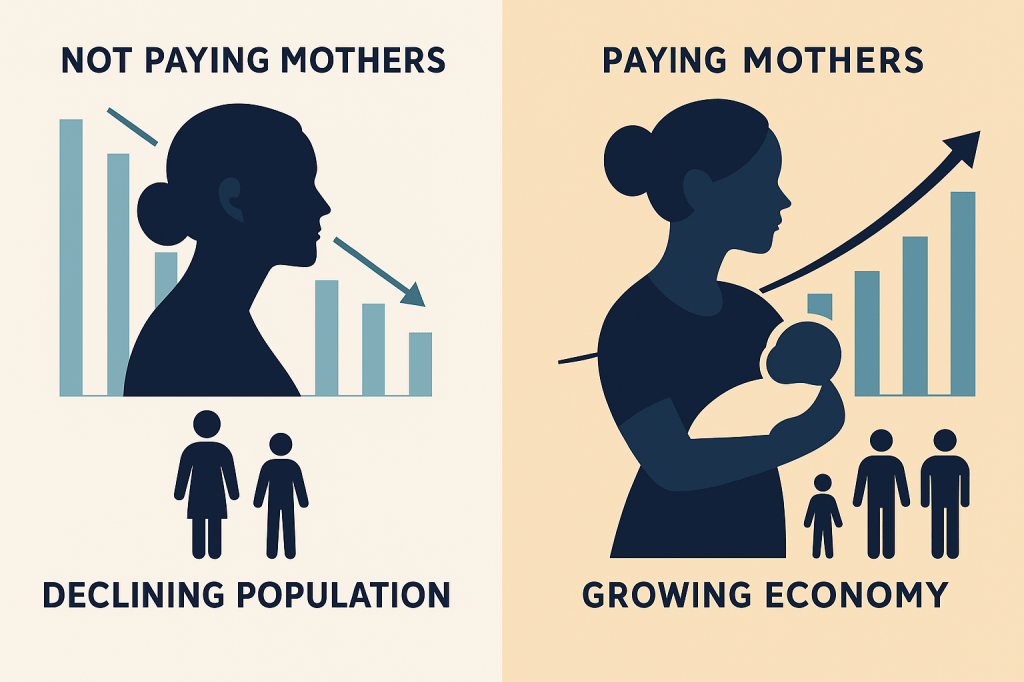
What if we paid primary caregivers a living wage (say, $30,000-$50,000 annually) for every child under six? Not a tax credit. Not a subsidy. Actual money. A salary for the most important job nobody currently pays for.
The objections write themselves: “Too expensive!” “Where’s the funding?” “People will abuse it!” Of course they do. Every bold idea sounds absurd until it’s necessary.
But consider: We fund militaries. We bail out banks. We subsidize industries. We debate UBI for the unemployed. Why? Because we’ve decided they’re essential. When did we decide children aren’t?
The Community Chips In
Children aren’t luxury goods. They’re the future of everything—your pension, your hospital care, your nation’s continued existence. They benefit everyone, not just their parents.
Some countries understand this. Certain nations have adopted approaches where the community—even visitors—contribute to social sustainability. The principle is sound: if society benefits, society pays.
In practice? Broad taxation remains the only scalable mechanism. Income tax, consumption tax, corporate tax—the same systems that fund every other social priority. The question isn’t feasibility. It’s willingness.
What Actually Works
What actually works? Universal childcare—not subsidized, universal. Housing policies that don’t treat shelter as a speculative asset. Real parental leave is measured in months, not weeks. Workplace flexibility that doesn’t punish parents for being human.
Money alone won’t solve this. But money plus structural change might.
The Choice We’re Making
Here’s what’s actually happening: We’ve created societies where children are incompatible with prosperity. Then we act surprised when rational people choose prosperity.
Immigration buys time. It addresses today’s labour shortage. But it doesn’t solve the underlying problem: We’ve made parenthood a terrible deal.
And here’s the delicious irony: We’re terrified of AI replacing humanity. We write dystopian novels, hold congressional hearings, wring our hands about machines making us obsolete. Turns out, we don’t need AI for that. We’re doing it ourselves, one rational economic decision at a time.
So we face a choice. We can continue with symbolic gestures and watch the demographic math compound into a crisis. Or we can treat this like the emergency it is—because a civilization that cannot reproduce itself is, by definition, temporary.
The children who don’t exist yet can’t advocate for themselves. But they’re counting on us anyway.
 Notes Beyond the Map
Leave a comment