The podcast had a good run. Something better just took its place.
Six weeks ago, I fed a stack of documents into an app on my phone, pressed a single button, and listened to two people spend forty-two minutes dissecting Canadian potash opportunities I had no idea existed. They had chemistry. They had opinions. They interrupted each other at exactly the right moments. I kept leaning in, waiting to catch the glitch, the robotic tell, the moment where the illusion would crack.
It never cracked.
By minute fifteen, I had forgotten I wasn’t listening to a podcast. By minute thirty, I understood aspects of Canadian resource investment that had eluded me through months of reading, searching, and watching actual humans fumble through the same material. By the time it ended, I sat in my car doing what you do after a really good episode of anything.
The hosts weren’t human. The podcast didn’t exist until I asked for it. And the information was shaped to exactly what I needed to know.
I kept thinking of a movie. The one with the chair and the cable and the skull. The one we all laughed at for being too far-fetched.
So it goes.
The Pattern That Repeats Itself, Shamelessly
History hands one generation a technology that rearranges everything, then watches while the previous generation defends their territory right up until the moment it vanishes.
Gutenberg didn’t build the printing press to kill the monks copying manuscripts by hand. He just built it. The monks kept copying. Then they stopped. Radio showed up in living rooms and newspapers adapted, partially. Television came along and radio specialized. The internet arrived and made television look slow. And then the podcast arrived and democratized radio completely. Anyone with a microphone and a belief that their opinions deserved an audience could publish. Millions did.
By 2025, 584 million people around the world were listening to podcasts. In the United States alone, 55 percent of the population tunes in monthly, the first time the medium has crossed that threshold. The industry is worth roughly $40 billion. There are 4.58 million podcasts in existence. Ad spending hit $4.46 billion last year and is growing.
The numbers look healthy. They should not be taken as reassurance.
Because here is the thing about inflection points: the audience numbers are always at their peak right before the format loses its reason to exist.
Notice I used the past tense.
We Used to Spend Hours on This
Think about your week. How many hours have you poured into podcasts, YouTube videos, articles, newsletters, all in the name of staying current, staying sharp, staying relevant? I have three podcast apps on my phone. A YouTube watch-later list that will outlive me. I have started articles I never finished and finished articles I immediately forgot.
We all have.
And the brutal truth is: most of it was inefficient. Not because the content was bad. But because it was built for everyone, which means it was built for no one in particular. You listened to the first fifteen minutes hoping the part you actually needed was coming. Sometimes it was. Often it wasn’t. The filler was part of the format.
We accepted this because there was no alternative. You couldn’t build your own podcast. You couldn’t commission a custom episode on exactly the topic you needed, from exactly the sources you trusted, at exactly the depth your schedule allowed.
Until now you couldn’t.
What Just Walked In the Door
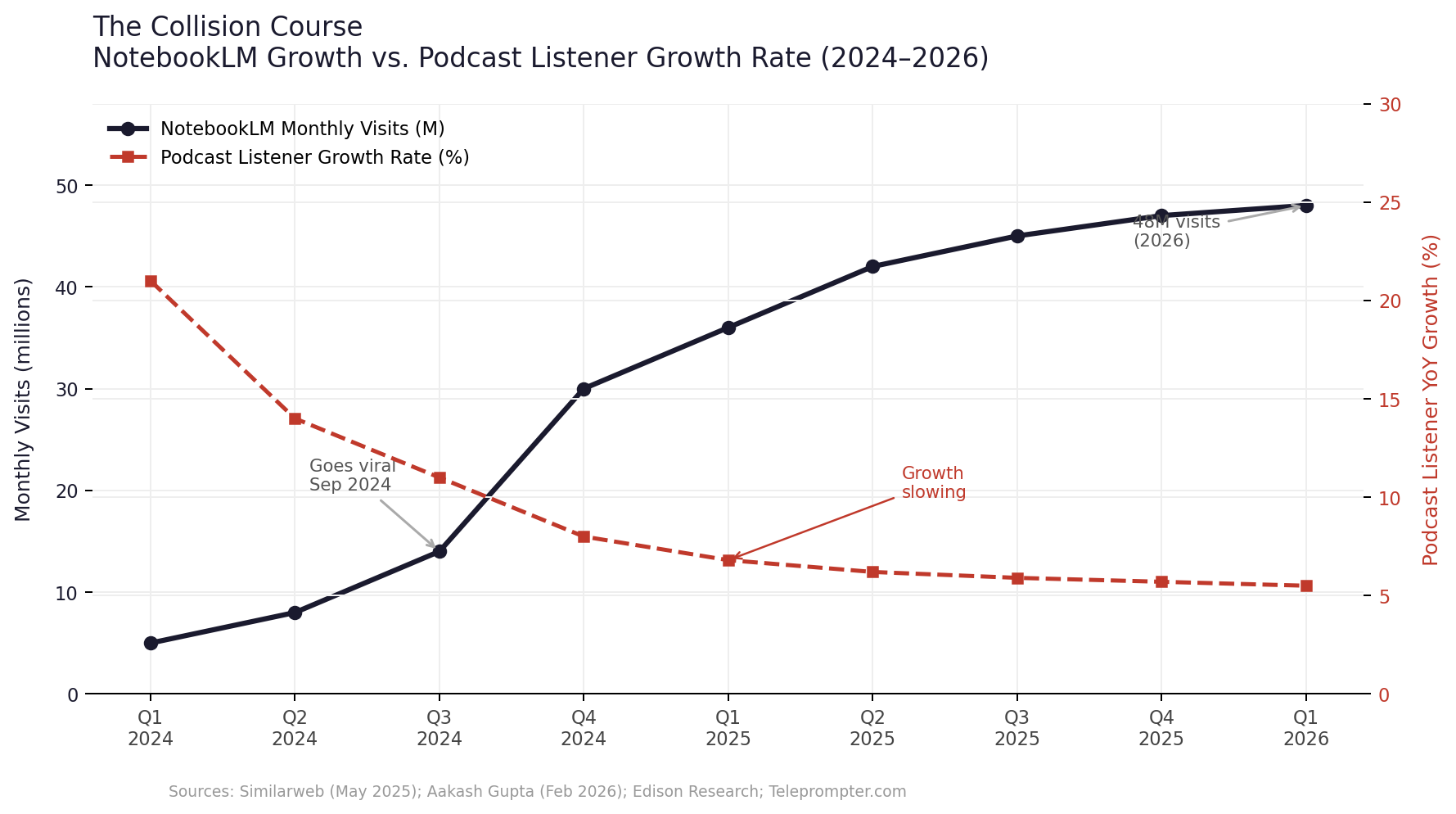
NotebookLM now receives 48 million monthly visits. It grew 120 percent quarter-over-quarter in Q4 2024. Monthly traffic jumped another 56 percent in the six months that followed. Over 80,000 organizations have adopted it. Millions of individuals are discovering what I discovered six weeks ago in a parking lot.
Here is what it does, for the uninitiated. You feed it sources. Documents, research papers, articles, your own notes, video transcripts, up to roughly three hours of content at once. Press a button. Within minutes, two AI hosts synthesize everything into a real conversation. They debate. They explain without condescending. They build on each other’s points.
And then, this is where it gets genuinely strange, you can interrupt them mid-episode and ask a follow-up question. They answer it, cited, and return to their script as though you hadn’t broken the fourth wall at all.
I have used this to understand Python fundamentals. App development. Project management frameworks. The mechanics of humour in professional environments. Canadian regulatory reform. And yes, Canadian potash specifically: the companies, the resource opportunities, the investment angles I had no idea existed until I loaded the research and let two synthetic voices walk me through it like a personal tutorial.
I do all of it while I drive, while I walk, while I do the things that used to be dead time.
The tool doesn’t ask what I want to learn. I tell it. I upload exactly the sources I care about. I get exactly the conversation those sources deserve.
It sounds like a product review. It isn’t. It’s an obituary.

“I Know Kung Fu”
There is a scene in The Matrix where Neo sits in a chair, plugs a cable into his skull, and downloads twenty years of martial arts training in roughly four seconds. He blinks and says: “I know kung fu.”
We spent twenty years laughing at that scene as science fiction.
We should have been taking notes.
Because what that scene was really about was not the cable or the chair. It was the idea that learning, real deep learning, didn’t have to be slow. Didn’t have to be painful. Didn’t have to happen on someone else’s schedule, in someone else’s format, at someone else’s pace. It could be yours. Immediate, precise, exactly what you needed. That idea felt absurd in 1999. It feels inevitable now.
The technology in your phone right now is not a jack in the skull. But the principle, absorbing structured knowledge rapidly, on demand, in exactly the format your brain needs, is no longer a metaphor. It’s a product feature. And it works.
Google Is Eating Itself, and It Doesn’t Seem Bothered
Here is a subplot worth paying attention to.
Google’s search market share dipped below 90 percent for the first time since 2015. AI Overviews now appear in over half of all Google searches. Meanwhile, Google’s own AI Mode has 75 million daily active users in the United States alone, and queries in AI Mode run three times longer than traditional searches. People aren’t just looking things up anymore. They’re having conversations.
Google Search revenue still grew 17 percent in Q4 2025 to $63 billion, its strongest quarterly growth in years. On the surface, this looks like evidence that AI is additive, not destructive. But look underneath. Publisher traffic from Google searches has fallen 33 percent globally and 38 percent in the United States. AI is giving users better answers while systematically gutting the websites those users used to visit. Analysts already have a name for it: zero-click search. You get the answer. Nobody gets the traffic.
I don’t use traditional Google search anymore. I type or speak my question and select AI mode directly. The results aren’t even comparable. It’s like going back to a card catalogue after you’ve used a computer.
Google’s CEO Sundar Pichai called this “an expansionary moment.” That phrase is doing a lot of work. What it really means is that Google is rewriting the rules of its own business before someone else does. They are disrupting their own product and calling it growth.
Which is either brilliant or a sign of how little choice they had. Possibly both.
As a Canadian, I find it almost impolite how fast this is happening. We prefer our revolutions gradual and apologetic. This one is neither.
What the Radio Numbers Are Actually Telling Us
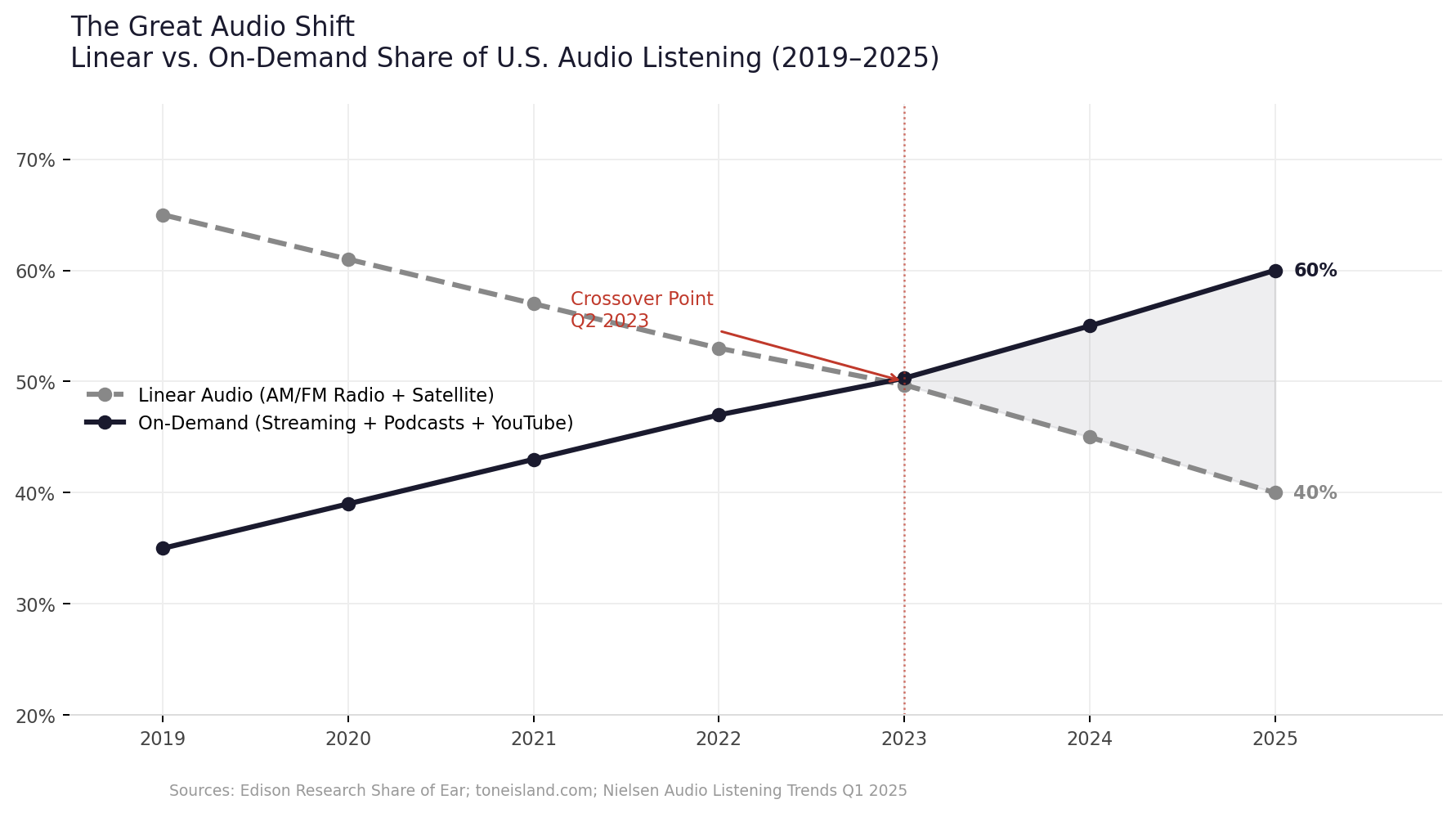
Traditional radio still commands 34 percent of all audio listening time in the United States, according to Edison Research. That sounds stable. But the trajectory tells a different story. In Q2 2023, for the first time in history, on-demand audio platforms overtook linear listening. Podcasts, streaming services, and YouTube collectively passed AM/FM in total share. That crossing happened quietly. Most people didn’t notice.
The reason radio still shows high numbers is demographics. Listeners 35 and older give nearly 75 percent of their audio time to radio. Gen Z listens primarily in the car and almost nowhere else. When the car changes, which it already is, automakers have been stripping out FM defaults for years in favour of connected dashboards, that last stronghold disappears.
Advertisers already know this. Radio ad revenue is declining while podcast ad spend grows at double digits annually. The money moves before the eulogies are written.
The podcast was supposed to be radio’s digital successor. It may instead be its final form. One more intermediate step before the format dissolves entirely into something personal, on-demand, and algorithmically assembled for a listener of exactly one.
What Dies and What Doesn’t
Not everything collapses. Let’s be clear about that.
Comedy is the most listened-to podcast genre by hours, accounting for 30 percent of total listening time. It will survive. Genuine human chemistry cannot be synthesized. The thing that makes you pull over because you are laughing too hard, that specific, unrepeatable collision of two nervous systems, no algorithm produces that on purpose. Personality-driven shows survive too. The parasocial bond between a host and their long-term audience is not informational. It is relational. AI cannot manufacture trust earned over years of showing up.
What doesn’t survive is the middle. News and politics is currently the largest podcast genre by market share, at 27 percent. Historical and educational content follows close behind. These formats are not bad. Many are genuinely good. But they are now competing with something that does exactly what they do, faster, personalized entirely to the listener, with no release schedule and no filler.
Research confirms what most of us can feel: people retain more and change their minds more readily through conversational AI audio than through traditional search or passive reading. The format is persuasive in a way that text on a screen is not. The informational podcast built its entire value on being a better way to learn than reading. AI just built a better way to learn than the informational podcast.
So it goes.

The Transformative Age
Here is the bigger frame. It matters more than the podcast.
Historians name eras only after they end. The Founding Era. The Gilded Age. The Post-War boom. The Information Age. Each defined by a force that reshaped civilization faster than anyone fully grasped while living through it. Futurist Peter Leyden and others who study civilizational cycles argue that 2025 marks the beginning of something genuinely new. Not an extension of the digital age. A rupture from it. A Transformative Age in which the rate of change will exceed anything in recorded history. Not incrementally. Exponentially.
Think about what it meant to go from riding a horse to getting a driver’s license. That was a civilizational leap spread across a generation. Now imagine that same leap compressed into five years, happening simultaneously across every industry, every institution, every profession, every skill set you thought was safe. And then maximized.
That is the rough shape of what is coming.
I am learning a new AI tool every week. Not because I enjoy running on a treadmill. Because if I stop, I fall behind. Not metaphorically. Actually. The people and organizations racing ahead right now are not smarter than you. They are simply moving. Standing still, in a moment like this, is a choice with consequences. Serious ones.
The informational podcast was a beautiful product of the last age. Patient. Passive. Built for a world where the bottleneck was access to information. That bottleneck is gone. The new bottleneck is synthesis, the ability to absorb, connect, and apply knowledge faster than the person next to you. Faster than you did yesterday.
That is what this technology solves. That is why this matters far beyond the disruption of one medium.
Strap In
Every civilization gets a handful of these moments. Technologies that don’t just add to what already exists but rewrite what’s possible. The printing press didn’t improve manuscripts. It made them obsolete. Television didn’t improve radio. It forced radio to reinvent itself entirely.
We are at one of those moments. Right now. Not in five years. Now.
The podcast had a good run. Parts of it will survive: the human parts, the funny parts, the parts built on genuine connection rather than the transmission of facts. But the informational podcast, the format that bet everything on being the best available way to learn, has lost that bet.
Six weeks ago I pressed a button and two synthetic voices taught me things I had been trying to understand for years. They were better than most of what came before them. Because the content was built for my questions, from my sources, at the depth I actually had time for.
The question isn’t whether this changes everything. It does.
The question is whether you will be one of the people who adapts early, who uses the tools, builds the habit, understands the age they are actually living in. Or whether you will spend the next five years explaining to people why you preferred the old way.
The old way was good. It served us well. But it is done.
The cable is in the chair. Neo reached for it. The rest of us are right behind him.
The only question left is what you choose to learn first.
Sources & References
NotebookLM & AI Tools
- Google DeepMind, Gemini 2.5 Capability Documentation
- NotebookLM, Wikipedia — en.wikipedia.org/wiki/NotebookLM
- Similarweb Traffic Analysis, May 2025 — NotebookLM 56% growth report
- Aakash Gupta, Complete Guide to NotebookLM, February 2026 — news.aakashg.com
- Medium, The Cognitive Engine: NotebookLM Evolution 2023–2026, December 2025
Google Search & AI Mode
- Alphabet Q4 2025 Earnings Call, February 4, 2026
- Search Engine Journal, Google Search Hits $63B, February 2026 — searchenginejournal.com
- ALM Corp, Google Search Revenue & AI Mode Analysis, February 2026 — almcorp.com
- Press Gazette / Chartbeat, Publisher Traffic Analysis, 2025
- bloola.com, The Shifting Landscape of Information Retrieval, August 2025
Audio & Radio Listening Trends
- Edison Research, Share of Ear, Q1 2025
- Nielsen, The Record: U.S. Audio Listening Trends, Q4 2024
- toneisland.com, 28 Top Radio Statistics, January 2025
- Radio Ink, 76% of News Consumers Still Use AM/FM, March 2025
Podcast Industry
- Grand View Research, Podcasting Market Report, 2024–2030
- Teleprompter.com, 2025 Podcast Statistics, November 2025
- Backlinko, Podcast Stats 2026 — backlinko.com
- Edison Research, Infinite Dial 2024
Broader Context & Frameworks
- Peter Leyden, civilizational cycle research — peterleyden.com
- Academic Paper: From SERPs to Sound — AI-generated podcasts and attitude change
- Academic Paper: AI-generated podcasts, Synthetic Intimacy and Cultural Translation in NotebookLM


Leave a Reply