
The largest fleet in the ancient world was destroyed by a handful of empty boats. Eight years later there was no Western Empire left to defend.
Now, I know what you’re thinking.
You’re thinking the American decline started in Kabul, in August of 2021, with people falling off the landing gear of a C-17. Or you’re thinking it started in Baghdad, or in a Dallas motorcade, or on whichever morning your particular politics says the wheels came off. Or, more likely, you’re thinking America isn’t declining at all, that people have been predicting this since Sputnik, and that betting against the United States has been the reliable way to lose money for eighty straight years.
It has been. I want to say that plainly before I say anything else.
But hear me out. Pull up a log. I want to tell you about the last great empire before this one, and I don’t mean Britain.
Britain was the biggest. It spanned more of the globe than Rome or America ever did, and it left behind parliaments, railways, common law, and the language you are reading this in, which is not a small inheritance. But Rome gave the West its roads, its calendar, its plumbing, and the idea that a person could be a citizen rather than a subject. America gave the world the century we are all still living inside, for better and for considerably worse. Britain administered brilliantly. Rome and America rewrote the operating system.
So we’re going to talk about Rome. Not the part you were taught.
We’re going to talk about the summer of 468, when Rome assembled the largest amphibious force in the history of the ancient world to reopen a shipping lane, and lost half of it in a single night to a few boats with nobody aboard.
That night cost them about a hundred ships. I’ll tell you at the end what it cost them eight years later, because that’s the number that matters, and because nobody alive at the time recognized the receipt when it arrived.
I. The Largest Fleet in the Ancient World
Some background, briefly, because it is the same shape as the news.
In 439 the Vandals took Carthage. This was not a raid. North Africa was the West’s breadbasket, and the sea lanes running out of it were the arteries of the Roman economy. A regional power with a good navy had put its hand on the tap. In 455 the Vandal king Gaiseric sailed up and sacked Rome itself, which was the fifth century equivalent of a rude gesture visible from space.
So in 468 the Eastern and Western empires did what superpowers do. They pooled their money and built something enormous.
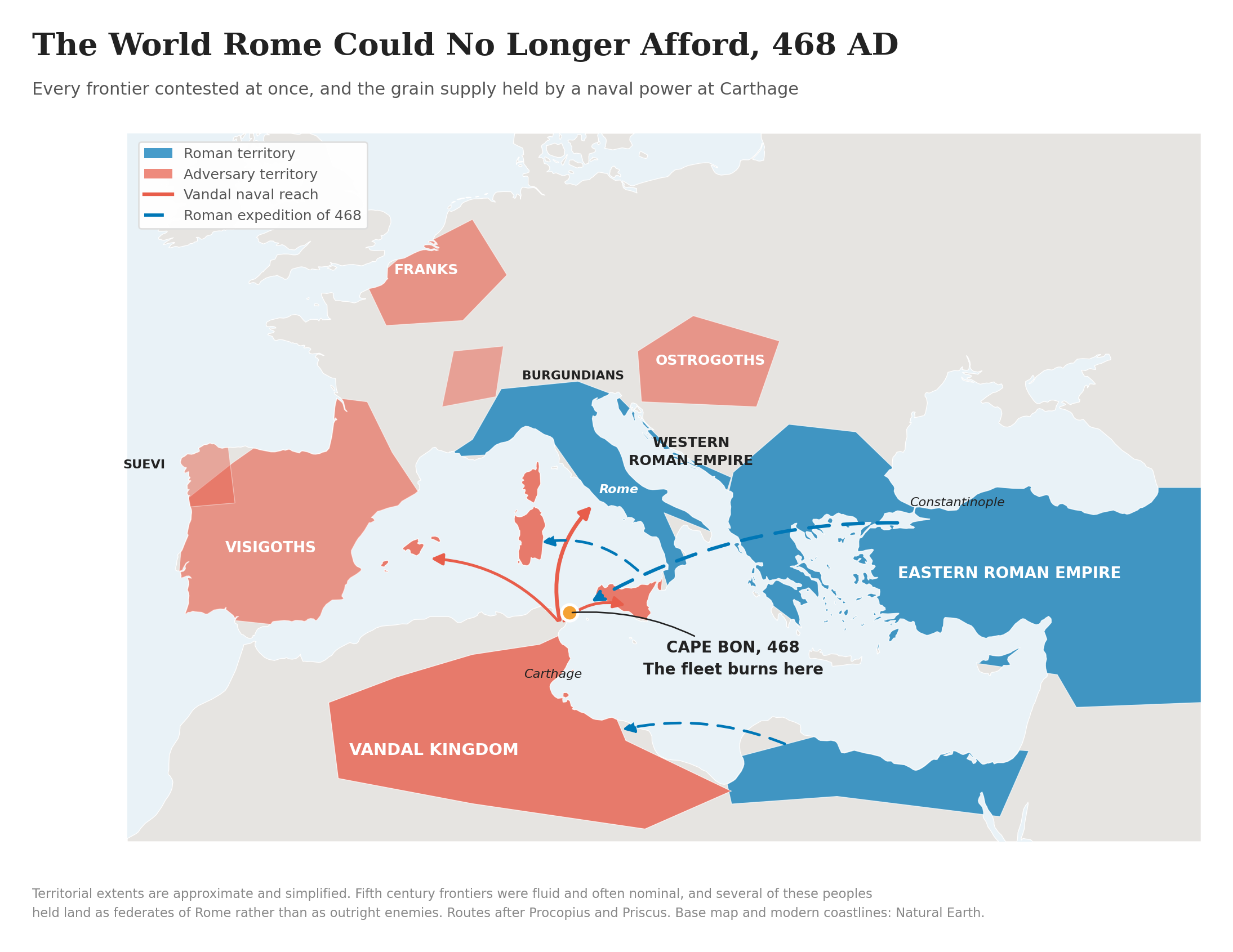
Around 1,113 ships. Procopius reports a hundred thousand men, though modern historians think that is inflated by half or more. Either way it was the biggest combined operation antiquity ever mounted. The bill ran to 130,000 Roman pounds of gold by one account, 65,000 pounds plus 700,000 of silver by another. Historians disagree about the number and agree about the adjective. It was ruinous.
Command went to Basiliscus, whose principal qualification was being the emperor’s brother-in-law. History is fond of this arrangement and has never once been rewarded for it.
The fleet anchored at Cape Bon, about forty miles from Carthage, in confined water, packed tight, lightly guarded. Gaiseric sent word asking for five days to discuss terms of peace.
Basiliscus, who had the larger fleet, the better ships, and every material advantage available to a human being in the year 468, said yes.
Gaiseric spent the five days filling boats with combustibles and waiting for the wind to turn.
When it did, he sent them in empty. No crews. Nothing aboard worth a single Vandal life. The Roman ships were anchored too close to maneuver, and the fire went through the fleet the way fire goes through anything packed tight, and the Vandal warships came in behind the flames to finish what was drifting. Over a hundred Roman ships sank. Roughly ten thousand men died. About half the largest fleet ever assembled was burned, taken, or scattered by morning.
Every advantage the Romans had was an advantage in a fight the Vandals declined to have.
Basiliscus fled early. He returned to Constantinople and took sanctuary in the Hagia Sophia until his sister, who happened to be the empress, arranged a pardon. He was later briefly emperor, because of course he was.
Heraclius, who had marched twenty thousand men in from Tripoli expecting naval support, walked them back across the Libyan desert instead.
The Eastern treasury did not recover for roughly thirty years.
II. February 28, 2026: The Day the Water Closed
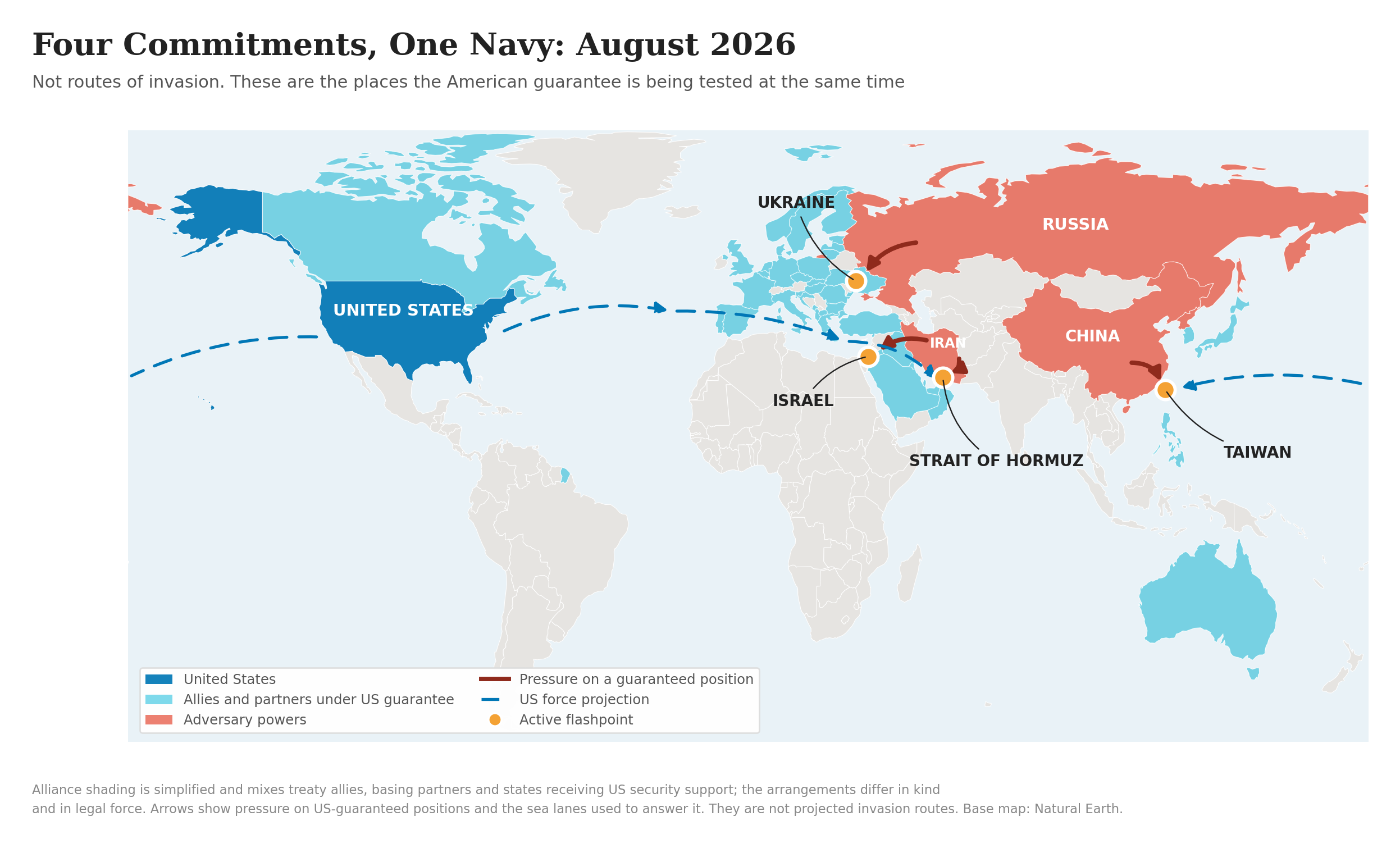
The United States and Israel struck Iran and killed Ayatollah Ali Khamenei. Iran’s answer was not a counter-invasion, because Iran does not have one.
Iran closed the Strait of Hormuz.
Twenty-one nautical miles of water. One fifth of the world’s oil.
Before the war, roughly 138 vessels crossed every day. In the week through July 20, Lloyd’s List Intelligence counted 53 for the entire week. S&P Global logged about 13 crossings a day. Saul Kavonic, who runs energy research at MST Marquee, put the flow at around 15 percent of pre-war levels and called expectations of a quick reopening “premature.”
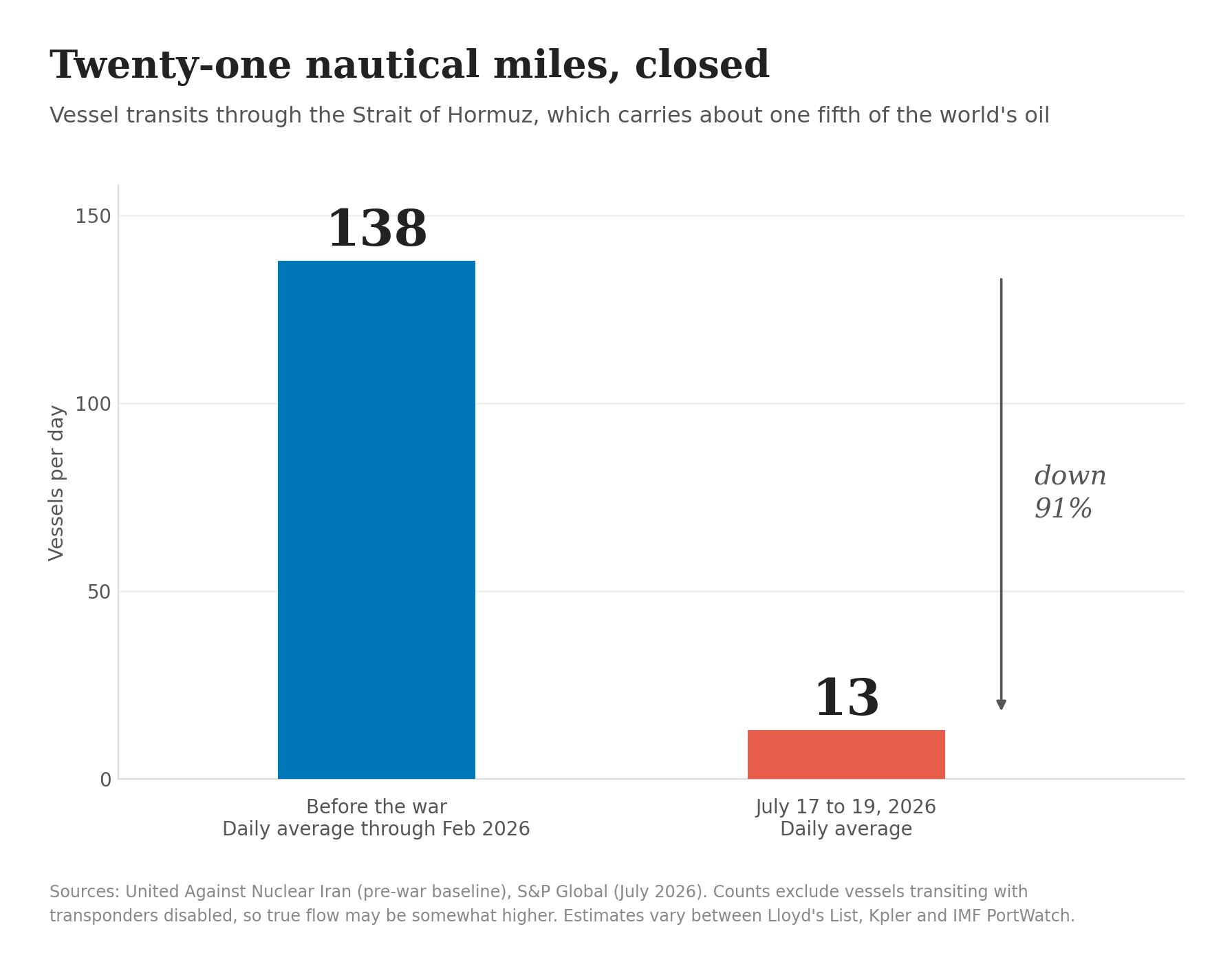
There has been a ceasefire, a memorandum of understanding, and the collapse of both. The strait is still shut. The Strategic Petroleum Reserve has fallen below 300 million barrels, its lowest level since 1983.
Six months. The most expensive navy ever assembled. A channel about as wide as the English Channel at Dover, which people have been swimming across since 1875.
Gaiseric would have recognized every part of this. The chokepoint. The truce that buys preparation time. The cheap unmanned thing sent in with the wind.
III. The Arithmetic That Eats Empires
Here is the part that should keep you up.
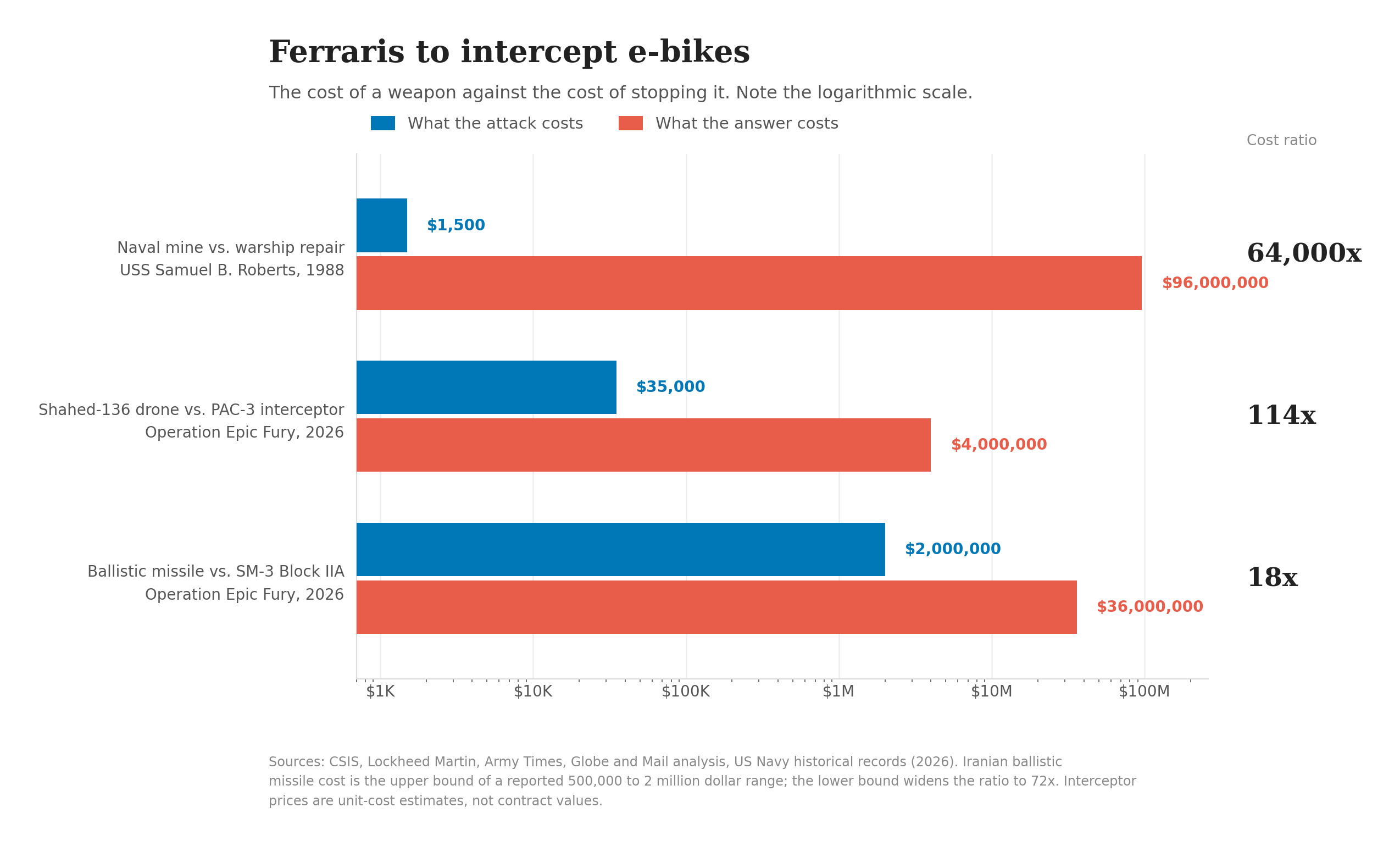
An Iranian Shahed drone costs somewhere between $20,000 and $50,000. A PAC-3 interceptor costs about $4 million. One analyst described the exchange as using Ferraris to intercept e-bikes. By one accounting, Iran spent roughly $70 million on drones and forced the United States and its Gulf partners to burn more than $2 billion in interceptors.
That is not a war. That is a subscription.
Stacie Pettyjohn at the Center for a New American Security warned before any of this that sustained mass attacks could drain American interceptor stockpiles in days. She was right, and being right about that is a miserable business. Lockheed announced a cheaper Patriot at the Farnborough airshow in July, which tells you what the Pentagon is worried about more honestly than any press briefing.
A defender who wins every engagement and loses money on each one is not winning. He is subscribing.
The precedent is old and it is local to this exact water. In 1988, an Iranian mine worth perhaps $1,500 nearly sank the USS Samuel B. Roberts and cost around $96 million to repair. Thirty-eight years later the ratio has not improved. It has been industrialized.
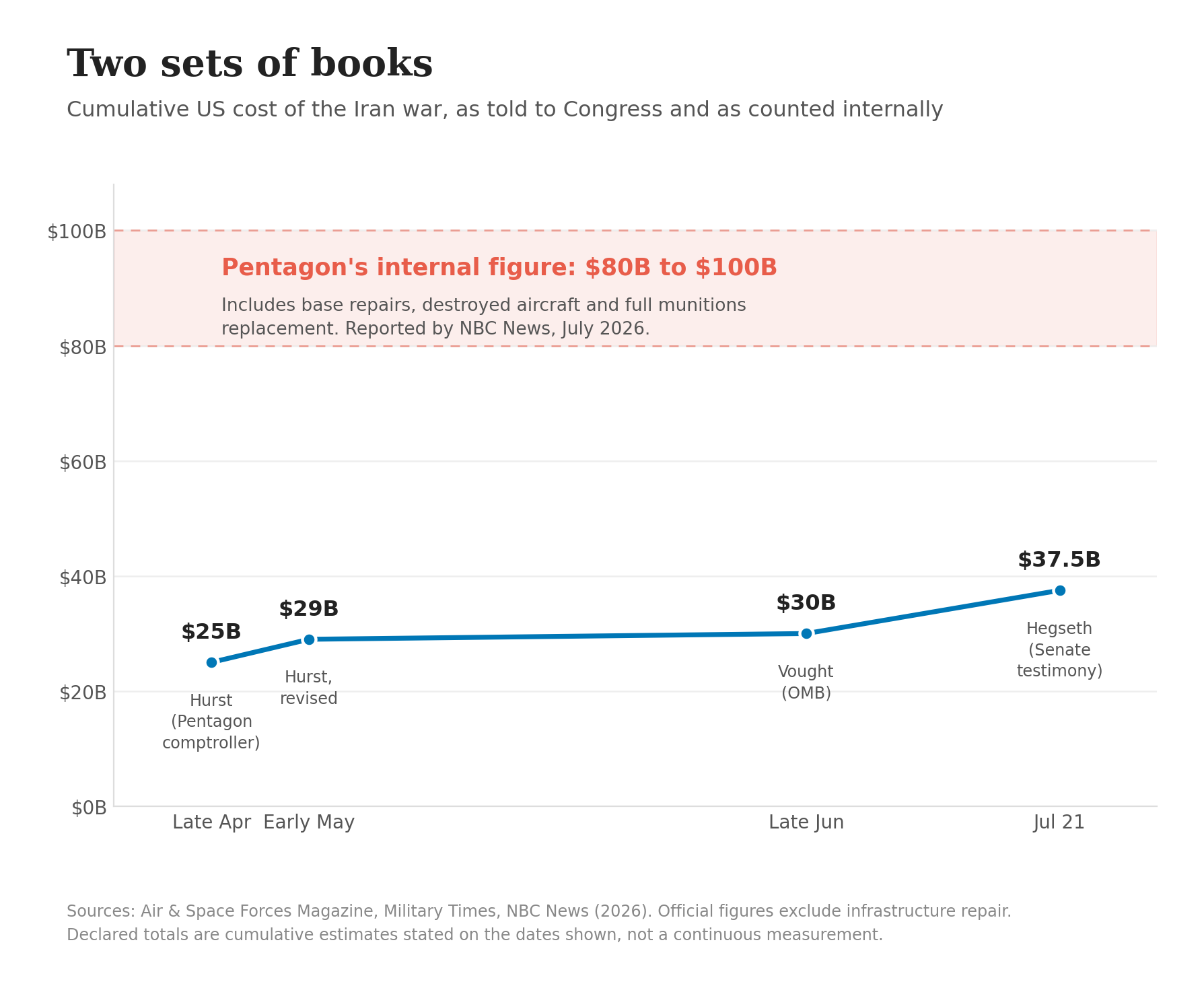
Defense Secretary Pete Hegseth told the Senate in July that the war has cost $37.5 billion, and asked for $67.1 billion more. NBC News reported that the Pentagon’s own internal figure, including base repairs and full munitions replacement, runs between $80 and $100 billion. Asked about an earlier $200 billion request, Hegseth said it takes money to kill bad guys.
Chairman of the Joint Chiefs Dan Caine has reportedly told other advisers, privately, that Washington needs to find an off-ramp.
That is the sound a guarantee makes when it starts to flake.
IV. The Currency Question, Answered Honestly
This is where you expect me to tell you the dollar is collapsing.
It isn’t.
The dollar index sits near 99.8, roughly where it started the year. Gold peaked at $5,595 an ounce on January 29 and then fell about 26 percent, trading near $4,100 by June. If you bought gold in January because you were certain the empire was ending, the empire has so far cost you a quarter of your money.
Rome’s money went differently, and slower than people think. The denarius ran about 98 percent silver under Augustus. Nero trimmed it after the fire of 64. Marcus Aurelius took it to around 75 percent, because philosophy does not pay legions. Septimius Severus cut it to roughly half. By the 260s the coin held about five percent silver, and the mint was dipping copper blanks in solution so they came out bright, and the shine wore off in your palm. Any Roman with teeth could audit the empire at a market stall.
Nobody bites a dollar. There is nothing to bite.
So look at the ledger instead. The national debt crossed $39.24 trillion on June 9, growing at roughly $7.2 billion a day. Annual interest now runs about $1 trillion, near $88 billion a month. Debt held by the public sits at 101 percent of GDP, the highest since the Second World War. The dollar’s share of global reserves has slid from about 71 percent in 1999 to somewhere near 57 today, while central banks buy gold at a pace they have not touched in half a century.
Niall Ferguson has a rule about this. Any great power that spends more servicing its debt than defending itself, he argues, “will not stay great for very long.” He points at Habsburg Spain, Bourbon France, the Ottomans, and the British. The United States crossed that line and has stayed across it.
So the debasement is real. It is simply not happening where everyone is looking.
Rome debased the coin. America debased the guarantee.
The dollar has never been backed by gold in your lifetime. It is backed by something less tangible and considerably more expensive: the promise that American ships keep the world’s water open. That promise is the reserve asset. That is what the 57 percent is actually buying.
And for six months, in a twenty-one mile channel, that promise has been coming back copper.
V. The British Precedent, or How Quickly This Happens Now
Rome took three centuries to finish falling, and people love that fact because it is soothing. It should not be.
Britain did it in about thirty. Peak territorial reach in 1922. India gone by 1947. Suez in 1956, where the pound came under such pressure that Washington simply declined to help, and Britain discovered that its currency and its foreign policy had been the same object all along. Sterling had been the world’s money since Waterloo. It stopped being the world’s money inside a single working lifetime.
Empires decline the way everything else does now. Faster, and mostly online.
Which does not mean a decade. Certainty is the cheapest thing on the internet and it is almost always wrong. The United States holds cards Rome never dreamed of: two oceans, its own energy, the deepest capital markets on earth, and no rival whose currency anyone actually wants to be paid in. China runs capital controls, which is a polite way of saying its money cannot leave, which is an impolite way of saying nobody will store their savings in it.
A ten-year collapse is not the base case. A ten-year erosion already has a running start.
VI. What It Cost Eight Years Later
On September 4 in the year 476, a teenager named Romulus Augustulus was removed from the Western imperial throne by a soldier named Odoacer.
He was not killed. That is the detail I have been holding.
According to the Anonymus Valesianus, Odoacer looked at the boy, took pity on his youth, granted him an income of six thousand solidi, and sent him to Campania to live with his relatives. The last emperor of the Western Roman Empire was retired on a pension.
There was no siege worth the name. No burning capital. The Roman Empire in the West ended in a severance negotiation, and the people conducting it did not think they were ending anything. They thought they were resolving a personnel matter.
Cape Bon is why. Not alone, nothing is ever alone, but the money was gone after 468 and it never came back. No fleet meant no Africa. No Africa meant no grain and no revenue. No revenue meant no soldiers who could be paid, which meant soldiers who had to be given land instead, which is exactly what Odoacer’s men were demanding when they mutinied. Every link in that chain runs back to a bay near Carthage and a few boats with nobody aboard.
Eight years. That’s the whole gap between the fire and the pension.
The empire was not conquered. It was outspent, by a smaller, poorer, cleverer opponent who understood that you do not have to beat a superpower’s navy. You only have to make operating it cost more than the empire can bear, for longer than the empire can bear it.
The index says 99.8. It will go on saying something reassuring right up until the week it doesn’t.
The number worth watching was never the price of the money.
It is the cost of keeping the promise.
Right now that number is $37.5 billion, or possibly $100 billion, for twenty-one nautical miles of water that is still closed.
Notes Beyond the Map is a blog about mind, world, and enterprise, written for people who refuse to follow the herd. New articles published at joshnash.ca.


Leave a Reply