
Benjamin Franklin actually caught lightning in a bottle. The money was in the rod.
In May of 2025, a man in Tel Aviv cleared one hundred and eighty-nine thousand dollars in profit from a company that had not existed the previous November. Six weeks later, Wix handed him eighty million dollars in cash for it.
The internet called it lightning in a bottle.
The internet does not know much about lightning. Benjamin Franklin genuinely did catch some in a bottle. A kite, a key, a Leyden jar, and a man either brave or insufficiently briefed on electricity. Magnificent theatre. It made him famous on two continents. It also made him no money and saved precisely zero houses.
The thing that did both was the lightning rod. A length of iron bolted to a roof and wired to the ground. Ugly, cheap, utterly without romance, and it only works if you put it up before the storm.
That is the whole argument. The rest is fine print, and the fine print is where people go broke.
Nobody actually catches lightning
Base44 is the story everyone tells wrong. The circulating version is one guy, no team, a chatbot, eighty million dollars out of thin air. The real one is more useful to you.
Shlomo had built a company before. Explorium, venture backed, real payroll, real scar tissue. He had spent months posting his progress publicly on LinkedIn, which is a boring way of saying he had an audience before he had a product. He had structured his code repository so AI could write about ninety percent of it, which is not a prompt, it is architecture. And by the time Wix signed he was not alone. Eight people, with twenty-five million of the price set aside to keep them.
None of that diminishes the achievement. It relocates it. He did not catch lightning. He had been standing in a field for years holding a grounded iron pole, and in June of 2025 the sky cooperated.
So did everyone else in this piece.
“In my little group chat with my tech CEO friends there’s this betting pool for the first year that there is a one-person billion-dollar company. Which would have been unimaginable without AI and now will happen.” Sam Altman, to Alexis Ohanian, reported by Fortune, February 2024
The jack of all trades was right all along
“Jack of all trades, master of none, though oftentimes better than a master of one.” A proverb we finished ourselves, recently, because we wanted it to be true
That second line is not old. “Jack of all trades” shows up in 1618 as an insult aimed at a prison porter. “Master of none” gets bolted on around 1721. The flattering part, the bit everyone quotes now, has no attestation before this century. We wrote it ourselves, because we wanted permission.
Turns out we were early.
For twenty years the advice was to be T-shaped. Deep in one thing, conversant in others. Decent advice for a world where becoming competent at a second thing cost three years and a mortgage.
That cost collapsed. Not to zero, but far enough that the shape of the useful person changed. Think of a bet with a lopsided payout. Deep in one or two things, credible in eight more, and any lucky break across the eight pays more than a bad one costs. The specialist has one door. The generalist has ten and needs one to open. Economists call it convexity. Your grandmother called it being handy.
This is not a personality. It is a construction project.
The math of walking away
Nash wrote the paper that won him a Nobel Prize at twenty-one. It was twenty-seven pages long. It then sat there while its author spent roughly three decades inside an illness that took his job, his marriage, and his reputation, and it did not stop being true for a single day of that. The prize came in 1994, when he was sixty-six, by which point he had spent years quietly haunting the halls of a mathematics department that no longer employed him.
No relation, though people ask.
His idea, stripped of the mathematics, is that in any game with other players there is a position where nobody improves by changing strategy alone. Finding it takes one discipline most people cannot manage. You price only the future. What you already spent is not in the equation, because it cannot be recovered, and the universe is not sentimental about your receipts.
Four moves fall out of that. Price only forward, because sunk cost is a feeling wearing a number’s clothes. Assume the other players are optimising too, which means a strategy that works only if your competitors stay stupid is not a strategy. Write your exit condition down before you start, specific terms, specific date, because a rule set by yesterday’s optimist is the one thing that outranks today’s ego. And hunt for the equilibrium nobody is sitting in, since the crowded position is priced and the empty one is not.
“Statistically, it would seem improbable that any mathematician or scientist, at the age of 66, would be able through continued research efforts, to add much to his or her previous achievements.” John Nash, Nobel autobiographical essay, 1994. He wrote that about himself, the year he won.
Which is the fifth thing he demonstrated. Being right early is worthless without the stubbornness to still be around when the world catches up.
The man who could not quit
Twain did the opposite, spectacularly, and he did it with prose so good that we forgive him.
He put three hundred thousand dollars into the Paige Compositor, a typesetting machine that worked beautifully in demonstrations and fell apart in rooms. Roughly eight million today. Much of it was not even his. He fed it his book royalties and a large slice of his wife’s inheritance, year after year, because each new year made the previous ones harder to abandon.
Fewer than six machines were ever built. Mergenthaler’s Linotype ate the market. Twain’s publishing house collapsed in 1894, and the funniest man in America spent his sixties on a lecture tour circling the planet to pay off creditors.
He is the anti-model, and Taleb is right that anti-models teach faster than heroes. Twain was not stupid. He was invested. Those are different failures, and the second is far more expensive, because it feels like loyalty right up until the bailiff arrives.
“‘Tis the difference between the lightning-bug and the lightning.” Mark Twain, letter to George Bainton, 1888
He could tell lightning from a lightning bug in a sentence. He could not tell them apart in a machine shop. Notice also that he got out, and the tour worked.
How to get stronger when things break
“Wind extinguishes a candle and energizes fire.” Nassim Nicholas Taleb, Antifragile, 2012
Taleb gave us a word we needed. Fragile things break under stress. Robust things endure it. Antifragile things improve because of it. Most careers are built to be robust, and robust is a losing position in a decade this loud.
Four rules, all boring, which is how you know they work.
Run the barbell. Extreme safety on one end, extreme exposure on the other, nothing in the middle. Keep your fixed costs humiliatingly low, then take swings whose downside is a lost weekend and whose upside has no ceiling. The respectable middle is where most people get killed, carrying enough risk to be hurt and not enough to be paid.
Practise via negativa. You improve more by subtraction. Do not buy a fourth AI subscription to rescue a business model that does not work. Remove the model. Remove the client who eats a third of your week for a twentieth of your revenue. Remove the meeting.
Buy optionality with small convex bets. An option is the right to a payoff without the obligation to suffer. A weekend project costing two hundred dollars and eleven hours is an option. Twelve a year is a portfolio, and you need one to hit.
And never take a risk that can wipe you out. Not because ruin is painful, but because it removes you from the game, and the whole strategy depends on you still being there when the sky opens.
The part nobody puts in the brochure
Michael Jordan was not cut from his high school team. He was put on junior varsity as a sophomore in 1978, because the varsity spot went to a boy who was six foot seven. He then spent a season being far too good for junior varsity, which is the actual lesson and a better one than the myth. Go where you get repetitions, not where you get the title. Let the record make the argument. Attach your humiliation to a number, because a number can be beaten and a feeling cannot.
“I’ve missed more than 9,000 shots in my career. I’ve lost almost 300 games. 26 times I’ve been trusted to take the game winning shot and missed. I’ve failed over and over and over again in my life. And that is why I succeed.” Michael Jordan, Nike, 1997
J.K. Rowling was rejected by twelve publishers. The thirteenth said yes because the chairman gave the first chapter to his eight year old daughter and she came back demanding the next one. Her editor then advised her to keep her day job, since there was no money in children’s books. Rock bottom, she said later, became the solid foundation on which she rebuilt her life. Three things there. She finished the manuscript, which almost nobody does. She kept knocking after twelve doors, which is well past where a reasonable person concludes the market has spoken. And she kept the safe end of the barbell attached throughout.
Neither is a story about talent. They are stories about people who stayed in the field holding the pole.
What this looks like on a Tuesday
Here is my own, offered as evidence rather than advertisement.
I spend four to seven hours a day working with AI. Not chatting with it. Working with it, which is a different verb. Every morning at 7:57 an email arrives that I did not write and nobody sent me. Gemini assembles it: world news, markets, technology, crypto, and a note on what happened this day in history. This morning, the Soviets putting two dogs into orbit in 1960 and getting them back, which is more than can be said for most projects. I read it before I open anything else.
Every week, Claude reviews my portfolio on a schedule I set once. Concentration, drift, what no longer earns its place, what has become interesting. It does not trade. I trade. But the review happens, which is the whole difference between a strategy and an intention.
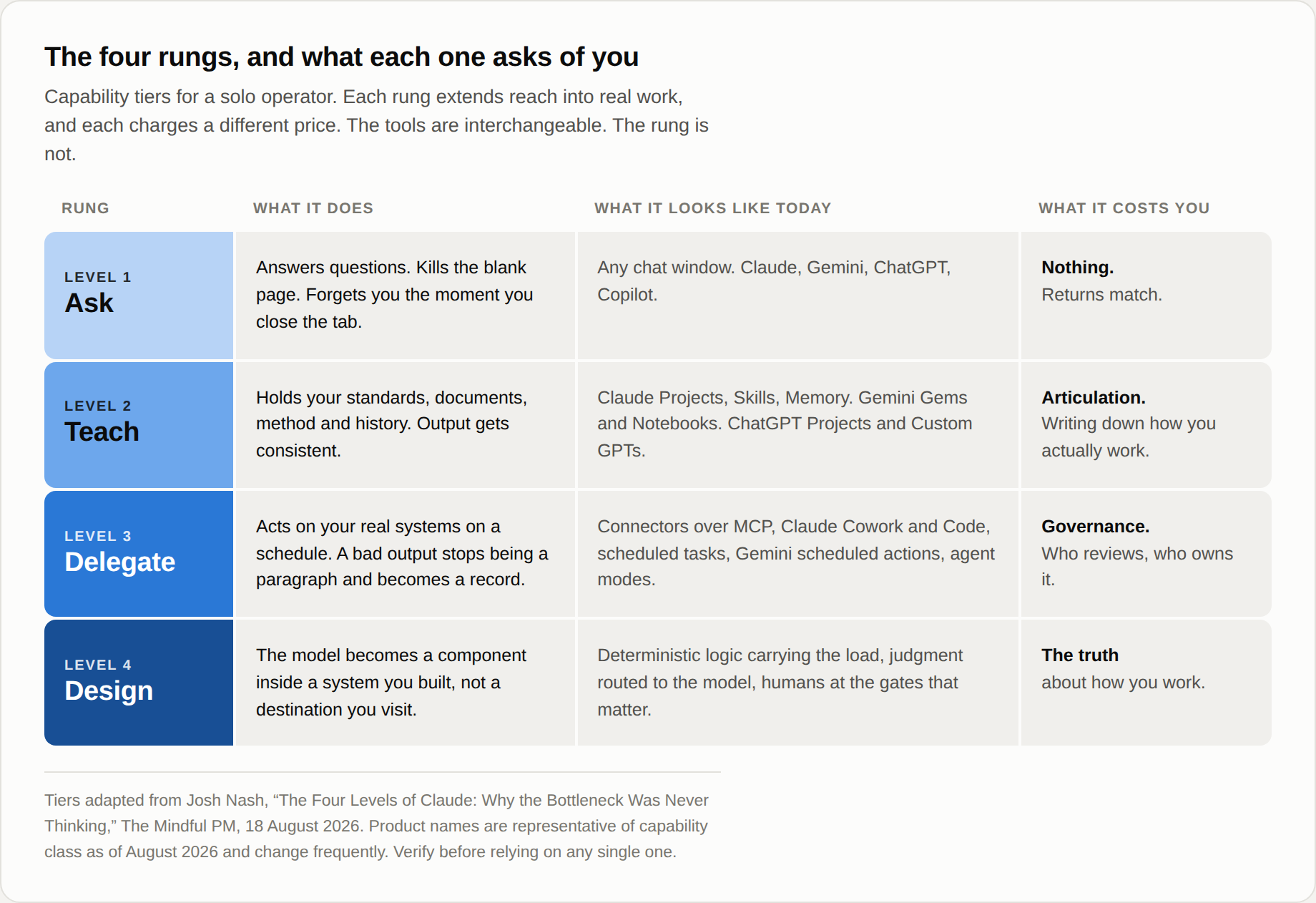
The ladder underneath both has four rungs. You ask, which costs nothing and gives you a brilliant advisor with amnesia. You teach, which costs articulation, and that sounds easy until you try to write down how you want things done and discover your standards were vibes with a job title. You delegate, which costs governance, because now a bad output is a record somebody has to undo. Then you design, and the model becomes a component rather than a destination, and the price is the truth about how you work.
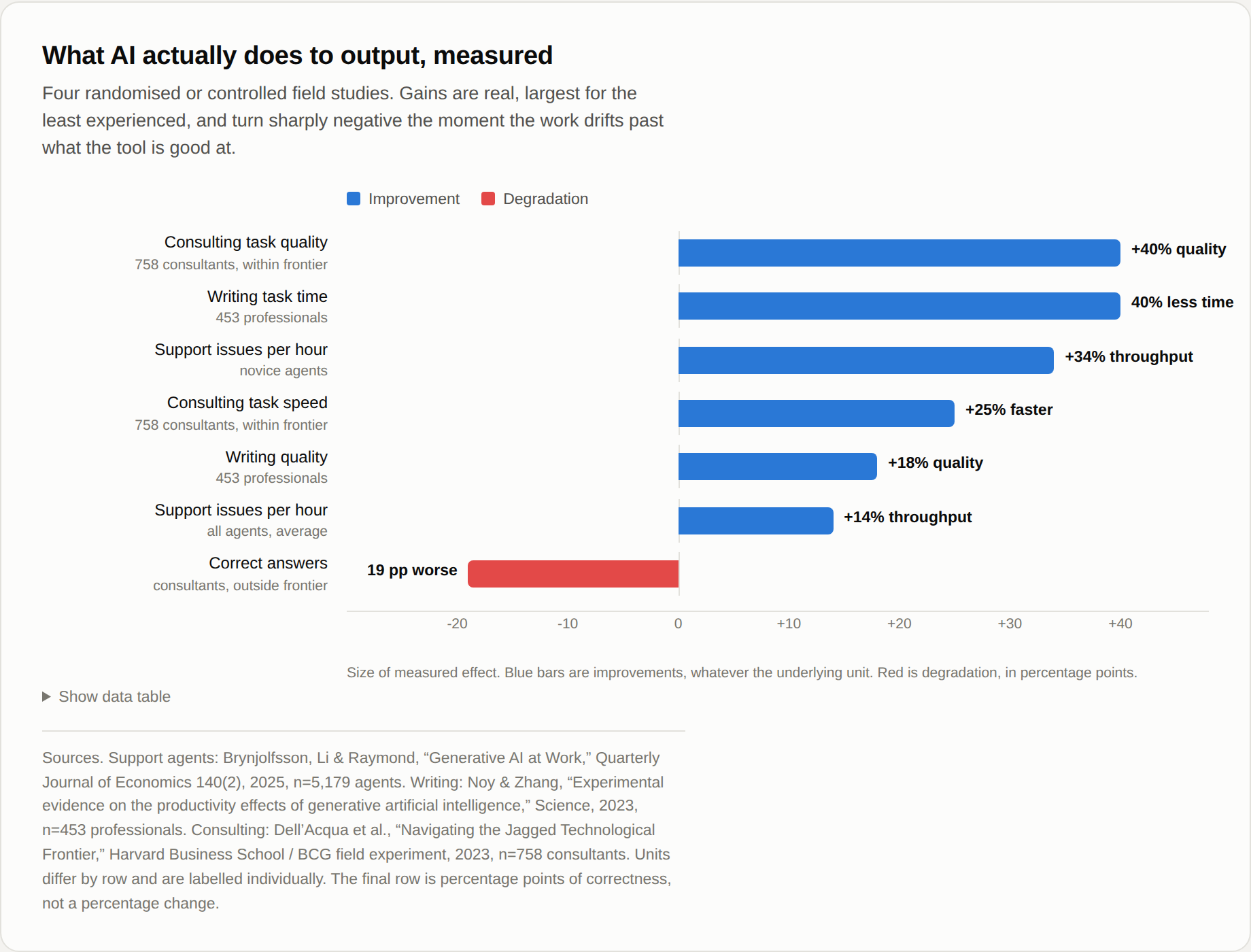
Read the outputs as carefully as you write the prompts. Nobody puts that in the course. The failure mode of this era is not the person who refuses to use AI. It is the person who uses it without reading, ships it, and turns out 19 percentage points less likely to be correct than the colleague who did it by hand. Not a warning. A measurement, taken on real consultants who wandered past the edge of what the tool was good at.
You have done this before
There is a version of you that already knows how to do this. It was the week you finished school with no track record, no proof and no leverage, and had to walk into rooms and behave as though you were worth hiring. You had no evidence. You had nerve and a decent haircut.
That is the posture again. The tools are extraordinary and getting easier by the month, and none of it helps if you will not stand in the field before the weather turns. What one person can build now is arithmetically larger than three years ago. Measured, not promised. Fourteen to forty percent depending on the task, and the people who gain most are the ones who started furthest behind, which should be the most encouraging sentence here.
But nobody is coming to hand you the rod.
Franklin’s neighbours thought the iron pole on his roof was an eccentricity. Then a storm came through Philadelphia and one house on the street was still standing with its shingles on, and after that the rods went up everywhere, and people said he had been lucky.
Put it up now. It is going to rain for a decade.

Sources
- Base44 and the Wix acquisition. Marina Temkin, “6-month-old, solo-owned vibe coder Base44 sells to Wix for $80M cash,” TechCrunch, 18 June 2025. Eighty million dollars cash, twenty-five million retention pool, eight employees at signing, 250,000 users in six months, $189,000 profit in May 2025, bootstrapped, founder Maor Shlomo, previously founder of Explorium. https://techcrunch.com/2025/06/18/6-month-old-solo-owned-vibe-coder-base44-sells-to-wix-for-80m-cash/
- Shlomo’s method. Lenny’s Newsletter, “The Base44 bootstrapped startup success story,” 2025. Repository structured so AI wrote roughly ninety percent of the code, growth driven by building in public on LinkedIn, VC funding declined. https://www.lennysnewsletter.com/p/the-base44-bootstrapped-startup-success-story-maor-shlomo
- John Nash. Princeton University Graduate School, “John Forbes Nash, Jr.” Dissertation “Non-Cooperative Games,” 1950, twenty-seven pages, completed before he turned twenty-two. Nobel Memorial Prize in Economic Sciences, 1994. https://gradschool.princeton.edu/about/viget-honor-roll/john-forbes-nash-jr
- Mark Twain and the Paige Compositor. Three hundred thousand dollars invested, roughly eight million in current money, funded partly from Olivia Clemens’s inheritance. Fewer than six machines built. Publishing house failed 1894, followed by a round-the-world lecture tour to repay creditors. Sources: Paige Compositor, Wikipedia; Biography, The Mark Twain House and Museum. https://en.wikipedia.org/wiki/Paige_Compositor and https://marktwainhouse.org/about/mark-twain/biography/
- Antifragility, the barbell strategy, via negativa and optionality. Nassim Nicholas Taleb, Antifragile: Things That Gain from Disorder, Random House, 2012.
- Michael Jordan. “A Myth Debunked: Was Michael Jordan Really Cut From His High-School Team?” TIME, 16 January 2012. Placed on junior varsity as a sophomore in 1978 rather than cut, with the varsity spot going to six foot seven Leroy Smith. https://newsfeed.time.com/2012/01/16/a-myth-debunked-was-michael-jordan-really-cut-from-his-high-school-team/
- J.K. Rowling. Manuscript rejected by twelve publishers before Bloomsbury; the chairman’s eight year old daughter Alice Newton read the first chapter and asked for the next; her editor advised her to keep a day job. Widely reported, including Silicon Canals, “J.K. Rowling’s editor at Bloomsbury told her she would never make money out of children’s books.”
- Productivity effects. Erik Brynjolfsson, Danielle Li and Lindsey Raymond, “Generative AI at Work,” Quarterly Journal of Economics 140(2), 2025, pp. 889 to 942. Fourteen percent average increase in issues resolved per hour across 5,179 support agents, thirty-four percent for novices. https://academic.oup.com/qje/article/140/2/889/7990658
- Shakked Noy and Whitney Zhang, “Experimental evidence on the productivity effects of generative artificial intelligence,” Science, 2023. Forty percent less time and eighteen percent higher graded quality across 453 college-educated professionals. https://www.science.org/doi/10.1126/science.adh2586
- Fabrizio Dell’Acqua et al., “Navigating the Jagged Technological Frontier,” Harvard Business School and Boston Consulting Group field experiment, 2023. 758 consultants. Within the frontier, over twelve percent more tasks, over twenty-five percent faster, over forty percent higher quality. Outside it, nineteen percentage points less likely to produce a correct solution. https://papers.ssrn.com/sol3/papers.cfm?abstract_id=4573321
- Quotations. Sam Altman on a one-person billion-dollar company, in conversation with Alexis Ohanian, reported by Paolo Confino, Fortune, 4 February 2024. https://fortune.com/2024/02/04/sam-altman-one-person-unicorn-silicon-valley-founder-myth/
- “Jack of all trades, master of none, though oftentimes better than a master of one.” The first clause is attested from 1618, in Geffray Mynshul, Essayes and Characters of a Prison and Prisoners, as an insult. “Master of none” appears by 1721 in The Boston News-Letter. The third clause has no attestation before the twenty-first century. https://en.wikipedia.org/wiki/Jack_of_all_trades
- John Nash, autobiographical essay, in Les Prix Nobel: The Nobel Prizes 1994, ed. Tore Frangsmyr, Nobel Foundation, 1995. https://www.nobelprize.org/prizes/economic-sciences/1994/nash/biographical/
- Mark Twain, letter to George Bainton, 1888, published in George Bainton, ed., The Art of Authorship, D. Appleton, 1890, pp. 87 to 88. Twain credited the lightning-bug image to Josh Billings, who used it in 1869.
- Nassim Nicholas Taleb, Antifragile, Random House, 2012, Prologue, “How to Love the Wind.”
- Michael Jordan, Nike “Failure” commercial, 1997.
- J.K. Rowling, “The Fringe Benefits of Failure, and the Importance of Imagination,” Harvard University commencement address, 5 June 2008. https://news.harvard.edu/gazette/story/2008/06/text-of-j-k-rowling-speech/
- The four levels. Josh Nash, “The Four Levels of Claude: Why the Bottleneck Was Never Thinking,” The Mindful PM, 18 August 2026. https://www.linkedin.com/pulse/four-levels-claude-why-bottleneck-never-thinking-josh-nash-n9jic/


Leave a Reply